Overview of Nano Titanium Sol
Nano titanium sol (Nano Titanium Sol) is a colloidal solution with nano titanium dioxide (TiO₂) particles as the dispersed phase. The particle diameter is usually between 10–100 nm and is evenly dispersed in water or organic solvents to form a stable colloidal system. Its preparation is usually through the sol-gel method, hydrolysis method, etc., so that the titanium source (such as tetrabutyl titanate) reacts under specific conditions to generate nano-scale TiO₂ particles and maintains dispersion stability through surface modification or pH control.
Specifications of Nano Titanium Sol
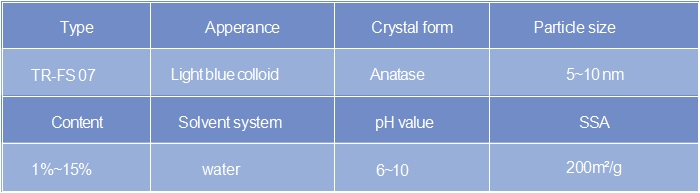
Nano-scale particle size and high specific surface area: The particles are small in size, large in specific surface area (usually >50 m²/g), and rich in surface active sites, giving excellent photocatalytic, adsorption and optical properties.
Colloid stability: Under appropriate conditions (such as specific pH, ionic strength or surface modification), the particles are not easy to agglomerate and can maintain a uniform dispersion state for a long time, which is convenient for processing and application.
Photoresponse characteristics: It has strong absorption of ultraviolet light (UV), and anatase nano-TiO₂ can generate photogenerated electron-hole pairs under light and has the ability to degrade organic matter photocatalytically.
Transparency and film-forming properties: It has high light transmittance in the sol state and can form a transparent or translucent film after drying, which is suitable for scenes requiring optical transparency.
Adjustable surface properties: The hydrophilicity and hydrophobicity can be adjusted through surface modification (such as silane coupling agent organic polymer), and it can adapt to different solvent systems (water-based, oil-based).
 Nano Titanium Sol
Self-cleaning coatings use photocatalytic properties to decompose surface pollutants (such as organic matter and bacteria) and are commonly used in architectural glass and exterior wall coatings.
Anti-UV coatings: added to plastics, textiles or coatings to block UV radiation and improve weather resistance (such as automotive interiors and outdoor equipment).
Anti-corrosion coatings: The barrier effect of nano-TiO₂ is combined with photocatalytic activity to inhibit corrosion of metal surfaces.
Environmental protection
Photocatalytic purification: Degradation of organic pollutants in water (such as dyes and pesticides) and volatile organic compounds (VOCs) such as formaldehyde in the air.
Air purification materials: Loaded on filters, tiles and other carriers to continuously decompose pollutants.
Energy field
Dye-sensitized solar cells (DSSC): As a photoanode material, it adsorbs dyes and transmits photogenerated electrons.
Lithium batteries: Added to electrode materials to improve conductivity and structural stability.
Cosmetics and personal care
Sunscreen products: After the nano-titanium sol is evenly dispersed, it can efficiently scatter and absorb UV light and has high transparency, avoiding the whitening problem of traditional sunscreens.
Anti-aging skin care products: Use photocatalytic activity to remove free radicals and assist in anti-oxidation.
Functional material modification
Polymer composites: Added to plastics and rubbers to enhance mechanical properties (such as strength toughness) and thermal stability.
Ceramic precursors: Prepare nano-TiO₂ ceramics by sol-gel method for catalyst carriers, biomedical materials, etc.
Nano-titanium sol has unique advantages in the fields of functional coatings, environmental management, energy and daily chemicals due to the size effect and colloidal stability of nanoparticles. Its performance can be further optimized through particle size regulation and surface modification to adapt to a variety of application scenarios.
Nano Titanium Sol supplier
Luoyang Tongrun Nano Technology Co. Ltd. (TRUNNANO) is a trusted global chemical material supplier & manufacturer with over 12 years of experience in providing super high-quality chemicals and Nanomaterials, including boride powder, nitride powder, graphite powder, sulfide powder, 3D printing powder, etc.
If you are looking for high-quality Nano Titanium Sol, please feel free to contact us and send an inquiry.
FAQs of Nano Titanium Sol
Q: What is nano titanium sol?
A: Colloidal solution of nano TiO₂ particles (10–100 nm) in water/organic solvents, stabilized for uniform dispersion.
Q: Key features?
A: Nano-size (high surface area), photocatalytic, UV-resistant, transparent film-forming, stable dispersion.
Q: Main applications?
A: Self-cleaning coatings, UV-blocking additives, water/air purification (photocatalysis), sunscreen cosmetics, composite materials.
Q: How is it made?
A: Sol-gel method or hydrolysis of titanium precursors (e.g., tetrabutyl titanate), with surface modification for stability.
Q: Why choose nano titanium sol over powder?
A: Better dispersion, no agglomeration, easier to incorporate into liquids, and maintains transparency in films.
Q: Is it safe for cosmetics?
A: Yes, when properly dispersed and regulated (e.g., coated particles), used in sunscreens for UV protection.