Preparation Methods of Nano Silicon Powder
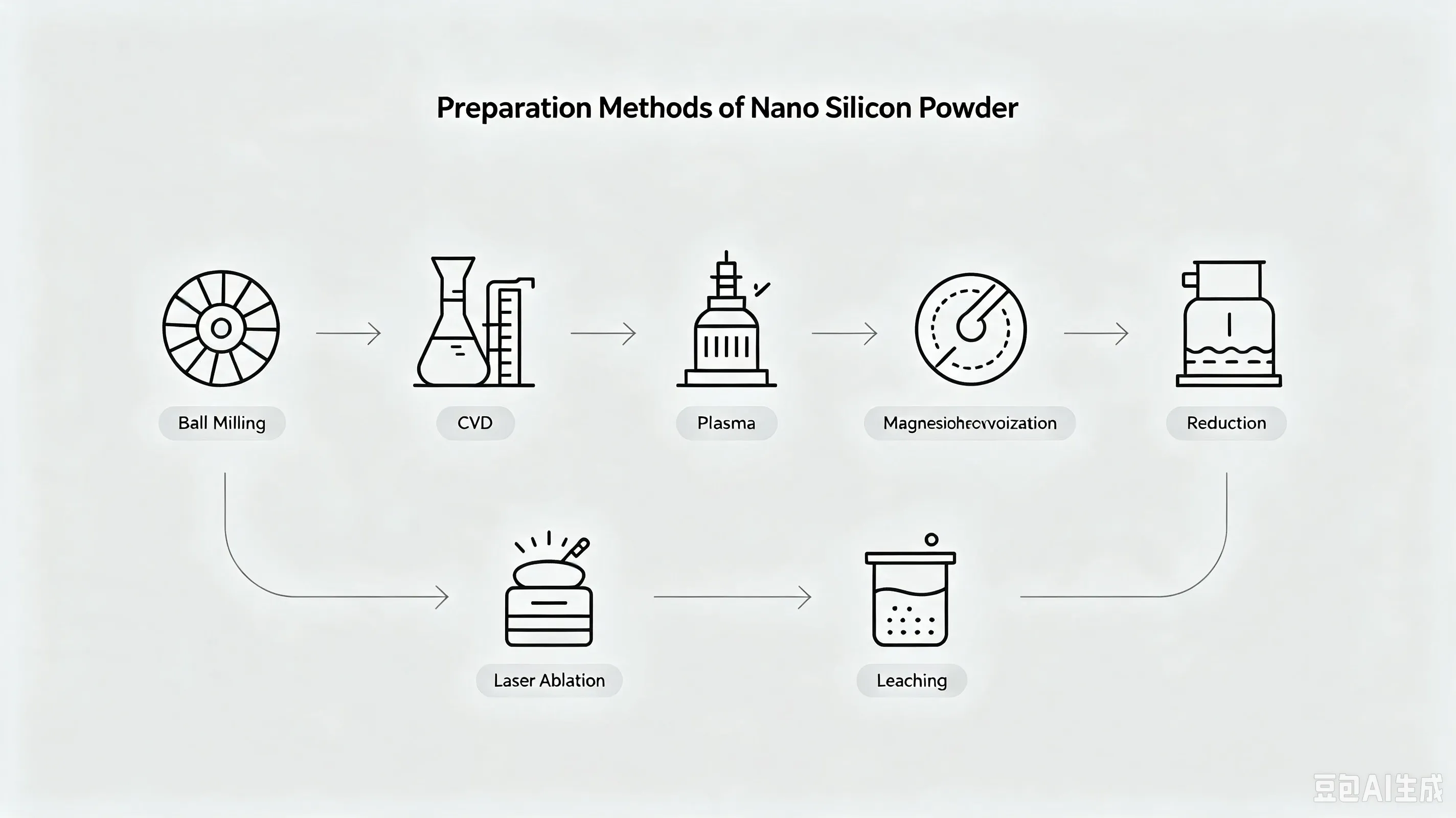
The production of nano silicon powder involves several synthesis routes, each offering distinct advantages for specific applications:
1. Ball Milling Method: This is one of the most common industrial methods for producing nano silicon powder. Bulk silicon is ground in high-energy ball mills using zirconia or tungsten carbide media. The process involves a solid-state, top-down approach where the particle size is progressively reduced by impact and friction forces. By optimizing parameters such as milling time, speed, ball-to-powder ratio, and milling atmosphere, it is possible to achieve particle sizes down to the tens of nanometers. This method's simplicity and scalability make it widely employed for industrial production; however, care must be taken to prevent contamination and agglomeration of the fine powder.
2. Chemical Vapor Deposition (CVD): In this method, nano silicon is deposited from gaseous precursors such as silane (SiH₄) or dichlorosilane (SiH₂Cl₂) on heated substrates. By carefully controlling the reaction temperature, pressure, and gas flow rates, the growth of nano particles with a controlled size distribution can be achieved. For high-purity applications, such as semiconductor and electronic applications, CVD is often preferred due to its ability to produce material with minimal contamination and excellent crystallinity.
3. Plasma Method: This technique utilizes a plasma discharge to vaporize silicon, which then condenses into nanoparticles as the vapor is quenched. The high energy and rapid quenching associated with the plasma process allow for the production of very fine particles with a narrow size distribution. The process can be operated in batch or continuous mode, making it versatile for both research and industrial applications.
4. Magnesiothermic Reduction: In this method, silicon dioxide (SiO₂) is reduced with magnesium metal to produce nano silicon:
SiO₂ + 2Mg → Si + 2MgO
The resulting mixture is then leached with acid to remove magnesium oxide, leaving behind nano silicon particles. This method offers a potentially lower cost route from inexpensive precursors; however, the process involves exothermic reactions that can lead to particle coarsening and contamination by residual magnesium compounds.
5. Laser Ablation: In this technique, a high-power laser is focused on a bulk silicon target in a controlled atmosphere. The laser energy vaporizes the silicon, producing a plume of atoms and clusters that condense to form nanoparticles. This method yields very pure, crystalline particles with a narrow size distribution; however, production rates are generally low, making it more suitable for research applications or high-value, small-scale production.
6. Selection Considerations: The choice of synthesis method depends on the application requirements. Ball milling is suitable for applications where cost and production volume are primary considerations. CVD is preferred for high-purity applications. The plasma method is often used for high-quality materials requiring fine particle size control. Magnesiothermic reduction is being developed as a potentially lower-cost route for energy storage applications.
Preparation Methods of Nano Silicon Powder
Nano Silicon Powder in Semiconductor Applications
The semiconductor properties of nano silicon powder make it valuable for a wide range of electronic and optoelectronic applications:
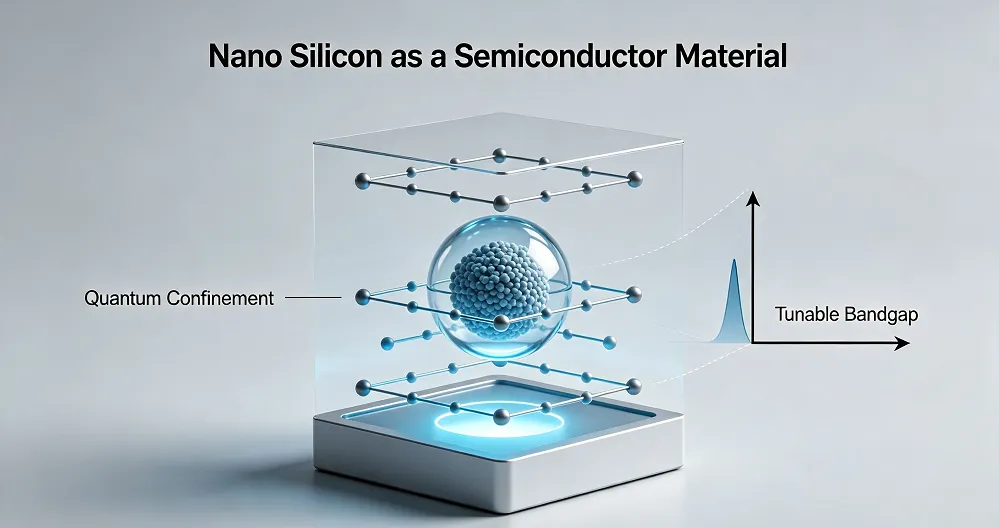
Quantum Confinement Effects: When silicon is reduced to the nanoscale, quantum confinement effects become significant. The electrons in the nanocrystal are confined in all three dimensions, resulting in discrete energy levels. This leads to a widening of the bandgap with decreasing particle size, enabling bandgap engineering. Quantum confinement also increases the oscillator strength for optical transitions, resulting in efficient photoluminescence even though bulk silicon has an indirect bandgap that makes it a poor light emitter.
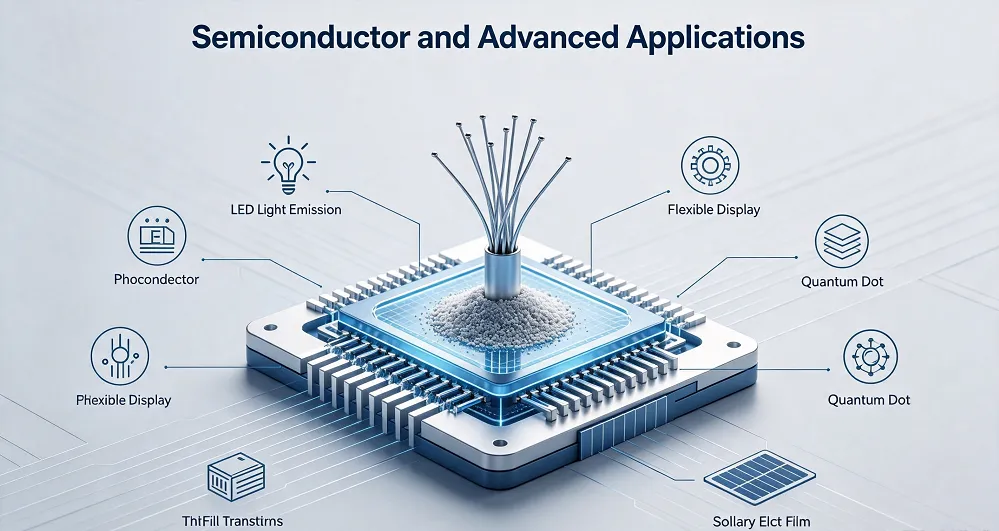
Light-Emitting Diodes (LEDs): Nano silicon powders can be used to fabricate silicon-based LEDs, offering a potential route to integrate photonic and electronic components on the same silicon platform. The light emission from nano silicon devices can be tuned by controlling the particle size, making it possible to design devices that emit specific wavelengths of light.
Photodetectors: Nano silicon photodetectors offer advantages of low dark current, fast response, and compatibility with silicon processing technology. The wide bandgap of nano silicon enables detection of shorter wavelength light compared to bulk silicon.
Thin-Film Transistors: Nano silicon powder is used to create silicon films for thin-film transistor applications. The solution processability of nano silicon suspensions allows for low-cost, large-area fabrication on flexible substrates, making it suitable for display technologies, sensors, and wearable electronics.
Next-Generation Computing: Nano silicon structures, including quantum dots and nanowires, are being explored for quantum computing applications. The ability to control the electronic and optical properties of nano silicon through size and surface chemistry makes it a promising material for quantum information processing.
Semiconductor and Advanced Applications
Safety Considerations for Nano Silicon Powder
While nano silicon powder is generally considered to have low toxicity, handling precautions should be taken to ensure operator safety and product quality:
Health Hazards: Nanoscale silicon particles may penetrate the respiratory system more deeply than larger particles due to their small size. While toxicity studies have not identified significant health risks at typical exposure levels, good industrial hygiene practices should be maintained. The possibility of oxidative stress effects from the large surface area of nanoparticles has been suggested in some studies, although the actual health implications remain under investigation. The fine powder can act as a lung irritant if inhaled in large quantities.
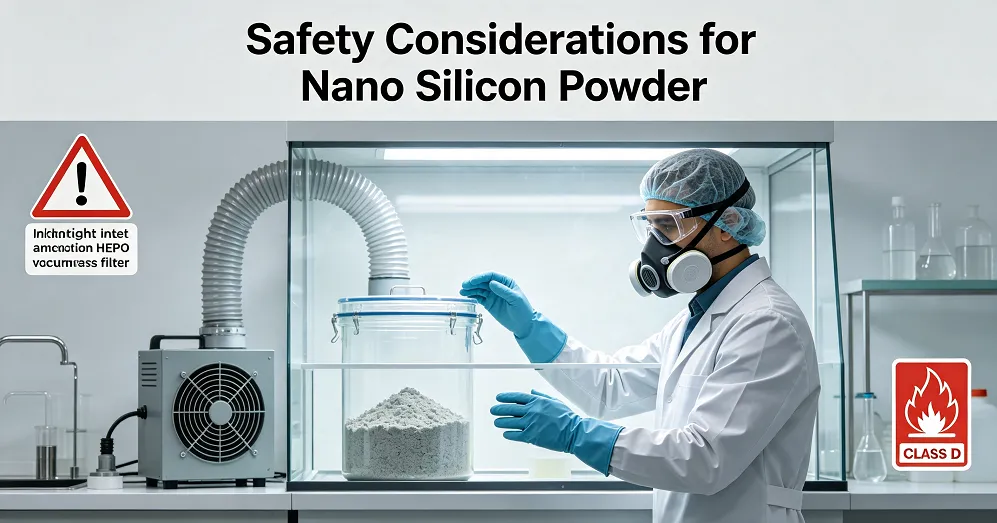
Protective Measures: When handling nano silicon powder, work in a well-ventilated area or fume hood. Appropriate personal protective equipment including gloves, safety goggles, and a dust mask or respirator should be worn. Since the particles are extremely fine, they can become airborne very easily; care should be taken to minimize dust generation. The use of HEPA-filtered vacuum systems or wet cleaning methods is recommended for spill cleanup, as the fine dust can be difficult to contain.
Flammability: Nano silicon powder can be pyrophoric (spontaneously igniting in air) under certain conditions, depending on the particle size and the presence of surface oxide layers. The fine particles have a high surface area-to-volume ratio, which can lead to rapid oxidation and ignition when exposed to air. Material should be stored under inert atmosphere (such as argon or nitrogen) and handled in an inert atmosphere to prevent oxidation.
Storage Requirements: Store nano silicon powder in airtight containers under inert atmosphere in a cool, dry place. Keep away from moisture, oxidizing agents, and sources of ignition. The material should be stored in containers that prevent exposure to air and moisture, as oxidation can compromise the properties of the powder and potentially lead to exothermic reactions.
Spill and Fire Response: In case of spill, avoid creating dust and collect carefully using vacuum or wet sweeping methods. For fire involving nano silicon powder, use Class D extinguishers or dry sand, and avoid using water which can react with burning metal and produce hydrogen gas.
Price, Purity and Supply of Nano Silicon Powder
Boron nano silica powder