What is aluminium carbide?
Aluminium carbide, also known as aluminium tetracarbide, with molecular formula Al4C3, is a kind of aluminium carbide. It is a yellowish brown, hard, transparent rhombic hexahedral crystal, an ionic crystal. It does not conduct electricity at room temperature, and the crystal structure is complex. The metal atoms in the system can be 4,5,6 coordinated, the length of the Al-C bond is 1.90-2.22A, and the shortest C-C bond is 3.16A. The X-ray study shows a single carbon atom in the structure in the form of discrete carbon negative ion C-4, which is different from acetylene.

aluminium carbideAl4C3 is prepared directly by combining two simple substances at high temperatures. First, prepare a mixture consisting of 1 part of heavy smoke black and six parts rich aluminium powder; moisten the mix with pine oil, put a tight layer in a clay crucible, and lay a layer of carbon powder on it. The crucible should be covered with a lid, and all the gaps should be coated with refractory clay mixed with asbestos fibres. Then, put the crucible containing the mixture in the oven for pre-drying, and burn the mixture at a temperature not lower than 1200 ℃ for 30min. Higher temperatures can make the reaction better. After cooling, treat the product with dilute hydrochloric acid (or alkali solution) under cooling to remove excess aluminium. The aluminium carbide prepared as a fine crystalline powder is washed with water to remove aluminium chloride and then washed away with alcohol quickly. The product is dried in a drying oven at 80~90 ℃. The product contains a large amount of aluminium nitride. Pure aluminium carbide is colourless, but the products produced by the above method often have different colours due to impurities in raw materials. When the mixture of the calculated amount of aluminium and soot is calcined in hydrogen, a pure product without aluminium nitride can be prepared. The calcination shall be carried out at 1800~1900 ℃ for 2~3h. The product obtained shall be ground and calcined again at the above temperature.
In modern industrial practice, alternative synthesis routes such as mechanical alloying and plasma-assisted methods have also been explored to produce aluminium carbide with finer particle sizes and higher purity. These advanced techniques allow better control over the final product characteristics, making it suitable for specialized applications in the electronics and aerospace sectors.
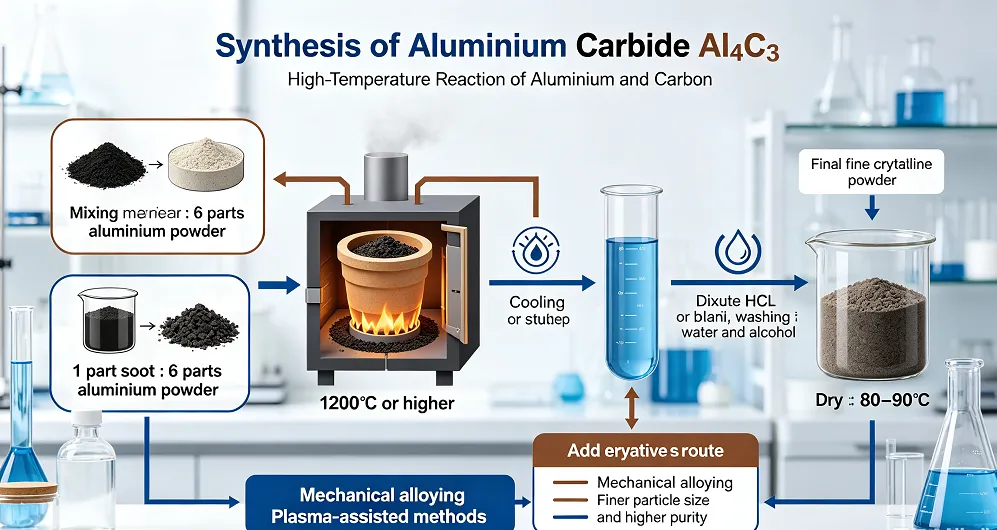
Synthesis process of Al₄C₃
Aluminium carbide is often used as an additive to enhance the strength of ternary aluminium-based materials (Al-Si AlC, Al Ali AlC). In addition, AlC is an essential compound in the technical field of the metal aluminium industry. It is used to reduce metal oxides in the metallurgical industry, chemical reaction catalysts in the chemical industry, and advanced ceramic materials such as high temperature, cutting and mould manufacturing in the ceramic industry. As an ionic compound Chemicalbook, in the lattice structure of AlC, carbon atoms exist in the form of C alone. C has strong alkalinity. During hydrolysis, it generates methane through C+4H → CH, so AlC also acts as a methane generator and dryer. At the same time, the rhombic hexahedron of AlC is a structure of alternating layers of AlC and AlC. This unique structure makes one-dimensional AlC nanowires a potential cold electron emitter.
In advanced ceramics, aluminium carbide is used as a precursor and reinforcing phase in ceramic matrix composites. When incorporated into silicon carbide or alumina-based systems, it can improve fracture toughness and thermal shock resistance. It is also being studied as a component in high-temperature structural materials for aerospace applications, where its combination of low density and high hardness offers advantages over conventional materials.
Storage and handling of aluminium carbide
Aluminium carbide is moisture-sensitive and reacts readily with water to generate methane gas, which is flammable and potentially explosive in confined spaces. Therefore, it should be stored in airtight containers in a dry, cool environment, away from moisture, acids, and oxidizing agents. When handling aluminium carbide powder, appropriate personal protective equipment including gloves, safety goggles, and dust masks should be worn to prevent skin contact and inhalation. In case of spillage, avoid using water for cleaning; instead, use dry methods and ensure adequate ventilation to prevent the accumulation of flammable gases. It is also recommended to have proper fire extinguishing equipment on hand, as methane generation can pose a fire hazard.
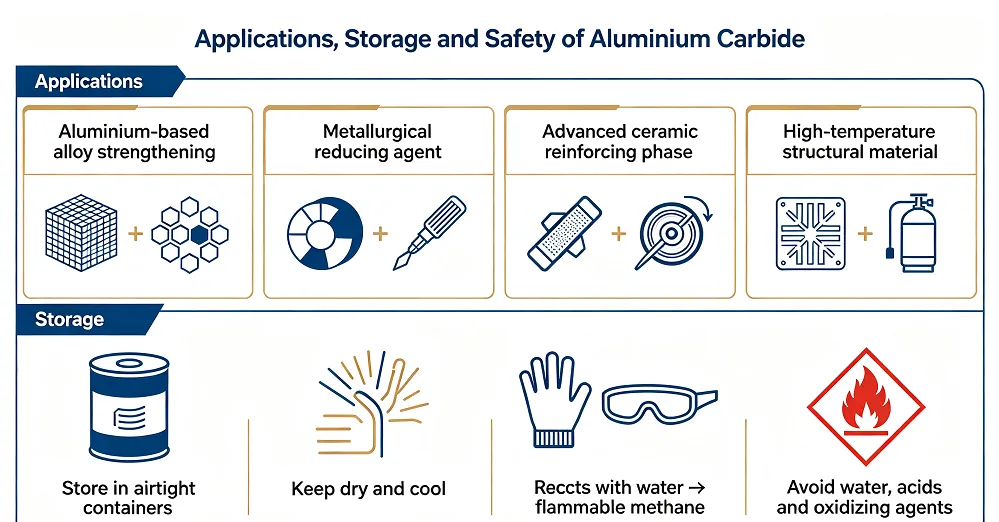
Applications, storage and safety of Al₄C₃
Why aluminium carbide has high hardness?
The high hardness of aluminium carbide is primarily attributed to its ionic crystal structure and strong Al-C bonding. The complex arrangement of aluminum and carbon atoms creates a rigid lattice that effectively resists dislocation movement and plastic deformation. Additionally, the presence of discrete C⁴⁻ ions in the structure contributes to strong electrostatic interactions between the constituent atoms. Unlike covalent carbides such as silicon carbide or boron carbide, which achieve hardness through directional covalent bonds, aluminium carbide combines ionic bonding with structural complexity to achieve its mechanical properties. This makes it particularly suitable for applications where wear resistance and stability at elevated temperatures are required, such as cutting tools, abrasives, and high-temperature refractory components.
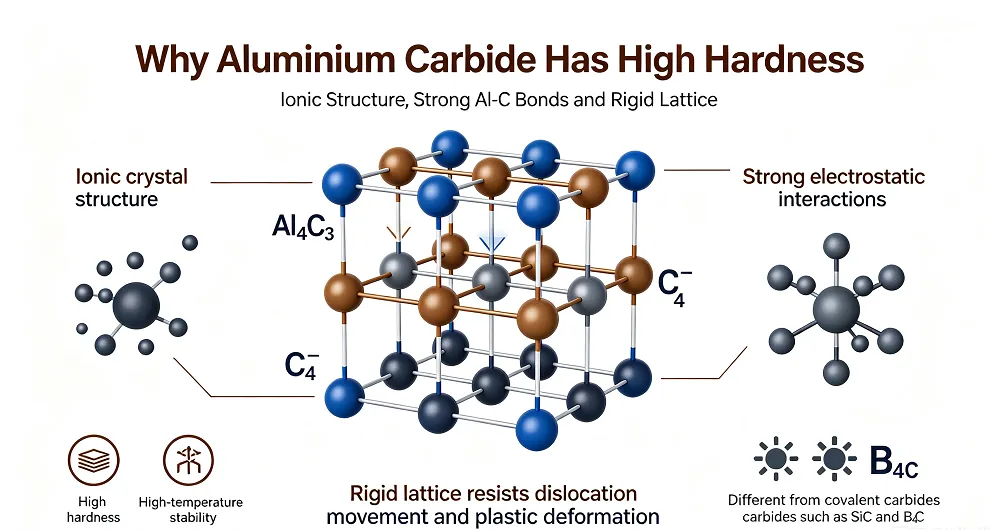
Hardness mechanism of aluminium carbide
Price of aluminium carbide
Aluminium carbide particle size and purity will affect the product's price, and the purchase volume can also affect the cost of aluminium carbide. A large amount of large amount will be lower. The price of aluminium carbide can be found on our company's official website.
Aluminium carbide supplier
Luoyang Tongrun Nano Technology Co. Ltd. (TRUNNANO) Luoyang City, Henan Province, China, is a reliable and high-quality global chemical material supplier and manufacturer. It has more than 12 years of experience providing ultra-high quality chemicals and nanotechnology materials, including aluminium carbide, nitride powder, graphite powder, sulfide powder, and 3D printing powder. If you are looking for high-quality and cost-effective aluminium carbide, you are welcome to contact us or inquire any time.