What is colloidal silicon dioxide?
Colloidal silica is a gaseous silica prepared by hydrolysis of silica compounds. It is a kind of fine silicon that can be uniformly dispersed. It is insoluble in water. Silicon is a natural element in the periodic table. It is nontoxic and is often used in industry. It is also the second most common element in the earth's crust, after oxygen.
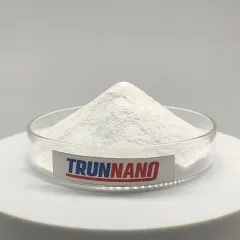
Colloidal Silicon Dioxide
What is colloidal silicon dioxide used for?
Food use.
Food usually contains colloidal silica. This is because it can act as a free-flowing agent. It is found in salt, seasoning salts and sodium bicarbonate (baking soda). It is also found in spices, meat pickling powder and many other foods that require anti-caking agents.
Medical use.
Because colloidal silica is inert and insoluble in water, it is commonly used as a coating for pills and dietary supplements. The trade name of medical grade colloidal silica is "Aerosil".
Other uses.
Colloidal silica can also be used as a thickener in industrial environments, such as paints, dyes, shampoos and some cosmetics. When used as an industrial thickener, its trade name is "Cab-o-Sil".
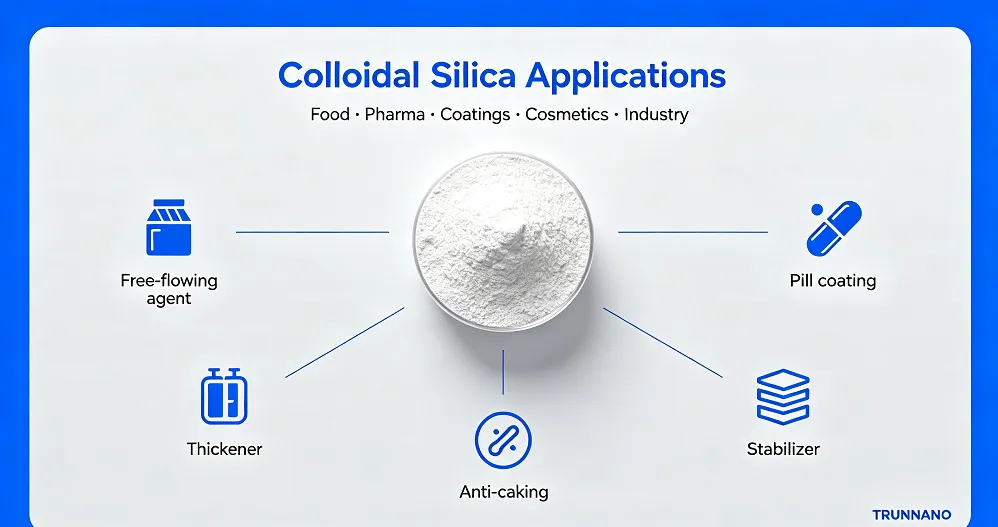
Colloidal Silicon Dioxide applications
In fact, it has been found that it does not accumulate in the body. According to the World Health Organization, excess silicon dioxide is excreted through the kidneys. In addition, the researchers found no association or association between silicon dioxide added to food and an increased risk of organ damage, disease or death.
Is silicon dioxide good for your health?
Silicon dioxide naturally exists in the earth and in our bodies. There is no evidence that it is dangerous to use it as a food additive. But inhaling silica can cause health problems.
There are many forms of silica. The type of silicon dioxide added to foods, supplements and medicines is different from crystalline silicon dioxide. Inhaling silica dust is unsafe. Continuous exposure to silica dust in the air can lead to silicosis, a lung disease. In essence, silica has a crystal structure. Inhaling it will introduce these crystals into your lungs in the form of nanoparticles. These nanocrystals create small incisions in your lung tissue. Over time, this forms scar tissue in the lungs, making it more difficult to breathe.
If you are handling colloidal silica in powder form at work, it is a good idea to wear a dust mask or respirator. Storing it in a cool, dry place with sealed containers will also help prevent moisture pickup and keep it performing as expected. And if you spill some, try not to sweep it dry — use a vacuum with a HEPA filter or clean it up with a wet method to avoid making dust airborne.
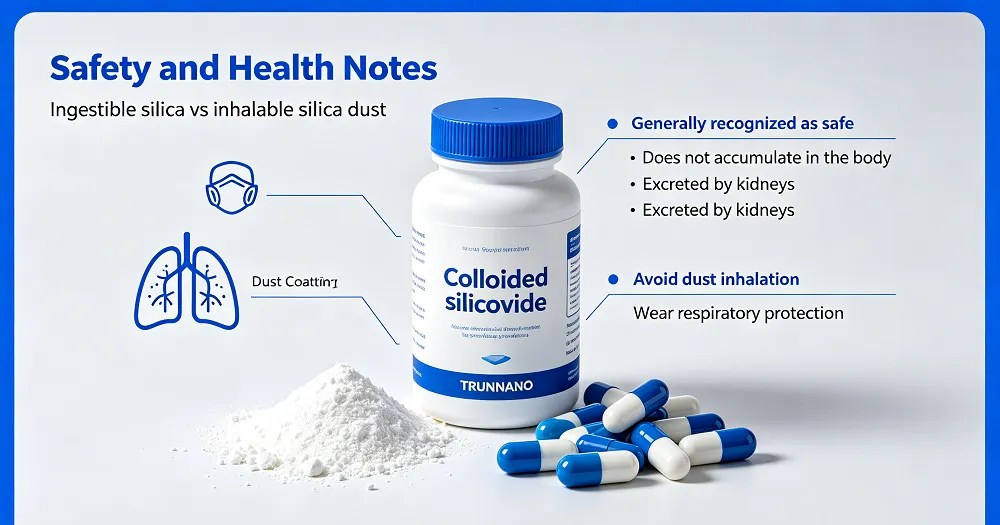
Safety and Health Notes
How should colloidal silicon dioxide be stored and handled?
If you are handling colloidal silica in powder form at work, it is a good idea to wear a dust mask or respirator. Storing it in a cool, dry place with sealed containers will also help prevent moisture pickup and keep it performing as expected. And if you spill some, try not to sweep it dry — use a vacuum with a HEPA filter or clean it up with a wet method to avoid making dust airborne. While colloidal silica is considered safe for consumption and topical use, the fine powder can be irritating to the respiratory system if inhaled in large amounts, so it is always better to take precautions in industrial settings.
Another thing to keep in mind is that colloidal silica is highly hygroscopic, meaning it readily absorbs moisture from the air. If exposed to humid conditions for too long, it can lose its free-flowing properties and become less effective as an anti-caking or thickening agent. For this reason, it is recommended to reseal containers immediately after each use and avoid leaving them open in damp environments. When transporting, keep it away from strong oxidizing agents and acids, and always check the safety data sheet (SDS) for specific handling instructions. For large-scale storage, silos with moisture control systems work well, while in labs, desiccators are a good option for keeping samples dry. If you are using colloidal silica dispersions rather than powder, avoid freezing or excessive heat, as temperature extremes can affect stability.
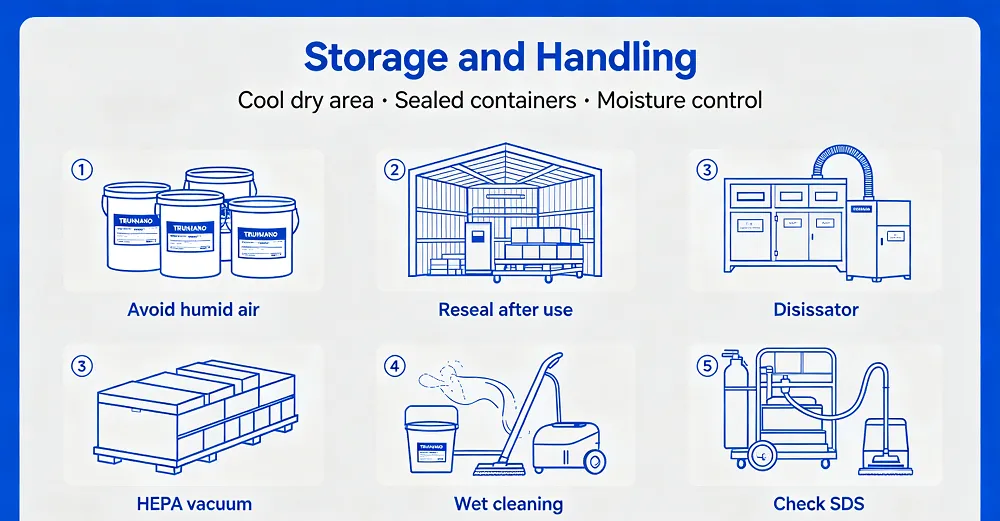
Storage and Handling
The price is influenced by many factors including the supply and demand in the market, industry trends, economic activity, market sentiment, and unexpected events.
If you are looking for the latest silica powder price, you can send us your inquiry for a quote.
Silicon Dioxide Supplier
Luoyang Tongrun Nano Technology Co. Ltd. (TRUNNANO) is a trusted SiO2 manufacturer and SiO2 supplier with over 12-year-experience. We ship our goods all over the world.
If you are looking for high-quality SiO2, please feel free to contact us and send an inquiry. (sales3@nanotrun.com)