What is copper oxide?
Copper oxide (chemical formula: CuO) is an oxide of copper, which is a black solid. It's a strong electrolyte. Insoluble in water and ethanol, soluble in acid, ammonium chloride and potassium cyanide solution, slowly dissolved in ammonia solution.
Preparation of copper oxide
Preparation method in the laboratory: Cu (OH) 2 is generated by the reaction of copper salt such as CuSO4 with alkali (NaOH), and Cu (OH) 2 is heated and decomposed to obtain copper oxide .It can also be obtained by heating copper metal in the air, or heating decomposition of copper hydroxide, copper nitrate, basic copper carbonate method. Industrial processes include copper powder oxidation, copper nitrate thermal decomposition, copper carbonate thermal decomposition, copper wire or copper powder nitrification, conductivity water dissolution.
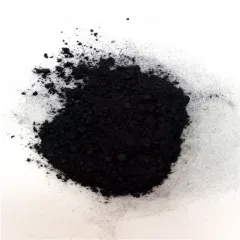
Copper oxide Powder
Application field of copper oxide
Copper oxide can be used as organic synthesis catalyst, analytical reagent, oxidant, catalyst and desulfurizer for petroleum; Used as colorant for glass, enamel, ceramic industry, anti-wrinkle agent for paint, polishing agent for optical glass. Used for manufacturing dyes, organic catalyst carriers and copper compounds. It is also used in rayon manufacturing industry and as a desulfurizer for grease. It is also a raw material for making artificial gems and can also be used as a burning rate catalyst and electrode active material for rocket propellant.
In addition, with the development of nanomaterial technology, nano-copper oxide has shown more excellent performance and expanded its application scope further. As a p-type semiconductor with a narrow band gap (about 1.2 eV), nano-copper oxide is widely used in electronic and optoelectronic fields, such as photovoltaic cells for solar energy conversion, photodetectors and gas sensors, which can sensitively detect harmful gases like CO and H2S as well as volatile organic compounds (VOCs). In the environmental protection field, it plays an important role in wastewater and waste gas treatment: it can decompose organic pollutants and dyes in wastewater, and remove sulfur dioxide and nitrogen oxides in flue gas through chemical reactions, contributing to flue gas desulfurization and denitrification.
In the medical and daily chemical fields, its strong antimicrobial properties against bacteria, fungi and viruses make it an ideal additive for antibacterial coatings, medical devices and water purification systems. It is also an essential component in the preparation of high-temperature superconducting materials for national power grids, as well as electrodes for lithium-ion batteries and supercapacitors, promoting the development of renewable energy technologies.
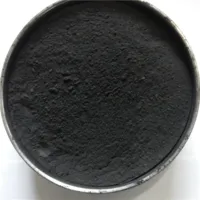
CuO powder
Physical and Chemical Properties of Copper Oxide
In addition to the basic properties mentioned above, copper oxide has more detailed physical and chemical characteristics. Physically, it is usually a black to brownish-black powder or granular solid with a molar mass of 79.55 g/mol and a density of about 6.315 g/cm³, and its hardness is between 3 and 4. It has slight hygroscopicity and can absorb a small amount of moisture when placed in the air, with good thermal stability— it does not decompose under normal heating conditions but will decompose into cuprous oxide (Cu₂O) and oxygen when heated to 1026℃, and melts at 1148℃ under pressure.
ts crystal structure has two forms: monoclinic and cubic, both of which are thermodynamically unstable, and the phase transition temperature between the two forms is 1013.28 K. Chemically, copper oxide is weakly amphoteric, difficult to dissolve in alkali but easy to react with various acids to form corresponding copper salts— for example, it reacts with sulfuric acid to produce copper sulfate and water, and with hydrochloric acid to form copper chloride and water. It has oxidizing properties and can be reduced to metallic copper or cuprous oxide by reducing agents such as hydrogen, carbon, carbon monoxide, zinc and iron under heating conditions; it can also oxidize organic gases into carbon dioxide and water. At 300~400℃, it can react with halogens or halogen compounds to form copper oxyhalides, and it reacts with BrF₃ to produce copper fluoride (CuF₂), oxygen and bromine. In the presence of ammonium salts such as ammonium chloride and ammonium sulfate, it dissolves more easily in ammonia solution, which is related to the formation of complex ions during the reaction.
| Copper-Related Substance | Chemical Formula | Physical State | Key Properties | Main Uses |
| Copper Oxide | CuO | Black solid | Strong electrolyte; Insoluble in water/ethanol, soluble in acid | Catalyst, desulfurizer, colorant, polishing agent |
| Copper (Element) | Cu | Reddish-brown metal | Good conductivity; malleable; forms CuO when heated | CuO raw material, electrical wires, alloys |
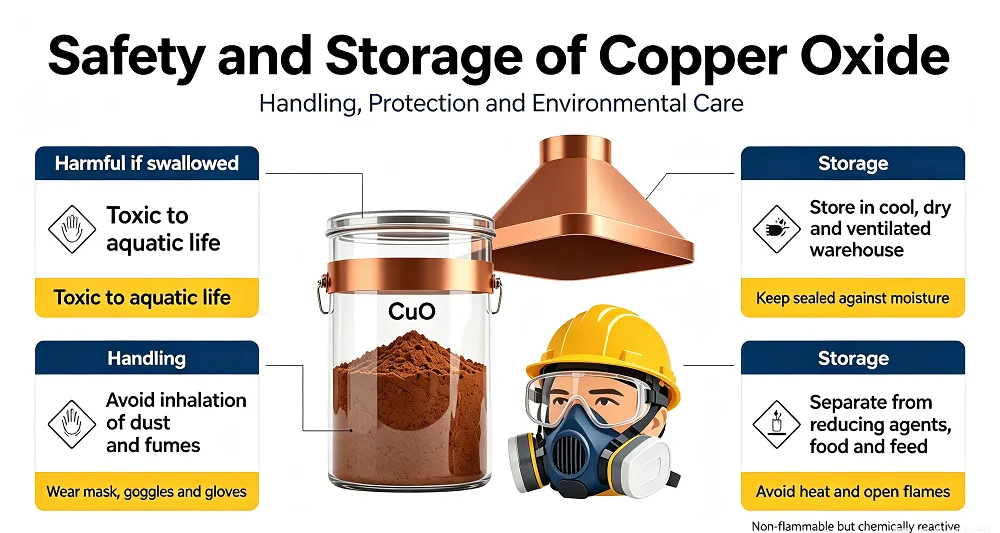
Safety and storage of CuO
Safety Precautions and Storage Methods
Copper oxide has certain hazards and needs to be handled and stored properly. It is harmful if swallowed and has great toxicity and long-term persistent impact on aquatic organisms (GHS hazard statements: H302, H400, H410). Inhalation of a large amount of copper oxide fumes can cause metal fume fever, accompanied by chills, increased body temperature and respiratory tract irritation symptoms; long-term contact may lead to eye conjunctiva irritation, nosebleeds, nasal mucosal ulcers, even nasal septum perforation, dermatitis and gastrointestinal symptoms, and long-term inhalation may also cause pulmonary fibrosis. When operating, it is necessary to wear appropriate protective equipment, avoid eating, drinking or smoking during operation, and clean thoroughly after operation to prevent accidental ingestion or inhalation. If accidentally swallowed, rinse the mouth immediately and seek medical attention if feeling unwell; if it overflows, collect the spilled material in time to avoid releasing it into the environment. Copper oxide is non-flammable and stable under normal storage and handling conditions, but it should avoid contact with incompatible substances such as strong reducing agents, aluminum, magnesium and hydrogen peroxide, and should also avoid moisture and excessive heat. It should be stored in a cool, dry and well-ventilated warehouse, away from fire and heat sources, sealed and stored to prevent moisture absorption and reaction with other substances; during storage and transportation, it should be handled with care to avoid package damage, and should be separated from food, beverages and feed to prevent contamination. When discarding, it should be disposed of in accordance with local laws and regulations to avoid environmental pollution.
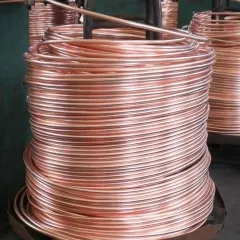
Copper Bus Bar
Natural Occurrence and Industrial Significance
In nature, copper oxide exists as a mineral called tenorite, also known as black copper, which is a product of copper mining and an important precursor for the preparation of other copper-containing compounds and products. In the industrial production of copper, copper oxide is an important intermediate product— in the pyrometallurgical process, copper ores are treated with a mixed solution of ammonium carbonate, ammonia and oxygen to form copper-ammine complex carbonates, which are then decomposed with steam to obtain copper oxide, which is an important link in copper extraction from ores. With the continuous development of science and technology, the application of copper oxide is still expanding. High-purity copper oxide (with a purity of 99.99% or more) is widely used in electronics, ceramics and catalysis fields, and its composite materials with other substances have shown broad application prospects in electrochemical sensing, energy storage and environmental remediation. As a cheap and easy-to-obtain metal oxide, copper oxide plays an irreplaceable role in promoting industrial development and technological progress.
Supplier
TRUNNANO (aka. Luoyang Tongrun Nano Technology Co. Ltd.) is a trusted global chemical material supplier & manufacturer with over 12 years experience in providing super high quality chemicals and Nano materials. The copper oxide produced by our company has high purity, fine particle size and impurity content. Lower, please contact us if necessary.