The way we insulate buildings hasn't changed much in decades. Thick layers of foam, fiberglass, or mineral wool are packed into walls and roofs. It works—but it's bulky, it's heavy, and it doesn't always fit where you need it. Then there's the problem of retrofitting old buildings, where there's no space to add insulation without tearing down walls.
That's where aerogel thermal insulation coating changes the game. A thin layer—just a couple of millimeters thick—can provide the same insulation performance as materials many times its thickness. It's applied like paint, sticks to almost any surface, and works in both buildings and industrial settings.
The global push for energy efficiency and tighter building codes is driving demand for solutions like this. Here's why aerogel coating is becoming a serious alternative to traditional insulation.
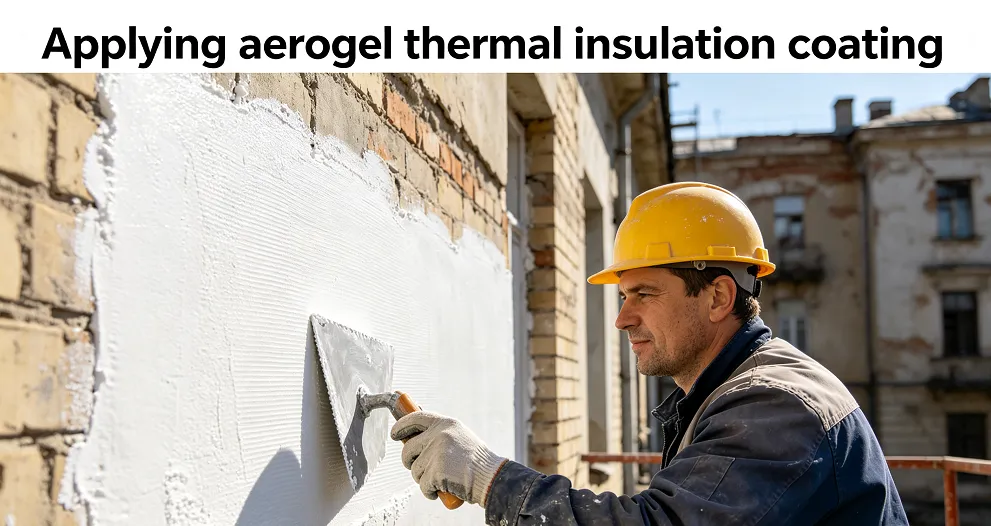
Applying aerogel thermal insulation coating
What Exactly Is Silica Aerogel Thermal Insulation Coating?
Silica aerogel thermal insulation coating is a paste-like material made by suspending aerogel particles in a binding agent. It's applied like paint but forms a thermally insulating layer that dramatically reduces heat transfer.
The key ingredient is silica aerogel—a material made up of more than 90% air. Its nanoporous structure traps heat and prevents it from moving through the coating. That's why a thin layer can do what thicker materials struggle to achieve.
In practical terms, this means you can apply it to internal and external walls, reducing heat exchange between the inside and outside of a building. It keeps heat in during winter and keeps it out during summer, which translates to lower energy bills and more comfortable indoor environments.
The coating itself is a white paste that can be applied by scraping, smearing, or spraying. It dries to a solid film that bonds strongly to most surfaces, with a recommended thickness of about 2mm for effective insulation.
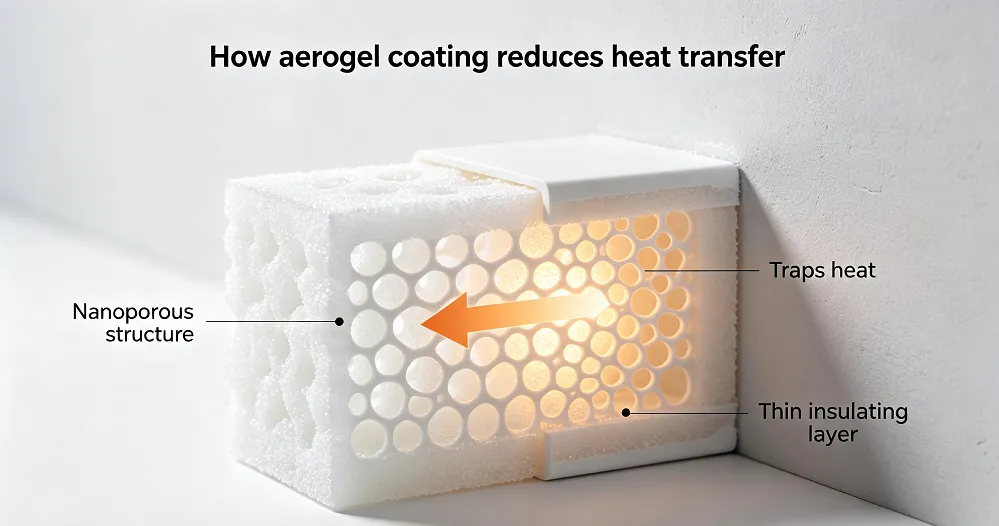
How aerogel coating reduces heat transfer
Why Aerogel Coating Outperforms Traditional Insulation
The numbers are what make aerogel stand out. With a thermal conductivity of 0.035 W/(m·K), aerogel coating is significantly more insulating than many conventional materials. In practical terms, this means you can achieve the same insulation effect with a much thinner layer.
Here's how it compares to traditional materials:
For building retrofits. Older buildings often have no cavity space for insulation. Adding external insulation requires new cladding, which is expensive and changes the building's appearance. Aerogel coating can be applied directly to existing walls—inside or outside—without major structural changes. It preserves the building's character while upgrading its thermal performance.
For complex surfaces. Pipes, valves, storage tanks, and irregular equipment are notoriously difficult to insulate with rigid materials. Aerogel coating can be sprayed or brushed onto any shape, covering corners and curves without gaps. This eliminates the problem of heat loss through uninsulated spots that plague traditional installations.
For limited space applications. In some cases—like between floors, behind cladding, or inside machinery—there's simply not enough room for standard insulation. A few millimeters of aerogel coating can fit where thicker materials cannot.
For fire safety. Traditional insulation materials like foam can be flammable and release toxic fumes when burned. Aerogel coating is non-combustible and able to withstand high temperatures, making it safer in fire conditions.
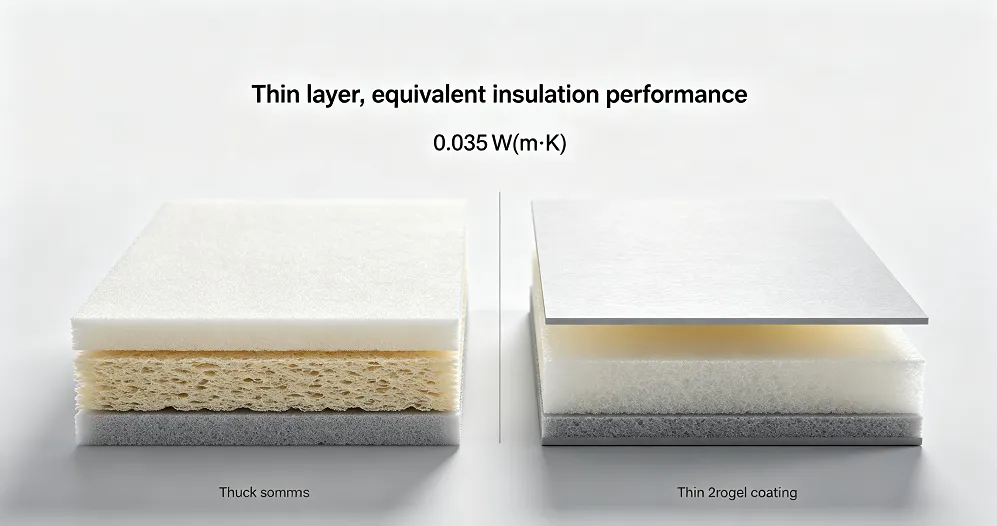 Aerogel coating thickness comparison — thin layer, superior insulation.
Key Features That Make It Work
The coating's performance comes from a combination of properties that work together:
Adhesion. It sticks to most surfaces—concrete, metal, brick, wood, and more. This means you don't need special primers or surface preparation in most cases.
Structural strength. The coating prevents substrate expansion and contraction caused by temperature changes. It moves with the building rather than cracking or peeling.
Wear resistance. In high-traffic or exposed areas, the coating holds up to abrasion better than many alternatives.
Chemical stability. It's unaffected by acids, alkalis, and corrosive substances. That's why it's used in industrial applications where chemical exposure is a concern.
Toughness. The coating resists fractures from impact and thermal vibration, which is essential in both building and industrial settings.
Environmental safety. It contains no volatile organic compounds or harmful substances, making it safe to apply and safe to occupy.
Where Is It Being Used?
The versatility of aerogel coating means it's finding applications in both building and industrial sectors. The market is expanding across multiple segments, each with its own specific requirements and challenges.
Building Applications
New residential construction. In new housing developments, aerogel coating is being applied to external walls and roofs as part of energy-efficient building design. It helps builders meet increasingly strict energy codes without increasing wall thickness or sacrificing living space. For architects, it offers design flexibility—walls can be thinner without compromising thermal performance.
External wall insulation in apartment buildings. Multi-story residential buildings present a unique challenge: insulating the exterior without disrupting residents. Aerogel coating can be applied to the building exterior with minimal disruption to occupants, reducing heat loss through the building envelope and lowering heating costs for residents and building owners alike.
Old house renovation and repair. Older homes often have solid walls with no cavity for insulation. Adding traditional insulation requires building out the wall or removing interior finishes. Aerogel coating can be applied directly to existing walls, inside or out, dramatically improving thermal performance without sacrificing floor space or altering the building's character. This makes it particularly valuable for heritage buildings and conservation areas where external appearance must be preserved.
Building roof insulation. Heat rises—and in winter, much of a building's heat loss occurs through the roof. Aerogel coating applied to roof surfaces, both flat and pitched, provides an effective thermal barrier that reduces heating costs in winter and cooling costs in summer. In flat roof applications, the coating also provides waterproofing benefits, protecting the roof membrane from UV damage and extending its service life.
Basement moisture and mildew protection. Basements are traditionally cold and damp, making them difficult to use as living space. Aerogel coating provides both thermal insulation and moisture resistance, creating a warmer, drier environment that reduces the risk of mold growth and makes basements suitable for habitation or storage.
Grain and oil warehouse insulation. Large storage facilities for grain, oil, and other temperature-sensitive materials require stable internal temperatures to preserve product quality. Aerogel coating applied to warehouse walls and roofs helps maintain consistent temperatures year-round, reducing spoilage and loss.
Public and commercial buildings. Schools, hospitals, offices, and retail spaces all benefit from improved insulation. Lower heating and cooling costs mean more budget for core services. The ability to apply the coating without major disruption is particularly valuable for buildings that must remain operational during renovation.
Fire-rated assemblies. In buildings where fire safety is critical—hospitals, schools, high-rise residential—aerogel coating's non-combustible properties add an extra layer of protection. It can be applied to structural steel to improve fire resistance and protect the building's frame from heat damage.
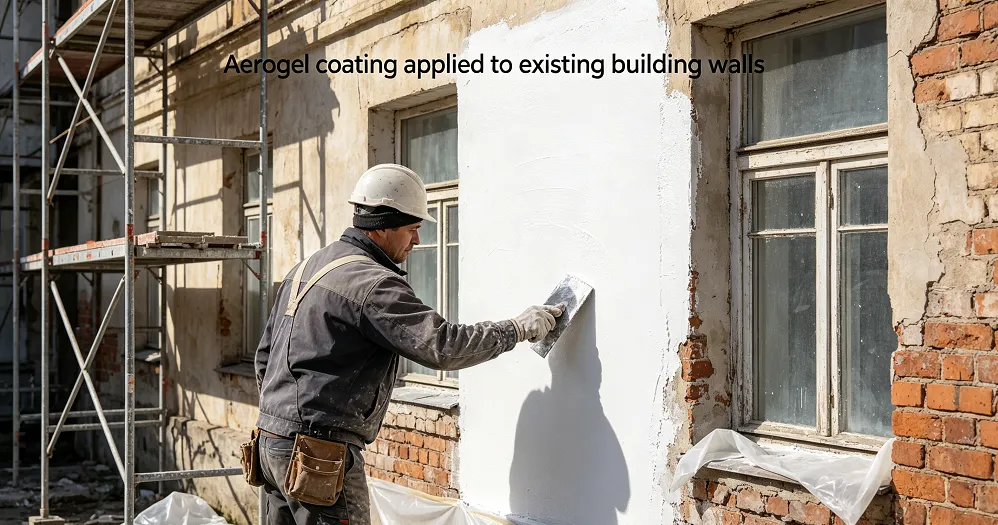
Aerogel coating applied to existing building walls
Industrial Applications
The industrial sector accounts for a significant portion of global energy consumption, and a large share of that energy is lost through uninsulated or poorly insulated equipment. Aerogel coating offers a practical solution for reducing these losses.
Petrochemical storage tank insulation. Storage tanks holding heated materials lose heat through their walls, requiring continuous energy input to maintain temperature. Aerogel coating applied to the exterior of tanks reduces heat loss, lowering energy consumption and reducing operating costs. In hot climates, it also prevents tanks from overheating, maintaining product integrity.
High-temperature furnace and ladle insulation. Steel mills and ceramic plants operate furnaces at extreme temperatures. Insulating these furnaces is critical for both energy efficiency and worker safety. Aerogel coating can be applied to furnace exteriors, reducing heat loss and lowering surface temperatures to safer levels. For ladles transporting molten metal, the coating protects the ladle shell from heat damage and extends its service life.
Steam turbine body insulation. Power plants rely on steam turbines to generate electricity, and keeping steam at the right temperature is essential for efficiency. Aerogel coating applied to turbine bodies reduces heat loss, improving efficiency and reducing fuel consumption. The coating's thin profile is particularly valuable in turbine applications where space around the equipment is limited.
Ceramic rail kiln insulation. The ceramic industry uses long tunnel kilns for firing products. Insulating these kilns reduces fuel consumption and improves product consistency by maintaining uniform temperatures. Aerogel coating can be applied to kiln exteriors, reducing heat loss and improving working conditions by lowering ambient temperatures in the factory.
Special-shaped equipment and pipelines. Industrial facilities are full of irregularly shaped equipment that is difficult to insulate with rigid materials—valves, flanges, pumps, and complex pipe networks. Aerogel coating can be applied to any shape, ensuring that every surface is insulated without gaps or voids that compromise thermal performance.
Dyeing vats and setting machines. Textile printing and dyeing plants use large vats of heated water and chemicals. Insulating these vats reduces energy consumption and maintains consistent processing temperatures. Aerogel coating is chemically resistant to the dyes and chemicals used in textile processing, ensuring long-term durability.
Food processing and cold storage. In food processing facilities, maintaining temperature control is critical for both product quality and food safety. Aerogel coating can be applied to cold storage walls and ceilings, improving insulation performance without taking up valuable floor space. In processing areas where both heating and cooling are used, the coating helps maintain stable temperatures and reduces energy consumption.
Shipbuilding and marine applications. Ships and offshore platforms require insulation that is lightweight, fire-resistant, and resistant to saltwater corrosion. Aerogel coating meets all of these requirements, making it a growing choice for marine insulation applications. It can be applied to ship hulls, engine rooms, and offshore living quarters, improving energy efficiency and crew comfort.
Aerogel coating on complex surfaces — insulation that fits anywhere.
What's Driving the Market Forward?
Several trends are pushing aerogel coating from niche to mainstream:
Energy standards. Building codes around the world are getting stricter. New construction must meet higher performance targets, and existing buildings are being required to upgrade. Aerogel coating helps meet these standards without the complexity of traditional insulation systems.
Retrofitting demand. The majority of buildings that will exist in 2050 are already built. Making them energy-efficient means retrofitting, and retrofitting needs solutions that work within existing structures. Aerogel coating fits that brief.
Industrial energy costs. For industry, energy is a major operating cost. Reducing heat loss from pipes, tanks, and furnaces has a direct impact on the bottom line. Aerogel coating offers a fast, effective way to cut those losses.
Sustainability goals. Companies and governments are committing to carbon reduction targets. Improving building efficiency is one of the most cost-effective ways to reduce emissions, and aerogel coating is a tool that can be deployed at scale.
Driven by energy standards and retrofitting demand
Supplier
TRUNNANO is a trusted global chemical material supplier and manufacturer with over 12 years of experience in providing high-quality chemicals and nanomaterials. The company has a professional technical department and quality supervision department, a well-equipped laboratory with advanced testing equipment, and a dedicated after-sales customer service center. TRUNNANO supplies high-quality silica aerogel thermal insulation coating for building and industrial applications. The company serves clients across more than 50 countries and offers comprehensive technical support, from product selection to application guidance. If you are looking for high-quality aerogel thermal insulation coating, please feel free to contact us.