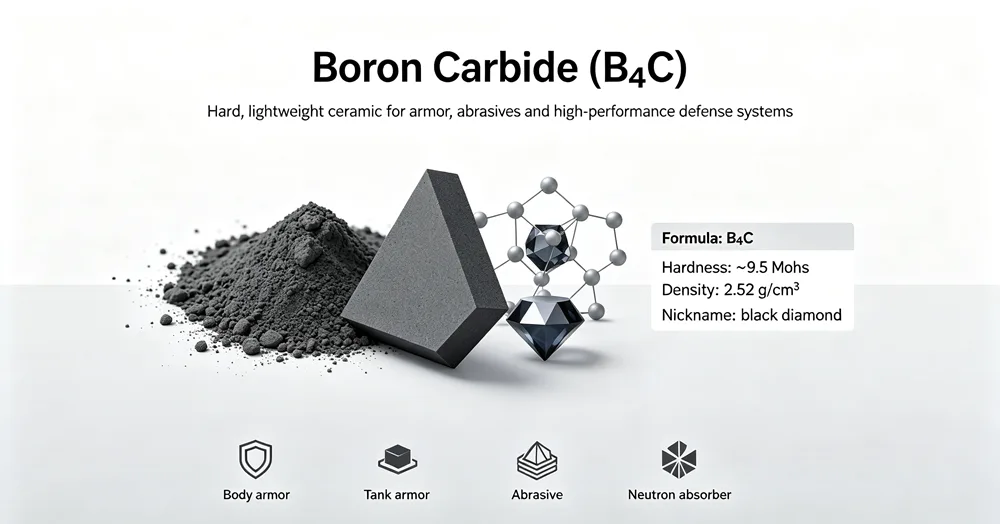
Boron carbide, also known as black diamond, has a molecular formula of B4C, and is usually gray-black powder. It is one of the three hardest materials known and is used in tank armor, body shields and many industrial applications.
Boron Carbide (B₄C)
Boron carbide (B₄C) is one of the hardest materials known to humanity, ranking just below diamond and cubic boron nitride on the hardness scale. Its extraordinary hardness has earned it the nickname "black diamond." The compound's unique combination of properties—extreme hardness, low density, chemical inertness, and neutron absorption capability—makes it a material of choice for demanding applications where other materials would fail. The synthesis of boron carbide typically involves the carbothermal reduction of boric oxide with carbon in an electric arc furnace at temperatures exceeding 2000°C. The resulting product is a dark gray to black crystalline powder that can be further processed into various forms, including sintered bodies, coatings, and fibers. The material's ability to be formed into complex shapes through sintering and hot pressing has expanded its application range beyond traditional abrasive and armor uses into high-tech fields such as semiconductor processing and aerospace engineering. The exceptional hardness of boron carbide arises from its unique crystal structure and strong covalent bonding between boron and carbon atoms. The material's rhombohedral crystal structure is characterized by icosahedral B₁₂ units and CBC chains that form a complex three-dimensional network, responsible for the material's exceptional hardness and chemical stability. With a Mohs hardness of approximately 9.5 and a density of only 2.52 g/cm³, boron carbide offers an exceptional specific hardness that surpasses that of diamond, making it particularly valuable in lightweight armor applications.
"In the past 12 years, researchers have been looking for ways to reduce the damage caused by the impact of high-speed bullets on armor made of boron carbide." said Dr. Kelvin Y. Xie, Assistant Professor in the Department of Materials Science and Engineering. "Our work has finally solved this unmet need. This is a step towards designing an advanced body armor that will defend against more powerful guns in battle."
The research conducted by Dr. Xie and his team at Texas A&M University represents a significant advancement in the understanding of boron carbide's behavior under high-speed impact. For over a decade, the scientific community has recognized that boron carbide's performance degrades catastrophically when subjected to impacts exceeding a critical velocity. This limitation has restricted the use of boron carbide in armor systems designed to protect against high-velocity rifle rounds and armor-piercing projectiles. The research team's work has provided new understanding of the fundamental mechanisms of this degradation and demonstrated a practical solution through silicon doping. The findings have important implications for the design of next-generation body armor that can protect against a wider range of threats while maintaining the weight advantages that make boron carbide so attractive for personnel protection.
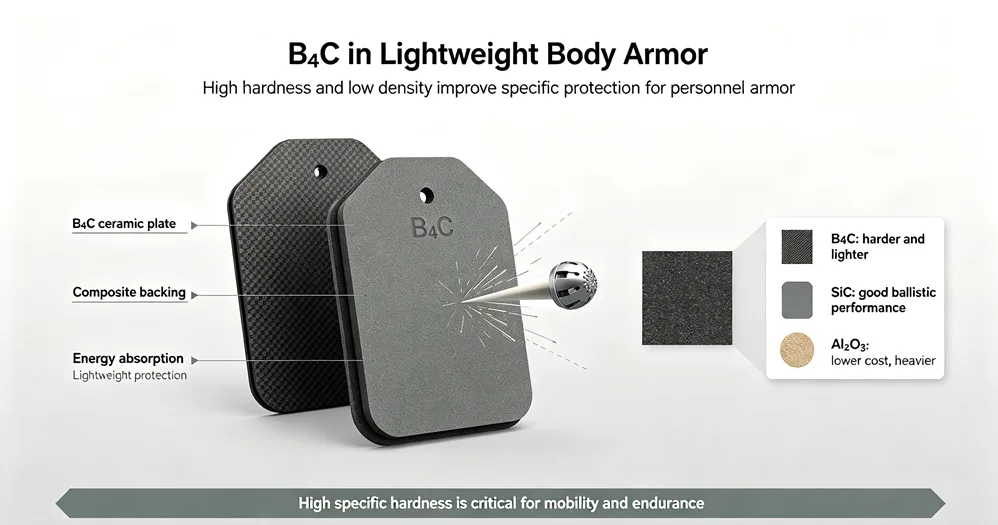
Boron carbide is called "black diamond" and its hardness is second only to cubic boron nitride. Unlike cubic boron nitride, boron carbide is said to be easier to mass produce than other armor materials such as silicon carbide, and is harder and lighter, making it ideal for bulletproof vests and other armor projects.
The comparison between boron carbide and other armor materials highlights the unique advantages of B₄C. Compared to silicon carbide (SiC), boron carbide is approximately 20% harder and 20% lighter, providing superior protection at a lower weight. Compared to alumina (Al₂O₃), boron carbide is significantly harder and lighter, although it is more expensive. Compared to cubic boron nitride (c-BN), boron carbide is easier to mass produce and more cost-effective, making it the preferred choice for large-scale armor applications. The density of boron carbide (2.52 g/cm³) is lower than that of silicon carbide (3.21 g/cm³) and alumina (3.98 g/cm³), providing significant weight savings in body armor systems. The hardness of boron carbide (Mohs 9.5) is second only to diamond (10) and cubic boron nitride (9.5-10), making it one of the hardest materials available for armor applications. The combination of high hardness and low density gives boron carbide an exceptional specific hardness that makes it ideal for lightweight armor systems where weight reduction is critical for mobility and endurance.

According to Texas A&M University, the main disadvantage of boron carbide is that it can be quickly damaged when subjected to a high-speed impact. Xie said in a statement: "Boron carbide is really good at stopping bullets moving at 900 meters per second, so it can effectively block most pistol bullets. But if it exceeds this critical speed, boron carbide will suddenly lose its trajectory. Performance has become less effective."
The critical velocity of approximately 900 m/s represents a fundamental limit for boron carbide in armor applications. Below this velocity, boron carbide performs exceptionally well, absorbing the kinetic energy of the projectile through a combination of elastic deformation and controlled fracture. Above this velocity, the material undergoes a sudden and catastrophic loss of performance due to a phase transformation that converts the crystalline boron carbide into an amorphous, glass-like state. This phase transformation is triggered by the high-pressure shock wave generated by the impact, which exceeds the material's ability to accommodate the stress through elastic and plastic deformation. The resulting amorphous phase has significantly lower strength and toughness, allowing cracks to propagate easily through the material and causing extensive damage. This phenomenon is particularly problematic for armor applications, where the ability to withstand multiple impacts and maintain structural integrity is essential for protecting the wearer.
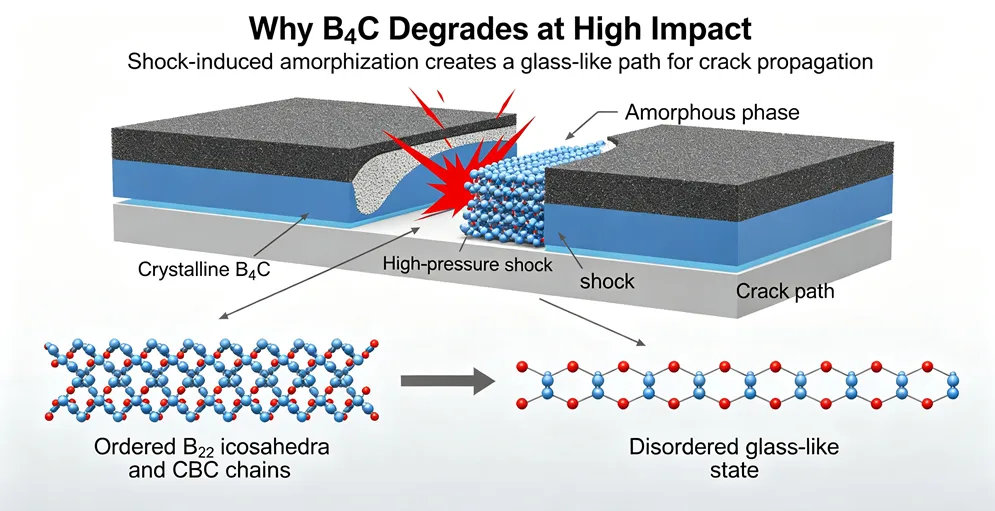
Scientists know that high-speed vibration will cause a phase change in boron carbide, one of which will change its internal structure and present two or more physical states at the same time. The impact of the bullet transforms the boron carbide atoms from a systematically arranged crystalline state to a disorderly arranged glass state. This glass-like state weakens the material integrity of the contact area between the bullet and boron carbide.
The phase transformation in boron carbide under high-speed impact is a classic example of a pressure-induced amorphization process. Under normal conditions, boron carbide exists in a crystalline rhombohedral structure with icosahedral B₁₂ units and CBC chains. When subjected to the high-pressure shock wave generated by a bullet impact, the crystal lattice undergoes a structural collapse that converts the ordered crystalline phase into a disordered amorphous phase. This transformation occurs at the nanometer scale and is driven by the inability of the crystal lattice to accommodate the shear stresses generated by the shock wave. The amorphous phase has a different atomic arrangement and different mechanical properties compared to the crystalline phase, including reduced hardness, reduced fracture toughness, and increased susceptibility to crack propagation. The coexistence of crystalline and amorphous phases in the impact zone creates a complex microstructure with heterogeneous properties, which contributes to the overall degradation of the material's performance.
Why B₄C Degrades at High Impact
Xie said: "When boron carbide undergoes a phase change, the glassy state creates a path for the propagation of cracks. Therefore, any local damage caused by the impact of a bullet can easily spread throughout the material and cause more and more damage."
The propagation of cracks through the amorphous phase is a critical factor in the catastrophic failure of boron carbide under high-speed impact. In the crystalline phase, the complex icosahedral structure and strong covalent bonding create numerous barriers to crack propagation, including grain boundaries, twin boundaries, and other microstructural features that deflect or arrest cracks. In the amorphous phase, these barriers are eliminated, and the material behaves more like a brittle glass, with cracks propagating rapidly and without obstruction. This creates a positive feedback loop where local damage leads to more damage, ultimately resulting in the fragmentation of the armor plate and the penetration of the projectile. The research by Xie and his team has shown that silicon doping can interrupt this feedback loop by reducing the extent of the phase transformation and preserving the crack-arresting microstructural features of the crystalline phase.
Previous work using computer simulations predicted that adding small amounts of other elements might make boron carbide less brittle. To simulate the initial impact of a high-speed bullet, the researchers made controllable dents on a boron carbide sample with a diamond tip. Then, they used a high-power electron microscope to observe the microscopic damage caused by the impact.
The use of computer simulations to predict the effects of doping on boron carbide's mechanical properties represents a powerful approach to materials design. The simulations showed that certain elements, including silicon, could occupy specific sites in the boron carbide crystal lattice and alter the material's response to stress. The experimental validation of these predictions was carried out using a combination of nanoindentation and electron microscopy. The diamond tip indentation experiments simulated the localized high-pressure conditions generated by a bullet impact, allowing the researchers to study the fundamental mechanisms of damage initiation and propagation in a controlled laboratory setting. The high-power electron microscope provided detailed images of the damage zone, revealing the distribution of cracks, the extent of the phase transformation, and the effects of silicon doping on the microstructure.
Xie and his collaborators found that even if the silicon content is small, the degree of phase change has been reduced by 30%, which significantly reduces the damage caused by indentation. Although silicon can well enhance the properties of boron carbide, Xie said that more experiments are needed to know whether other elements can also improve the properties of boron carbide.
The 30% reduction in phase transformation achieved by silicon doping is a significant improvement that could translate into meaningful performance gains in armor applications. The silicon atoms, which are smaller than boron and carbon atoms, occupy interstitial sites in the boron carbide lattice and create local strain fields that inhibit the propagation of the shock wave and reduce the driving force for amorphization. The presence of silicon also alters the bonding characteristics of the material, increasing the resistance to shear deformation and reducing the tendency for the crystal lattice to collapse. The research team's findings suggest that other elements with similar atomic radii and bonding characteristics could also be effective in reducing phase transformation and improving impact resistance. Further experiments are needed to explore the full range of doping elements and to optimize the doping levels for maximum performance. The development of new boron carbide-based armor materials with improved impact resistance is an active area of research, driven by the need for lighter and more effective protection for military and law enforcement personnel.
B₄C in Lightweight Body Armor
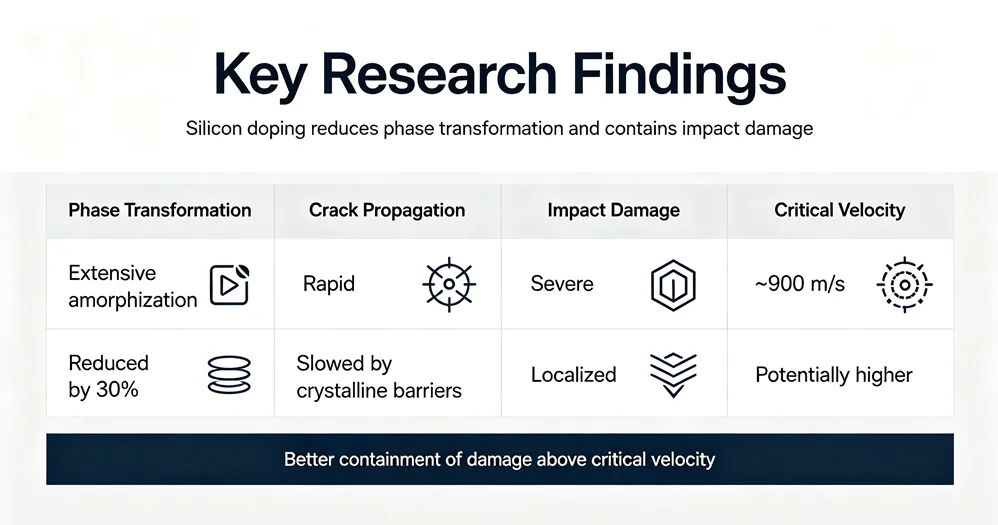
| Aspect | Before Silicon Doping | After Silicon Doping | Improvement |
|---|---|---|---|
| Phase Transformation | Extensive amorphization | Reduced by 30% | Significant |
| Crack Propagation | Rapid and unobstructed | Slowed by crystalline barriers | Significant |
| Impact Damage | Severe and widespread | Localized and contained | Significant |
| Critical Velocity | ~900 m/s | Potentially higher | Under investigation |
| Armor Performance | Limited above critical velocity | Improved above critical velocity | Significant |
Key Research Findings
Luoyang Trunnano Tech Co., Ltd (TRUNNANO) is a professional boron carbide powder with over 12 years experience in chemical products research and development. If you are looking for high quality boron carbide powder, please feel free to contact us and send an inquiry.
Tags: Boron Carbide, B₄C, Black Diamond, Body Armor, Armor Materials, Silicon Doping, Phase Transformation