Types and properties of silica
Do you know about the types and characteristics of silica? I believe that many people have a relatively small understanding of silica, today we will learn together some basic knowledge of silica, silica products are mainly divided into two categories: fumed silica and precipitation method silica, what are their characteristics? Specifically, we go down together to understand it.
Silica (silicon dioxide, SiO₂) is one of the most versatile and widely used industrial materials, with applications ranging from rubber reinforcement and coatings to pharmaceuticals and food additives. The two main categories of synthetic silica—fumed silica and precipitated silica—differ significantly in their manufacturing processes, physical properties, and application areas. Fumed silica is produced through a high-temperature flame hydrolysis process, resulting in particles with extremely small size and high purity. Precipitated silica is produced through a wet chemical process, yielding a material with different surface chemistry and particle morphology. The choice between fumed and precipitated silica depends on the specific requirements of the application, including the desired reinforcement effect, rheological properties, and cost considerations. The development of new silica grades and processing methods continues to expand the range of applications for these versatile materials. The global demand for silica is driven by its widespread use in the rubber industry, where it serves as a reinforcing filler, and in other industries such as coatings, plastics, and personal care products. The environmental and health considerations associated with silica production have led to the development of more sustainable manufacturing processes. The ongoing research on the properties and applications of silica is expected to lead to new innovations and expanded applications in various fields.
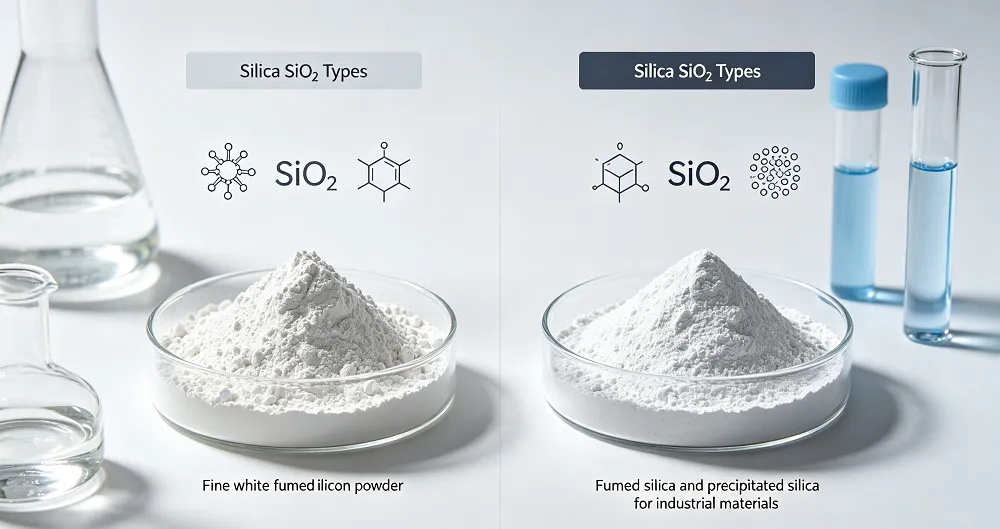
Silica SiO₂ Types
The size, specific surface area, surface properties, and structure of fumed silica particles are related to the ratio of the raw gas, the combustion rate, and the residence time of the SiO2 nucleus in the combustion chamber.
The finer the fumed silica particles, the larger its specific surface area, and the better the reinforcement effect, but the worse the operating performance. On the contrary, its coarser particles, the specific surface area is also small, and the reinforcement effect is poor, but the operability is better.
Fumed silica is one of the most commonly used reinforcing agents for silicone rubber, and the rubber reinforced by it has high mechanical strength and good electrical properties of the vulcanized rubber. Fumed silica can also be used with other reinforcing agents or weak reinforcing agents to make different rubber materials with different requirements.
However, the price is the disadvantage of fumed silica, because of the high price of raw materials and the large amount of energy required for production, it has a greater disadvantage compared to precipitated silica in terms of price and environmental protection, but nowadays, with the improvement of the precipitated silica process, it is gradually able to partially or even completely replace fumed silica.
Fumed silica, also known as pyrogenic silica, is produced by the high-temperature hydrolysis of silicon tetrachloride or other chlorosilanes in a flame of hydrogen and oxygen. The process results in the formation of a three-dimensional network of aggregated primary particles with extremely small sizes (typically 5-50 nm) and very high specific surface areas (typically 100-400 m²/g). The high specific surface area of fumed silica is responsible for its excellent reinforcing properties in silicone rubber and other elastomers. The reinforcing effect of fumed silica is attributed to the strong interaction between the silica particles and the polymer chains, which results in improved mechanical properties such as tensile strength, tear resistance, and abrasion resistance. The surface properties of fumed silica, including the presence of silanol groups (Si-OH), can be modified through surface treatment to improve compatibility with different polymer systems. The use of fumed silica in silicone rubber provides high mechanical strength and good electrical properties, making it suitable for applications in the electronics and automotive industries. The high cost of fumed silica is due to the expensive raw materials and the high energy consumption required for production. The development of more cost-effective production methods and the use of alternative raw materials are areas of ongoing research. The environmental impact of fumed silica production, including the generation of hydrogen chloride gas, requires careful management and treatment. The use of precipitated silica as a partial or complete replacement for fumed silica is increasing, driven by its lower cost and improved performance in some applications. The continued research on the properties and applications of fumed silica is expected to lead to new innovations and expanded applications in various fields.
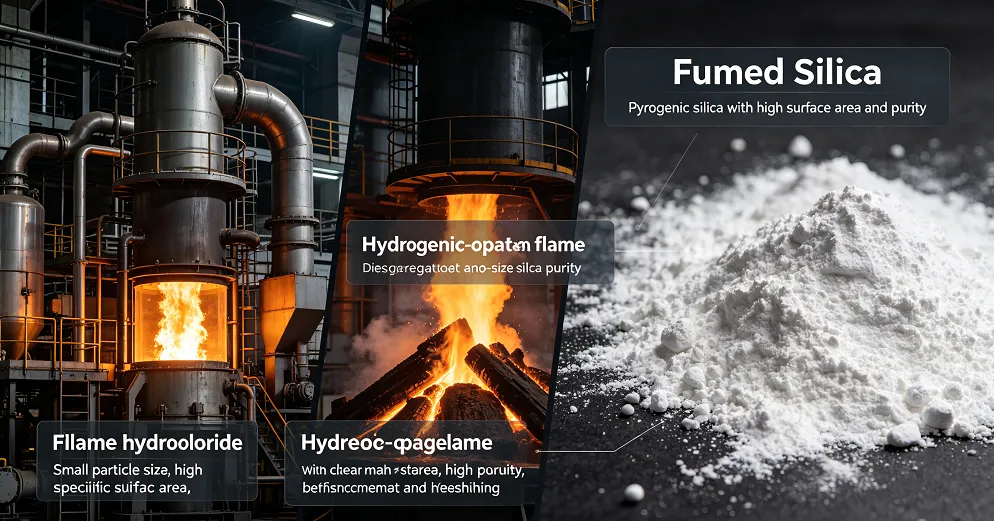
Fumed Silica
Fumed silica applications are different from those of precipitated silica. Fumed silica is a fine, special amorphous silica product produced by high-temperature hydrolysis of halothane over a hydroxide flame. Fumed silica does not contain crystalline water, has a small particle size and a large specific surface area, and has excellent stability, dispersibility, reinforcement, thickening and thixotropy, and the product purity can be as high as 99.8%. It is used as a reinforcing agent in the field of silicone rubber products and mainly used as a reinforcing agent and thickening agent in the field of coating and printing ink.

Fumed Silica
The unique properties of fumed silica make it valuable in a wide range of applications beyond rubber reinforcement. In coatings and paints, fumed silica is used as a thickening agent and rheology modifier, providing improved sag resistance, leveling, and anti-settling properties. The thixotropic behavior of fumed silica-based coatings allows them to flow easily during application while maintaining their shape and preventing dripping after application. In printing inks, fumed silica is used to control viscosity and improve print quality, ensuring sharp, consistent images and text. In adhesives and sealants, fumed silica provides reinforcement, thickening, and thixotropy, improving the application properties and mechanical strength of the final product. In the cosmetics and personal care industry, fumed silica is used as a thickening agent, absorbent, and matting agent in products such as creams, lotions, and powders. The high purity of fumed silica (up to 99.8%) makes it suitable for use in food and pharmaceutical applications, where it is used as an anti-caking agent and flow aid. The absence of crystalline water in fumed silica contributes to its stability and performance in various applications. The development of new fumed silica grades with tailored surface properties and particle sizes continues to expand the range of applications for this versatile material. The use of fumed silica in emerging technologies, such as lithium-ion batteries and advanced composites, is being explored, offering the potential for improved performance and new applications. The demand for high-performance fumed silica in specialty applications is expected to drive continued growth in the production and use of this material.
Precipitated silica is the most important type
Silicon dioxide is an inorganic substance with the chemical formula SiO2 and can be classified according to the manufacturing method into fumed silica and liquid silica. Further distinctions can be made between precipitated silica and gel silica based on the pH value of the reaction system and whether or not the reaction process is gelatinized.
Precipitated silica is produced by a wet chemical process involving the reaction of sodium silicate (water glass) with an acid, typically sulfuric acid, under controlled conditions. The process parameters, including temperature, pH, and reactant concentration, significantly influence the properties of the resulting silica. Precipitated silica is characterized by its high purity, controlled particle size, and specific surface area. The production of precipitated silica is generally more cost-effective and environmentally friendly than fumed silica, as it does not require high-temperature processing and generates fewer hazardous by-products. The ability to control the particle size and morphology of precipitated silica through the adjustment of process parameters enables the production of silica grades tailored for specific applications. The distinction between precipitated silica and gel silica is based on the pH of the reaction system and the occurrence of gelation during the process. Gel silica is produced under conditions that promote the formation of a gel network, resulting in a material with different physical properties compared to precipitated silica. The development of new methods for producing precipitated silica, including supergravity technology, sol-gel methods, and microemulsion methods, continues to expand the range of available silica grades. The growing demand for silica in various industries is driving the development of new production methods and the optimization of existing processes. The environmental and economic advantages of precipitated silica make it the most important and widely used type of synthetic silica.
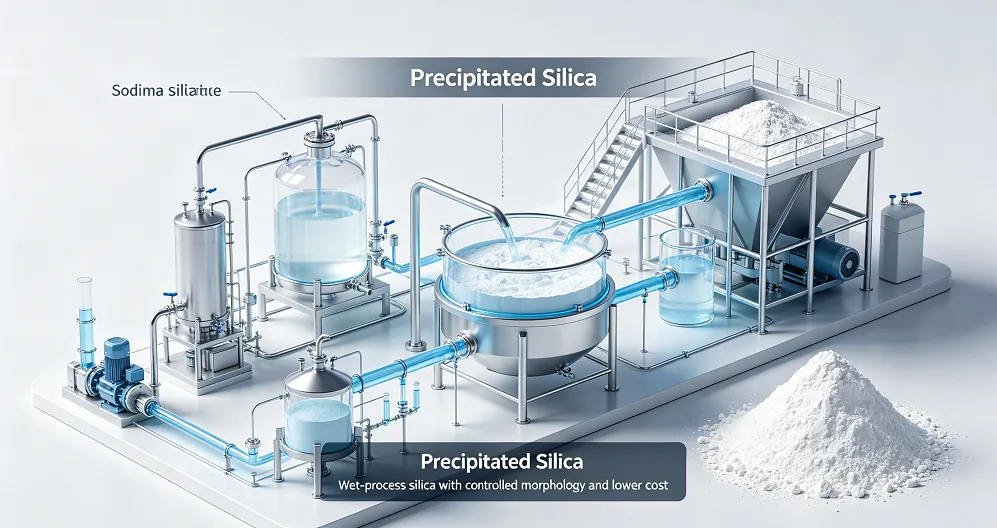
Precipitated Silica
Precipitated silica products are divided into traditional precipitated silica, which is produced from sulfuric acid, hydrochloric acid, CO2 and water glass, and special precipitated silica, which is produced by special methods such as supergravity technology, sol-gel method, chemical crystal method, secondary crystallization method or inverse micellar microemulsion method.
The performance of precipitated silica is influenced by the precipitation conditions such as acidity and temperature.
Compared with the silicone rubber reinforced with fumed silica, the mechanical strength of the rubber reinforced with traditional precipitated silica is slightly lower, and the dielectric properties, especially after moisture, are poorer, but the heat aging resistance is better, and the cost of the compound is much lower. When the mechanical strength of the product is not high, precipitated silica is available or used with fumed silica.
The traditional production of precipitated silica involves the reaction of sodium silicate with an acid to form silica particles, which are then filtered, washed, and dried. The properties of traditional precipitated silica, including its specific surface area, particle size, and morphology, are influenced by the reaction conditions, including temperature, pH, and the concentration of reactants. Special precipitated silica grades are produced using advanced methods that enable the control of particle size, morphology, and surface properties. The use of supergravity technology, sol-gel methods, and microemulsion methods allows for the production of precipitated silica with tailored properties for specific applications. The mechanical strength of silicone rubber reinforced with traditional precipitated silica is generally lower than that of rubber reinforced with fumed silica, but the cost of the compound is much lower. The heat aging resistance of precipitated silica-reinforced rubber is better than that of fumed silica-reinforced rubber, making it suitable for applications requiring long-term thermal stability. The dielectric properties of precipitated silica-reinforced rubber are poorer than those of fumed silica-reinforced rubber, particularly after exposure to moisture. The choice between fumed and precipitated silica depends on the balance between performance requirements and cost. The use of precipitated silica in combination with fumed silica allows for the optimization of properties and cost in rubber formulations. The development of new precipitated silica grades with improved reinforcing properties continues to expand the range of applications for this material. The use of precipitated silica in applications where high mechanical strength is not required is increasing, driven by its lower cost and improved environmental profile. The continued research on the properties and applications of precipitated silica is expected to lead to new innovations and expanded applications in various fields.
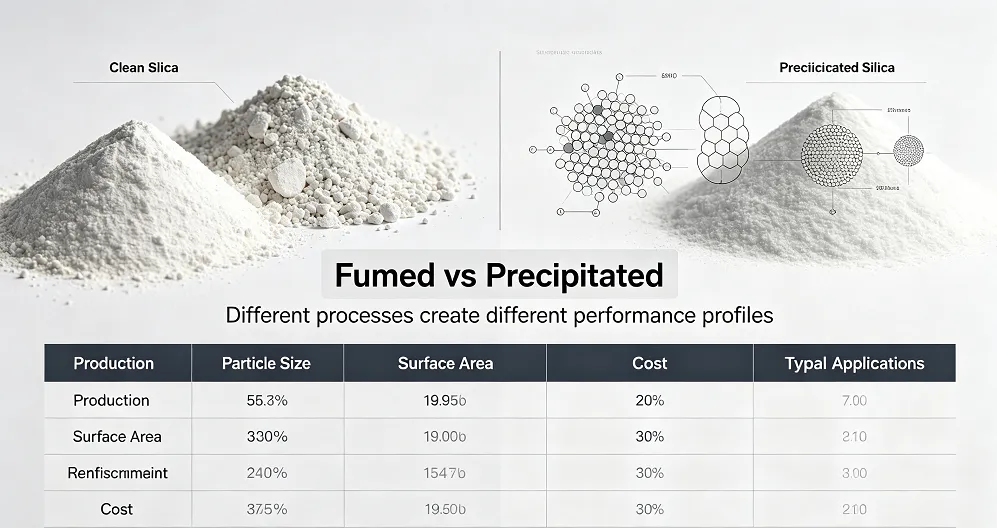
Fumed vs Precipitated
Precipitated silica, known as precipitated hydrated silica or precipitated silica, is made by reacting a solution of water glass with an acid (usually sulfuric acid), precipitating, filtering, washing and drying. Because of its chemical inertness and stability to chemical agents and its ability to significantly improve the mechanical properties of rubber products (such as tensile strength, abrasion resistance, aging resistance, tear resistance, etc.), it is widely used as a chemical filler in the rubber industry, animal feed carrier, food, medicine, oral care, paper, coatings, agrochemicals, silicone rubber and many other fields.
In the pharmaceutical field, highly dispersible silica is used as a carrier for vitamin E. In the rubber field, it is mostly used as a replacement for carbon black and is called silica, while outside the rubber industry, it is mostly called silica.
The versatility of precipitated silica is reflected in its wide range of applications across various industries. In the rubber industry, precipitated silica is used as a reinforcing filler in tires, footwear, and industrial rubber products. The addition of silica to tire tread compounds improves wet grip and reduces rolling resistance, contributing to improved fuel efficiency and safety. In footwear, precipitated silica is used to improve the abrasion resistance and mechanical properties of rubber soles. In the animal feed industry, precipitated silica is used as a carrier for vitamins and minerals, providing a stable and inert matrix for the delivery of nutrients. In the food industry, precipitated silica is used as an anti-caking agent, flow aid, and carrier for flavors and colors. In the pharmaceutical industry, highly dispersible silica is used as a carrier for active ingredients, improving the stability and bioavailability of drugs. In oral care products, precipitated silica is used as an abrasive in toothpaste, providing gentle cleaning and polishing of tooth surfaces. In coatings and paints, precipitated silica is used as a matting agent, providing a controlled gloss and improving the surface properties of the coating. In agrochemicals, precipitated silica is used as a carrier and dispersant for pesticides and herbicides. The use of precipitated silica in silicone rubber as a reinforcing filler provides improved mechanical properties and cost-effectiveness compared to fumed silica. The development of new precipitated silica grades with tailored properties continues to expand the range of applications for this versatile material. The demand for precipitated silica in various industries is driven by its excellent performance, cost-effectiveness, and environmental compatibility. The continued research on the properties and applications of precipitated silica is expected to lead to new innovations and expanded applications in various fields.
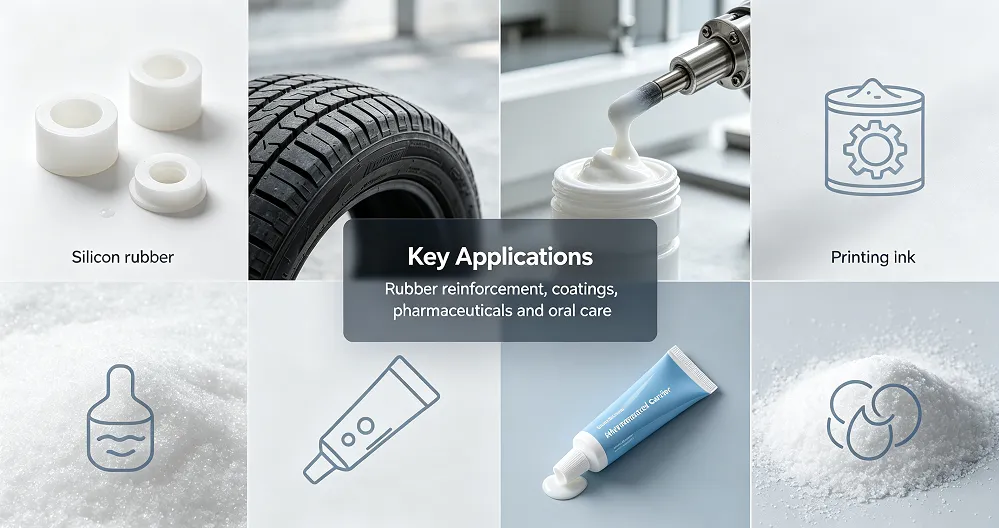
Key Applications
Luoyang Tongrun Nano Technology Co. Ltd. (TRUNNANO) Luoyang City, Henan Province, China, is a reliable and high-quality global chemical material supplier and manufacturer. It has more than 12 years of experience providing ultra-high quality chemicals and nanotechnology materials, including Zinc sulfide, nitride powder, Zinc sulfide powder, sulfide powder, and 3D printing powder. If you are looking for high-quality and cost-effective silica powder, you are welcome to contact us or inquire at any time.