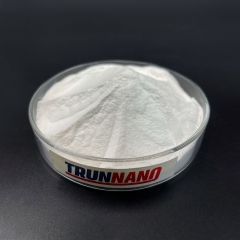


Sodium molybdate is an inorganic substance with the chemical formula Na2MoO4, which is a white rhombic crystal. Molybdenum trioxide can be generated by oxidizing and roasting molybdenum concentrate, and sodium molybdate solution can be obtained by leaching with liquid alkali. After filtration, concentration, cooling, centrifugation, and drying, it can be prepared.
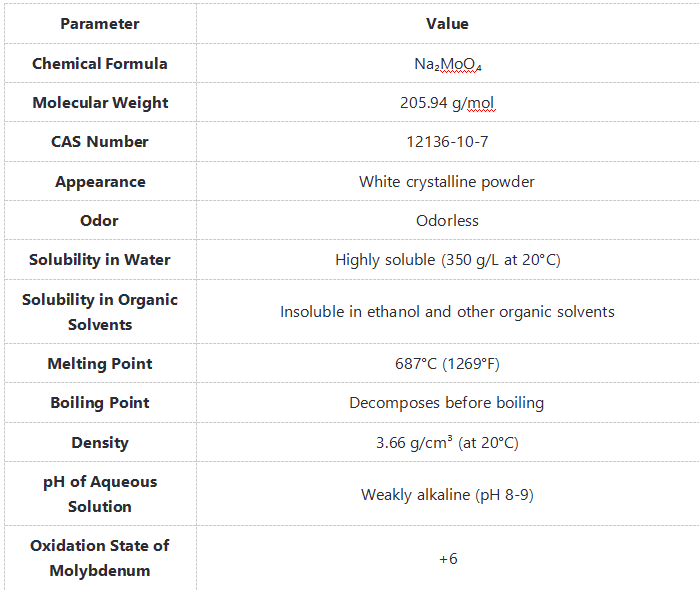
Melting point: 687°C(lit.)
Density: 3.78g/ml at 25°C(lit.)
Refractive index: 1.714
Storage conditions: Store at 4°C, protect from light, stored under nitrogen
Solubility: In soluble in EtOH; in soluble in DMSO; ≥20.6mg/ml in H2O
Form: Powder
Color: White
Odor: Odorless
Water solubility: It is soluble in water
Determine alkaloids and glycosides. Measure the total phosphorus and effective phosphorus content of phosphate fertilizer calcium superphosphate. Check for protein free blood filtrate and serum protein. Corrosion inhibitors. In haploid breeding, H medium, T medium, improved Nisch medium, MS medium, and RM medium are prepared. Manufacturing pigments.



By sea, by air or by express as soon as possible once payment is received.
FAQs of Sodium Molybdate
Q:What are the chemical properties of sodium molybdate?
A:Sodium molybdate is readily soluble in water, forming a clear solution, but insoluble in alcohols. Sodium molybdate is stable at room temperature but decomposes at high temperatures. Sodium molybdate solutions are weakly alkaline, with a pH generally between 8 and 9. Sodium molybdate has some oxidising properties and can react with reducing agents to form low valence compounds of molybdenum. Sodium molybdate can form complexes with certain metal ions, which makes it an important catalyst in some chemical reactions.
Q:What are the main methods of preparing sodium molybdate?
A:Preparation of molybdenum ore (e.g. molybdenite MoS₂) and sodium hydroxide (NaOH). The molybdenum ore is roasted at high temperature to convert it to molybdenum oxide (MoO₃). The molybdenum oxide is mixed with a sodium hydroxide solution and heated to dissolve to form sodium molybdate. After the reaction is complete, the insoluble material is removed by filtration and the filtrate is concentrated to the desired concentration. The concentrated solution is cooled to precipitate sodium molybdate crystals and then dried to obtain solid sodium molybdate.
Q: What are the main industrial applications of sodium molybdate?
A:Sodium molybdate can be used as a metal preservative, especially for the anti-corrosion treatment of steel and aluminium. It can form a protective film on the metal surface to prevent corrosion. Sodium molybdate can be used as a catalyst for certain chemical reactions to increase reaction rates and yields. For example, sodium molybdate is often used as a catalyst in petroleum refining and ammonia production. Sodium Molybdate can be used as a micronutrient fertiliser to provide plants with the molybdenum they need to promote plant growth and increase crop yields. Sodium Molybdate can be used in water treatment to remove heavy metal ions and organic pollutants from water and improve water quality. Sodium Molybdate can be used as an additive in paints and pigments to improve the weathering and corrosion resistance of products.
Q:What are the applications of sodium molybdate in the field of environmental protection
A:Sodium molybdate can be used to treat industrial wastewater, remove heavy metal ions and organic pollutants in water, and improve water quality. Sodium molybdate can be used to prepare highly efficient air purification materials to remove harmful gases from the air and improve indoor air quality. Sodium molybdate can be used to remediate contaminated soil, especially soil containing heavy metals, by forming stable complexes to reduce the migration and toxicity of heavy metals.