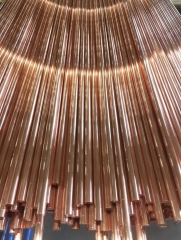

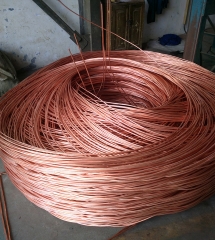
Definition of Copper Pole
Copper rods are rods made of molten electrolytic copper through a certain process and are in the shape of wire rods. Copper rod is the raw material for the production of products such as wires and cables, copper rods and copper bars.

(Carbon Copper Bus Bar)
Advantages of Copper Pole
Copper rods have good electrical conductivity, thermal conductivity, corrosion resistance and machinability, smooth surface without drawing, precise dimensions, high mechanical properties, high copper content, low oxygen content, dense structure and free supply length. Our product grades have good processing performance and can meet various demands.
Lower Resistivity: Copper rods have a lower resistivity than iron rods, making them suitable for use in wires and cables. High Capacity: Copper rods have a high electrical capacity and can carry higher currents, so they are often used for power transmission and distribution. Flexible: Copper rods are flexible, allowing for thinner wires and cables to be pulled, and they are also easier to solder when connecting.
Low Coefficient of Thermal Expansion: Copper rods have a relatively low coefficient of thermal expansion, which means that they don't experience excessive stress during temperature changes, reducing damage to wires and cables.
Good corrosion resistance: Copper rods have good corrosion resistance in natural environments and in certain specific environments, making them more suitable for outdoor or wet environments.
Good Thermal Conductivity: Copper rods have good thermal conductivity and can therefore be used in radiators, heat exchangers, and other devices that require heat dissipation. Application of copper rods Copper rod can be used in electrical industry, new energy charging pile, electrician, electrical appliances, power transmission and transformation, mould, hardware processing and other industries.
It is a high-quality conductive material for all kinds of high- and low-voltage electrical accessories. It is the raw material for the production of wires and cables, copper rods and copper tubes.
The Application of Copper Poles
The copper pole is used in the electrical industry, new energy charging piles, electricians, electrical appliances, power transmission and transformation, moulds, hardware processing, and other industries. It is a high-quality conductive material for various high and low-voltage electrical accessories. It is the raw material for producing wire and cable, copper bars and copper rods, and other products.

| Item | T1 | C11000 | C10200 | C10300 | C12000 | C12200 | |
| Element content | Cu+Ag(≥) | 99.95 | 99.9 | 99.97 | 99.95 | 99.9 | 99.9 |
| P(≤) | 0.001 | 0.002 | 0.002 | 0.004-0.012 | 0.015-0.04 | ||
| Bi(≤) | 0.001 | 0.001 | 0.001 | 0.001 | 0.002 | 0.002 | |
| Sb(≤) | 0.002 | 0.002 | 0.002 | 0.002 | 0.002 | 0.002 | |
| As(≤) | 0.002 | 0.002 | 0.002 | 0.002 | 0.002 | 0.005 | |
| Fe(≤) | 0.005 | 0.005 | 0.004 | 0.004 | 0.01 | 0.05 | |
| Ni(≤) | 0.002 | 0.005 | 0.002 | 0.002 | 0.005 | 0.01 | |
| Pb(≤) | 0.003 | 0.005 | 0.003 | 0.004 | 0.005 | 0.005 | |
| Sn(≤) | 0.002 | 0.002 | 0.002 | 0.002 | 0.002 | 0.01 | |
| S(≤) | 0.005 | 0.005 | 0.004 | 0.004 | 0.005 | 0.005 | |
| Zn(≤) | 0.005 | 0.005 | 0.003 | 0.003 | 0.003 | 0.003 | |
| O(≤) | 0.02 | 0.06 | 0.002 | 0.003 | 0.01 | 0.01 | |
| Item | Characteristic | Fields of application |
| C11000 | It has good electrical conductivity, thermal conductivity, corrosion resistance and processing properties, and can be welded and brazing. Impurities containing reduced electrical and thermal conductivity are small, and trace amounts of oxygen have little effect on electrical conductivity, thermal conductivity and processing properties, but it is easy to cause "hydrogen disease", and it is not easy to process (annealing, welding, etc.) and use in a high temperature (such as 370 °C) reducing atmosphere. | Used in electrical, thermally conductive and corrosion-resistant equipment. Such as: wires, cables, conductive screws, detonators for blasting, chemical evaporators, storage devices and various pipelines |
| C10200、C10300 | It has high purity, excellent electrical and thermal conductivity, no "hydrogen disease" or very little "ammonia disease" (no hydrogen embrittlement), good processing performance and welding, corrosion resistance and cold resistance | It is mainly used as electric vacuum instrumentation devices, various hardware products, lamps, pipe fittings, zippers, plaques, rivets, springs, settlement filters, etc |
| C12000 | Its welding performance and cold bending performance are good, generally no "hydrogen disease" tendency, can be processed and used in a reducing atmosphere, but not suitable for processing and use in an oxidizing atmosphere. The residual phosphorus content of C12000 is less than that of C12200, so its electrical and thermal conductivity is higher than that of C12200. | It is mainly used in pipes, but can also be supplied as plates, strips or rods and wires. Used as gasoline or gas transmission pipes, drain pipes, condensation pipes, mine pipes, condensers, evaporators, heat exchangers, train car parts. |
| C12200 |