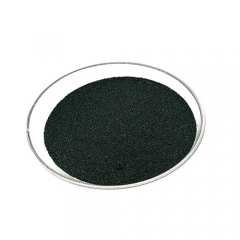
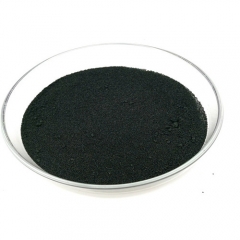
About Molybdenum Disulfide MoS2 Powder:
Molybdenum disulfide is an inorganic compound composed of molybdenum and sulfur. Molybdenum disulfide chemical formula is MoS2.
Like most mineral salts, Moly disulfide has a high melting point but begins to sublime at a relatively low 450ºC. This property is useful for purifying compounds.
This compound is classified as a transition metal dihalide. Moly sulfide is a silver-black solid in the form of molybdenite (the main ore of molybdenum). MoS2 is relatively unreactive. It is not affected by dilute acid and oxygen. In appearance and feel, molybdenum disulfide is similar to graphite. Because of its low friction and robustness, it is widely used as a dry lubricant. Bulk MoS2 is a diamagnetic, indirect bandgap semiconductor similar to silicon, with a bandgap of 1.23 eV.
In addition to its lubricity, MoS2 is also a semiconductor. It is also known that when doped with an electrostatic field, it and other semiconductor transition metal chalcogenides become superconductors on its surface.
MoS2 and related molybdenum sulfides are efficient catalysts for hydrogen evolution, including the electrolysis of water; thus, are possibly useful to produce hydrogen for use in fuel cells.
As in graphene, the layered structures of MoS2 and other transition metal dichalcogenides exhibit electronic and optical properties that can differ from those in bulk. Bulk MoS2 has an indirect bandgap of 1.2 eV, while MoS2 monolayers have a direct 1.8 eV electronic bandgap. supporting switchable transistors and photodetectors.
The sensitivity of a graphene field-effect transistor (FET) biosensor is fundamentally restricted by the zero band gap of graphene, which results in increased leakage and reduced sensitivity. In digital electronics, transistors control current flow throughout an integrated circuit and allow for amplification and switching. In biosensing, the physical gate is removed and the binding between embedded receptor molecules and the charged target biomolecules to which they are exposed modulates the current.
MoS2 also possesses mechanical strength, electrical conductivity, and can emit light, opening possible applications such as photodetectors. MoS2 has been investigated as a component of photoelectrochemical (e.g. for photocatalytic hydrogen production) applications and for microelectronics applications.
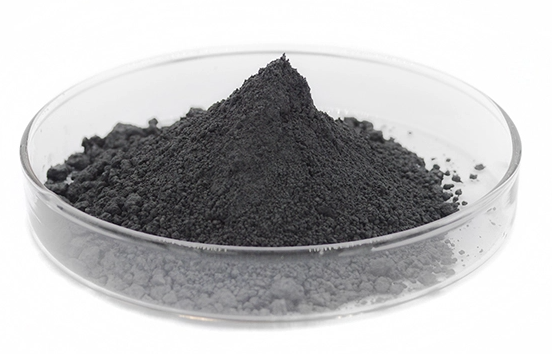
Molybdenum Disulfide MoS2 Powder
Feel free to send an inquiry to get the latest Molybdenum disulfide price if you would like to buy Molybdenum Disulfide powder MoS2 Powder in bulk.
Molybdenum Disulfide:
Molybdenum Disulfide basic information:
English name: Molybdenum Disulfide
Molybdenum Disulfide CAS No.: 1317-33-5
Molybdenum Disulfide Molecular formula: MoS2
Molybdenum Disulfide Molar mass:160.06
Molybdenum Disulfide Appearance: black/lead-gray solid
Molybdenum Disulfide Density(water=1): 4.8
Molybdenum Disulfide Melting point(℃): 1185
Molybdenum Disulfide Solubility: decomposed by aqua regie, hot sulfuric acid, nitric acid, insoluble in dilute acid and water
Molybdenum Disulfide Hazardous characteristics: the powder in high temperature will burn and react violently with peroxide.
|
MoS2 Grade |
FFFS |
Particle size SEM |
Laser Median Particle size |
Bulk density |
|
Technical |
3 to 4 μm |
<1 to100 μm |
<30 μm |
1.3 g/cm3 |
|
Technical Fine |
0.65 to 0.8 |
<0.5 to 20 μm |
<6 μm |
0.4 g/cm3 |
|
Super Fine |
0.4 to 0.45 |
<0.5 to 8 μm |
<1.5 μm |
0.3 g/cm3 |
Specification of Molybdenum Disulfide MoS2 Powder:
|
Brand |
Particle size |
Purity |
Character |
|
TR-MoS2-01 |
100nm |
99.9% |
Black powder |
|
TR-MoS2-02 |
500nm |
98.5% |
Grey black powder |
|
TR-MoS2-03 |
D50:1.5μm |
98.5% |
Grey black powder |
|
TR-MoS2-04 |
D50:3-6μm |
98.5% |
Grey black powder |
|
TR-MoS2-05 |
D50:12-16μm |
98.5% |
Grey black powder |
|
TR-MoS2-06 |
D50: 16-30μm |
98.5% |
Grey black powder |
Certificate of Molybdenum Disulfide:
|
Chemical Composition Analysis % |
||||||||||
|
MoS2 |
Fe |
SiO2 |
H2O |
MoO3 |
Oil |
acid insoluble |
PH |
|||
|
98.5 to 99 |
0.25 |
0.13 |
0.14 |
0.25 |
0.16 |
0.25 |
0.5 |
|||
How is Molybdenum Disulfide MoS2 Powder produced?
MoS2 is naturally found as molybdenite (a crystalline mineral) or pyroxene (a rare low-temperature form of molybdenite). The molybdenite is processed by flotation to obtain relatively pure MoS2. The main pollutant is carbon. MoS2 can also be produced by heat treatment of almost all molybdenum compounds with hydrogen sulfide or elemental sulfur and can be produced by the metathesis reaction of molybdenum pentachloride.
Molybdenum Disulfide Uses:
Molybdenum disulfide is used as a dry lubricant in, e.g. greases, dispersions, friction materials and bonded coatings. Molybdenum-sulfur complexes may be used in suspension but more commonly dissolved in lubricating oils at concentrations of a few percent. MoS2 is used as additives in lubricating grease, friction materials, plastic, rubber, nylon, PTFE, coating and so on.

Molybdenum Disulfide Uses
Advanced Solid Lubricants:
Molybdenum disulfide is widely used in advanced solid lubricants due to its unique layered structure and excellent physical properties. It maintains excellent lubricating properties at high temperatures and pressures.
Catalyst
Molybdenum disulfide has electrical conductivity similar to that of metallic semiconductor materials and can be used as a highly efficient electrocatalyst for many different catalytic reactions such as hydrolysis. In addition, molybdenum disulfide can be used with precious metals as a Pd-MoS2 catalyst with excellent catalytic activity and stability.
Composites
The micro- and nanostructures of molybdenum disulfide can be used to reinforce high-performance composites and to prepare high-performance materials such as transistors and integrated circuits.

Advanced Solid Lubricants
Friction materials
Molybdenum disulfide can be used in friction materials to provide friction reduction and friction enhancement, as well as an anti-oxidation effect.
Optical conductors and semiconductors displaying P- or N-type conductivity properties:
Molybdenum disulfide has excellent electrical conductivity and physicochemical properties and can be used as a photoconductor and semiconductor material.
Storage Condition of Molybdenum Disulfide MoS2 Powder:
Damp reunion will affect MoS2 powder dispersion performance and using effects, therefore, Molybdenum Disulfide MoS2 Powder powder should be sealed in vacuum packing and stored in cool and dry room, the Molybdenum Disulfide MoS2 Powder can not be exposure to air. In addition, the Molybdenum Disulfide powder should be avoided under stress.
Packing & Shipping of Molybdenum Disulfide MoS2 Powder:
We have many different kinds of packing which depends on the Molybdenum Disulfide MoS2 Powder quantity.
Molybdenum Disulfide MoS2 Powder packing: vacuum packing, 100g, 500g or 1kg/bag, 25kg/barrel, or as your request.
Molybdenum Disulfide MoS2 Powder shipping: could be shipped out by sea , by air, by express as soon as possible once payment receipt.

Packing & Shipping of Molybdenum Disulfide MoS2 Powder
Luoyang Tongrun Nano Technology Co. Ltd. (TRUNNANO) is a trusted global chemical material supplier & manufacturer with over 12-year-experience in providing super high-quality chemicals and Nanomaterials, including boride powder, nitride powder, graphite powder, sulfide powder, 3D printing powder, etc.
If you are looking for high-quality Molybdenum disulfide powder, please feel free to contact us and send an inquiry.
FAQs of Molybdenum Disulfide MoS2 Powder:
Q: What is molybdenum disulfide used for?
A: Molybdenum disulfide (MoS2) powders are utilized in a wide range of applications due to their unique properties, including excellent lubrication even under extreme pressure and high temperatures, as well as good chemical stability. MoS2 serves as an effective solid lubricant in machinery, automotive components, aerospace parts, and other mechanical systems where traditional oil-based lubricants may not perform adequately. Its low friction coefficient makes it ideal for use in bearings, gears, and sliding parts. Additionally, MoS2 is employed in the manufacturing of semiconductors, lithium-ion batteries, and as a catalyst in petrochemical processes. The material's layered structure also lends itself to applications in nanotechnology and advanced materials research.
Q: Is molybdenum disulfide safe for human exposure?
A: Exposure to molybdenum disulfide should be managed with caution. While bulk MoS2 is generally considered to have low toxicity, fine particles can pose inhalation risks that might cause irritation to the respiratory system, eyes, and skin. It is important to handle the powder using appropriate personal protective equipment (PPE), such as gloves, safety goggles, and a respirator if dust is airborne. Good ventilation and adherence to occupational exposure guidelines are essential for worker safety. Always consult the Safety Data Sheet (SDS) provided by the manufacturer for detailed handling instructions and any updates on health impacts.
Q: What is the formula and structure of molybdenum disulfide?
A: Molybdenum disulfide has the chemical formula MoS2, indicating it consists of one molybdenum atom (Mo) and two sulfur atoms (S). This compound crystallizes in a layered hexagonal structure, similar to graphite, with each layer consisting of a sheet of molybdenum atoms sandwiched between two sheets of sulfur atoms. These layers are held together by weak van der Waals forces, which allow them to slide past each other easily, contributing to MoS2's exceptional lubricating properties. This structure is key to its performance in various applications, particularly those requiring low-friction surfaces or high-temperature stability.
Q: Can molybdenum disulfide be incorporated into composite materials?
A: Yes, molybdenum disulfide can be integrated into composite materials to enhance specific properties such as lubricity, wear resistance, and thermal stability. Composites containing MoS2 benefit from its inherent characteristics while offering improved design flexibility and functionality. For example, incorporating MoS2 into polymer matrix composites can yield materials with superior sliding properties suitable for use in mechanical components. When used as a filler in metal matrices, MoS2 can improve the material's tribological behavior, reducing friction and wear. Moreover, MoS2 nanoparticles can be dispersed within ceramics or glasses to create composites with enhanced toughness and reduced friction. The versatility of MoS2 makes it a valuable component in developing innovative materials across multiple industries, including manufacturing, automotive, aerospace, and electronics.
|
Molybdenum Disulfide Properties: |
|
|
Other Names |
Molybdenum Disulfide, Molybdenum Sulfide, MoS2 |
|
CAS No. |
1317-33-5 |
|
Compound Formula |
MoS2 |
|
Molecular Weight |
160.07 g/mol |
|
Appearance |
black/lead-gray solid |
|
Melting Point |
2,375 °C (4,307 °F; 2,648 K) |
|
Boiling Point |
N/A |
|
Density |
5.06 g/cm3 |
|
Solubility in H2O (water) |
insoluble |
|
Electrical Resistivity |
N/A |
|
Poisson's Ratio |
N/A |
|
Specific Heat |
N/A |
|
Thermal Conductivity |
N/A |
|
Thermal Expansion |
N/A |
|
Young's Modulus |
N/A |
|
Exact Mass |
161.849549 |
|
Monoisotopic Mass |
161.849549 |
|
|
|
|
|
|
|
Molybdenum Disulfide Health & Safety Information: |
|
|
Safety Warning |
Warning |
|
Hazard Statements |
H315-H319-H335 |
|
Hazard Codes |
Xi |
|
Risk Codes |
N/A |
|
Safety Statements |
N/A |
|
RTECS Number |
N/A |
|
Transport Information |
NONH for all modes of transport |
|
WGK Germany |
3 |