
By TRUNNANO | 23 July 2026 | 0 Comments
What are the characteristics of AES surfactants
What are the properties of AES surfactants?
AES surfactant is a white or yellow gel paste, easily soluble in water, and an excellent anionic surfactant. Excellent deterring power, emulsification power, wetting power, foaming properties, hard water resistance, and mild washing performance will not damage the skin. Good solubility, thickening effect, wide compatibility, high biodegradability, and low irritation to skin and eyes.
AES surfactant is derived from fatty acid extracted from vegetable oil and processed to obtain fatty alcohol, and then reacts with petroleum source ethylene oxide to obtain fatty alcohol polyoxyethylene ether, and then adds sulfuric acid, and finally adds sodium hydroxide to get AES. If AES is diluted into an aqueous solution containing 30% or 60% of the active substance without a viscosity regulator, it usually results in a gel with a high viscosity. To avoid this situation, the correct method is to add the highly active product to the specified amount of water while stirring. However, water should not be added to highly active raw materials, or a gel may form.
What are the applications of AES surfactants
1. Widely used in shampoo, bath liquid, dishwashing detergent, composite soap and other washing cosmetics; Used in the textile industry as a wetting agent, cleaning agent, etc.
In the personal care sector, AES is widely used due to its low irritation and good compatibility. It improves product feel and foam quality, efficiently removing sebum and dirt. The largest consumer market for AES today is personal cleansing products and dishwashing detergents.
2. Washing industry: as a non-ionic surfactant, emulsification, foaming, and decontamination effect. It is the main active ingredient of laundry detergent, body wash, washing powder, dishwashing liquid, and metal cleaning agents, but it is not resistant to strong alkalis.
In the detergent industry, AES is a key active ingredient not only for its excellent detergency and foaming properties but also for its unique salt-thickening effect—the addition of a small amount of NaCl significantly increases solution viscosity, which is crucial for product residence time on applied surfaces and cleaning effectiveness. Studies have also shown that AES molecules possess good wetting properties, effectively improving the wettability of various substrate surfaces, making it valuable in industrial cleaning applications.
3. Textile printing and dyeing industry: as a textile printing and dyeing assistant, emulsion silicone oil penetrant levelling agent polypropylene oil agent plays an emulsifying role.
In textile printing and dyeing, AES serves as a dyeing and finishing auxiliary. Its emulsifying function originates from the balance between the hydrophilicity of the EO chain segment and the lipophilicity of the long-chain alkyl group. Furthermore, when AES is compounded with other surfactants, it can form stable emulsifying systems—a property that is particularly critical in textile auxiliary formulations.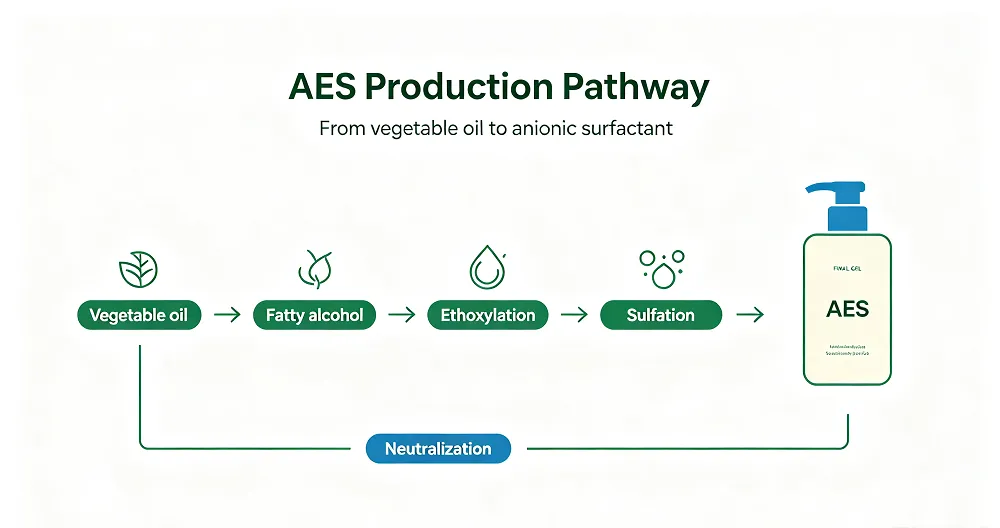
In the paper industry, AES serves multiple functions. As a deinking agent, it penetrates the interface between ink and paper fibers, disrupting adhesion and allowing ink particles to be dispersed and removed through flotation or washing processes—which is particularly valuable in waste paper recycling. As a desensitizing agent, it prevents resins and sticky contaminants from depositing on equipment surfaces, reducing pitch problems and improving production efficiency. As a blanket cleaning agent, it emulsifies and removes ink residues and paper debris from press blankets without damaging the surface, helping maintain printing quality and extend equipment service life.
5. Other include pesticide emulsifiers, crude oil demulsifiers, lubricating oil emulsifiers, etc.
In enhanced oil recovery, AES is used to improve crude oil recovery rates due to its ability to reduce oil-water interfacial tension. Molecular dynamics simulation studies have shown that AES can effectively lower oil-water interfacial tension and form stable interfacial films. When AES is compounded with nonionic surfactants such as alkanolamides, the interfacial film thickness and stability are further enhanced, demonstrating excellent resistance to metal ions.
AES in shampoo, shower liquid, tableware liquid detergent (dishwashing liquid), and clothing liquid detergent application, if the pH quality index allows, should be as high as possible to the pH value. AES water solubility is better than AS; At room temperature, it can be prepared into any proportion of transparent water solution. AES is more widely used than LAS in liquid detergent and has better compatibility; It can be combined with many surfactants to form a transparent aqueous solution. AES in synthetic surfactants, the output ranks third, and the price is lower than AS. AES surfactants are less irritating to the skin, soluble in water, and can improve dry and rough skin, but the stability in acidic media is slightly poor - the pH must be controlled much higher than 4, and the decontamination power is inferior to LAS and AS. Partially replacing LAS with AES reduces or eliminates phosphates and reduces the consumption of the total active substance.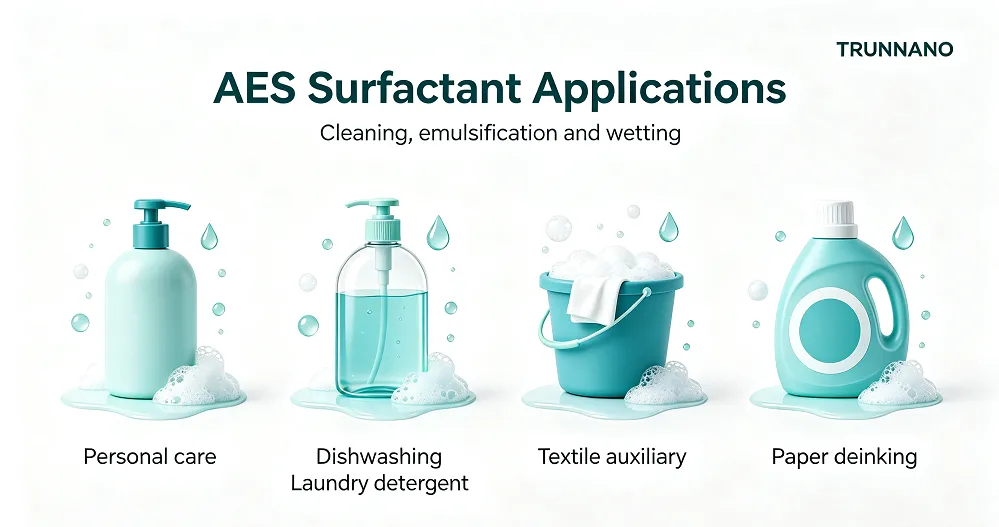
AES Surfactant Applications
Safety and Environmental Considerations
AES Safety and Environment
High-quality AES surfactants supplier
TRUNNANO is a trusted global supplier and manufacturer of chemical materials with over 12 years of experience in ultra-high quality nanomaterials and chemicals. The company has developed several powder materials and chemicals. Provide OEM service. You can contact us if you are looking for AES surfactants. You can click on the product to contact us.
AES surfactant is a white or yellow gel paste, easily soluble in water, and an excellent anionic surfactant. Excellent deterring power, emulsification power, wetting power, foaming properties, hard water resistance, and mild washing performance will not damage the skin. Good solubility, thickening effect, wide compatibility, high biodegradability, and low irritation to skin and eyes.
AES surfactant is derived from fatty acid extracted from vegetable oil and processed to obtain fatty alcohol, and then reacts with petroleum source ethylene oxide to obtain fatty alcohol polyoxyethylene ether, and then adds sulfuric acid, and finally adds sodium hydroxide to get AES.

What are the applications of AES surfactants
1. Widely used in shampoo, bath liquid, dishwashing detergent, composite soap and other washing cosmetics; Used in the textile industry as a wetting agent, cleaning agent, etc.
In the personal care sector, AES is widely used due to its low irritation and good compatibility. It improves product feel and foam quality, efficiently removing sebum and dirt. The largest consumer market for AES today is personal cleansing products and dishwashing detergents.
2. Washing industry: as a non-ionic surfactant, emulsification, foaming, and decontamination effect. It is the main active ingredient of laundry detergent, body wash, washing powder, dishwashing liquid, and metal cleaning agents, but it is not resistant to strong alkalis.
In the detergent industry, AES is a key active ingredient not only for its excellent detergency and foaming properties but also for its unique salt-thickening effect—the addition of a small amount of NaCl significantly increases solution viscosity, which is crucial for product residence time on applied surfaces and cleaning effectiveness. Studies have also shown that AES molecules possess good wetting properties, effectively improving the wettability of various substrate surfaces, making it valuable in industrial cleaning applications.
In textile printing and dyeing, AES serves as a dyeing and finishing auxiliary. Its emulsifying function originates from the balance between the hydrophilicity of the EO chain segment and the lipophilicity of the long-chain alkyl group. Furthermore, when AES is compounded with other surfactants, it can form stable emulsifying systems—a property that is particularly critical in textile auxiliary formulations.
AES Production Pathway
4. Paper industry: as a deinking agent, blanket cleaning agent, and desensitizing agent.In the paper industry, AES serves multiple functions. As a deinking agent, it penetrates the interface between ink and paper fibers, disrupting adhesion and allowing ink particles to be dispersed and removed through flotation or washing processes—which is particularly valuable in waste paper recycling. As a desensitizing agent, it prevents resins and sticky contaminants from depositing on equipment surfaces, reducing pitch problems and improving production efficiency. As a blanket cleaning agent, it emulsifies and removes ink residues and paper debris from press blankets without damaging the surface, helping maintain printing quality and extend equipment service life.
5. Other include pesticide emulsifiers, crude oil demulsifiers, lubricating oil emulsifiers, etc.
In enhanced oil recovery, AES is used to improve crude oil recovery rates due to its ability to reduce oil-water interfacial tension. Molecular dynamics simulation studies have shown that AES can effectively lower oil-water interfacial tension and form stable interfacial films. When AES is compounded with nonionic surfactants such as alkanolamides, the interfacial film thickness and stability are further enhanced, demonstrating excellent resistance to metal ions.
AES in shampoo, shower liquid, tableware liquid detergent (dishwashing liquid), and clothing liquid detergent application, if the pH quality index allows, should be as high as possible to the pH value. AES water solubility is better than AS; At room temperature, it can be prepared into any proportion of transparent water solution. AES is more widely used than LAS in liquid detergent and has better compatibility; It can be combined with many surfactants to form a transparent aqueous solution. AES in synthetic surfactants, the output ranks third, and the price is lower than AS. AES surfactants are less irritating to the skin, soluble in water, and can improve dry and rough skin, but the stability in acidic media is slightly poor - the pH must be controlled much higher than 4, and the decontamination power is inferior to LAS and AS. Partially replacing LAS with AES reduces or eliminates phosphates and reduces the consumption of the total active substance.
AES Surfactant Applications
Safety and Environmental Considerations
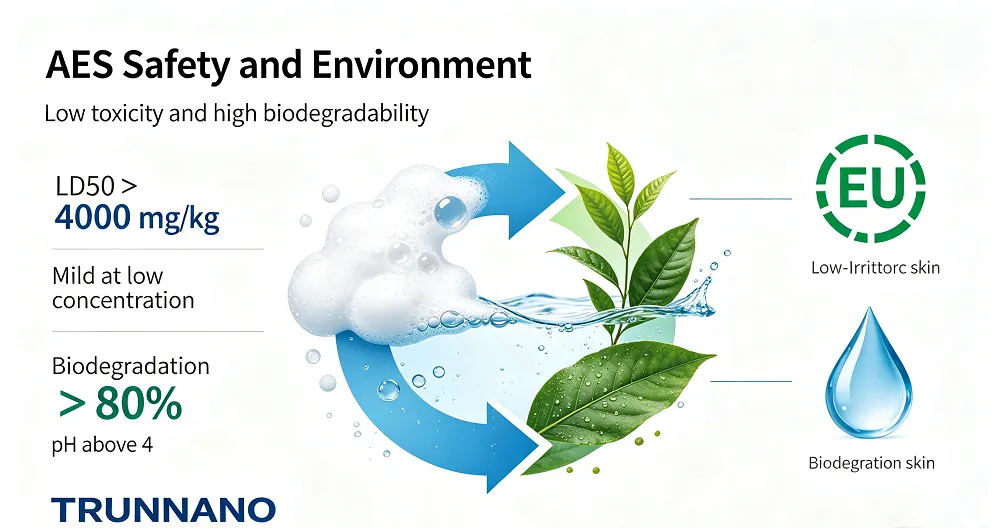
AES exhibits a favorable safety profile. Its median lethal dose (LD50) is generally above 4000 mg/kg, indicating very low toxicity. Undiluted AES has some irritant properties; at a concentration of 10%, it is moderately to strongly irritating, but at 1% concentration, it is already quite mild.
In terms of environmental friendliness, AES has a biodegradation rate exceeding 80%, meeting the requirements of the EU Detergent Regulation for surfactant biodegradability. The degradation rate increases with decreasing EO chain length and increasing alkyl chain linearity and length, and is primarily achieved through ether bond cleavage.
AES Safety and Environment
TRUNNANO is a trusted global supplier and manufacturer of chemical materials with over 12 years of experience in ultra-high quality nanomaterials and chemicals. The company has developed several powder materials and chemicals. Provide OEM service. You can contact us if you are looking for AES surfactants. You can click on the product to contact us.
Leave a Reply
Your email address will not be published.Required fields are marked. *