
What chemical substance is chromium oxide?
Chrome oxide is an oxide of chromium element, which is a black solid at normal temperature and pressure. The molecular formula is CrO2, the molecular weight is 83.9949, and it is mainly used to manufacture chromium dioxide magnetic powder.
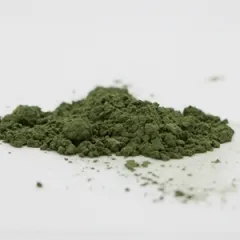
chromium oxide
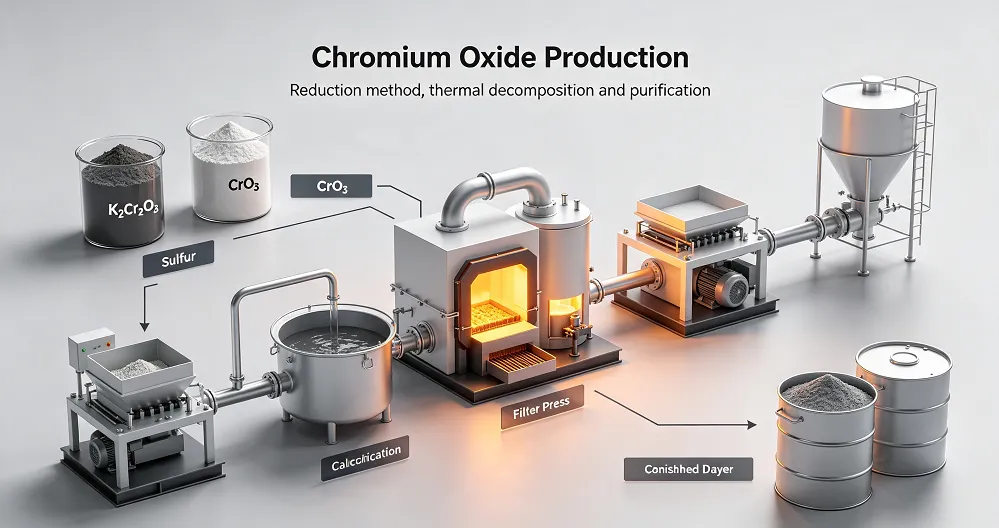
1.Reduction method: 99.5% potassium dichromate and 98% sulfur are mixed according to the mass ratio of 7:1 and then roasted to produce chromium oxide and potassium sulfate. After the reaction, the furnace charge is wet ground, then put into a washing tank with a stirrer to be washed with hot water, and the chromium oxide is filtered out by a filter press to obtain a paste filter cake with a water content of 30%-35%.
The filter cake is dried at 300℃, cooled, and crushed to obtain the finished product of chromium oxide green.
The washing liquid contains a large number of soluble salts such as potassium sulfate, chromium sulfate, hexavalent chromium, etc.
The hexavalent chromium can be reduced to chromium hydroxide precipitate by introducing hydrogen sulfide and then separated out by filtration. Hydrochloric acid is added to the filtrate, and the solution is concentrated and crystallized to produce potassium chloride as a by-product. Sulfur dioxide and sulfur trioxide gas released during roasting can be absorbed by dilute ammonia water, and ammonium sulfate can be produced as a by-product.

The thermal decomposition method is a straightforward and efficient route for producing high-purity chromium dioxide. Chromic anhydride (CrO₃) is a dark red crystalline solid that decomposes upon heating to form CrO₂ and oxygen. The decomposition reaction can be represented as: 2CrO₃ → 2CrO₂ + O₂. The calcination temperature is critical, as insufficient temperature results in incomplete decomposition, while excessive temperature can lead to the formation of other chromium oxides such as Cr₂O₃. The calcination time of 1 to 1.5 hours is sufficient to achieve complete conversion while minimizing the risk of thermal decomposition of the CrO₂ product. The cooling step must be carried out in a controlled manner to prevent oxidation of the CrO₂ product. The grinding step using a high-speed pulverizer is essential for achieving the desired particle size distribution for the finished product. The thermal decomposition method produces chromium dioxide with high purity and consistent properties, making it suitable for demanding applications such as magnetic recording media. However, the high calcination temperature and the need for high-purity starting materials make this method more expensive than the reduction method. The thermal decomposition method is typically used for producing high-grade chromium dioxide for specialized applications, while the reduction method is more commonly used for bulk production. Recent developments in microwave-assisted and plasma-assisted thermal decomposition have shown promise for reducing the energy consumption and improving the efficiency of this process.
3. Thermal chromium hydroxide decomposition method: sodium sulfide solution is added into the hot solution of sodium chromate to react to generate chromium hydroxide. After filtration, the obtained chromium hydroxide filter cake is washed and centrifugally dehydrated and then baked at about 1400℃ to generate chromium trioxide. The furnace charge is washed, dried, and crushed to obtain chromium oxide products. Sodium bicarbonate and sodium thiosulfate can be recovered from the alkali liquor obtained by separating chromium hydroxide, which is carbonized by carbon dioxide. The chromium trioxide prepared by this method is dark in color, so it is not suitable to be used as a pigment. It is mainly used for smelting metallic chromium and making a polishing paste.
The thermal decomposition of chromium hydroxide provides an alternative route for producing chromium dioxide, particularly when the starting materials are readily available. The initial reaction between sodium chromate (Na₂CrO₄) and sodium sulfide (Na₂S) produces chromium hydroxide [Cr(OH)₃] precipitate, which is separated by filtration and thoroughly washed to remove soluble impurities. The chemical reaction can be represented as: Na₂CrO₄ + Na₂S + 4H₂O → Cr(OH)₃↓ + Na₂SO₄ + 2NaOH. The chromium hydroxide filter cake is then calcined at approximately 1400°C to produce chromium dioxide through a dehydration reaction: 2Cr(OH)₃ → 2CrO₂ + 3H₂O. The calcination temperature and time are carefully controlled to ensure complete dehydration and to prevent the formation of other chromium oxide phases. The resulting product is darker in color compared to that produced by other methods, which limits its use as a pigment. However, this darker material is well-suited for applications such as the smelting of metallic chromium and the manufacture of polishing pastes, where color is not a critical factor. The recovery of sodium bicarbonate (NaHCO₃) and sodium thiosulfate (Na₂S₂O₃) from the alkali liquor provides additional economic value and reduces the environmental impact of the process. The carbonization step using carbon dioxide (CO₂) converts the alkali liquor to valuable by-products. The thermal decomposition of chromium hydroxide method is particularly useful when sodium chromate is a readily available and cost-effective starting material. The process is more complex than the reduction method but offers flexibility in the use of raw materials and the recovery of valuable by-products.
Mainly used for smelting metal chromium and chromium carbide. Used as a glaze for enamels and ceramics. Colorants for artificial leather, building materials, etc. Special ink for manufacturing sun-resistant coatings, abrasive materials, green polishing paste, and printing banknotes. Used as a catalyst for organic synthesis. It's advanced green.
Pigment.
The applications of chromium dioxide are diverse and reflect the material's unique combination of magnetic, catalytic, and optical properties. In the magnetic recording industry, CrO₂ was widely used in audio and video tapes from the 1970s to the 1990s, valued for its high coercivity and excellent magnetic saturation, which enabled higher recording densities and better signal-to-noise ratios. Although largely replaced by metal particle tapes, CrO₂ continues to be explored for specialized magnetic sensors and data storage devices.
In metallurgy, chromium dioxide serves as a precursor for producing metallic chromium and chromium carbide. The reduction of CrO₂ with carbon at high temperatures produces metallic chromium, essential for stainless steel and superalloy production, while chromium carbide is used in wear-resistant coatings and cutting tools due to its extreme hardness.
In the ceramics industry, CrO₂ is used as a pigment and glaze additive for enamels, ceramic tiles, and pottery. Its dark color provides durable coloration that is resistant to fading and chemical attack at high temperatures.
In coatings and special inks, CrO₂ serves as a colorant in artificial leather, building materials, and sun-resistant coatings, where its UV resistance ensures long-term color retention. It is also used in special inks for printing banknotes and security documents, where its distinctive color provides anti-counterfeiting features.
As a catalyst for organic synthesis, CrO₂ is used in oxidation reactions, including the oxidation of alcohols to carbonyl compounds. The high surface area and redox activity of CrO₂ make it effective for these reactions, with recent research exploring its use for converting biomass-derived compounds to valuable chemicals.
In advanced spintronic devices, CrO₂ has attracted significant attention as one of the few half-metallic ferromagnets that can operate at room temperature, with nearly 100% spin polarization at the Fermi level. This makes it promising for magnetic tunnel junctions and spin valves with high magnetoresistance and low power consumption.
In the pigment industry, CrO₂ is used as an advanced green pigment offering superior color stability, heat resistance, and chemical durability compared to traditional pigments, making it suitable for high-performance coatings, automotive paints, and architectural finishes. In research laboratories, CrO₂ serves as a model material for studying magnetism, catalysis, and surface chemistry, with CrO₂ thin films and nanoparticles extensively studied for potential applications in magnetic recording, spintronics, and catalysis.
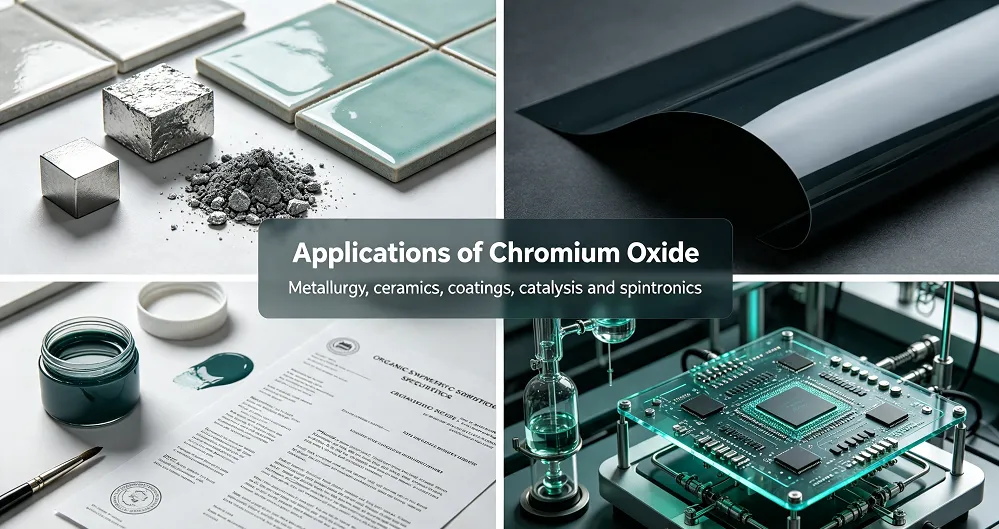
Applications of Chromium Oxide
Chromium oxide particle size and purity will affect the product's price, and the purchase volume can also affect the cost of chromium oxide. A large amount of large amount will be lower. The price of chromium oxide can be found on our company's official website.
Chromium oxide powder supplier
Luoyang Tongrun Nano Technology Co. Ltd. (TRUNNANO) Luoyang City, Henan Province, China, is a reliable and high-quality global chemical material supplier and manufacturer. It has more than 12 years of experience providing ultra-high quality chemicals and nanotechnology materials, including chromium oxide, nitride powder, graphite powder, sulfide powder, and 3D printing powder. If you are looking for high-quality and cost-effective chromium oxide, you are welcome to contact us or inquire at any time.