
By Trunnano | 02 September 2026 | 0 Comments
Characteristics and Production of Zinc Sulfide ZnS
Introduction to Zinc Sulfide ZnS Powder
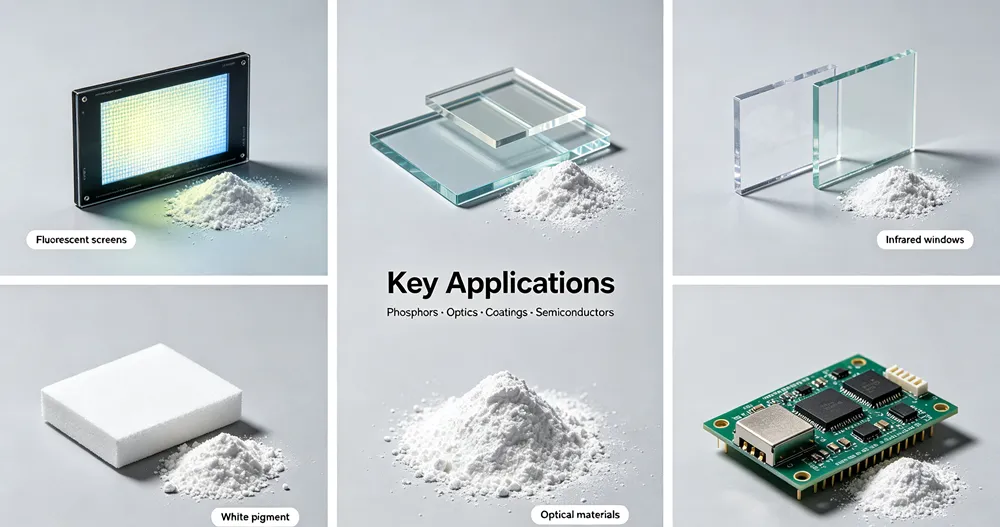
Zinc sulfide is a group ⅱ-ⅵ compound semiconductor material composed of sulfur and zinc. The molecular formula is ZnS, molecular weight is 97.45, melting point is 1020℃(15MPa), white crystal, the lattice constant is 0.547nm, hexagonal crystal, density is 4.08g/cm3. It is hardly soluble in water, but soluble in acid. Under prolonged exposure to humid air, it will turn into zinc sulfate. The bandgap is 3.6eV, which is the widest among group ⅱ-ⅵ compound semiconductor materials. Therefore, it can be used to make blue tubes. Powdered zinc sulfide is the most important field luminescent material, photofluorescence material, used in the preparation of picture tube fluorescent screens, scoreboard displays, etc. It is also infrared optical material in the window material, coating material.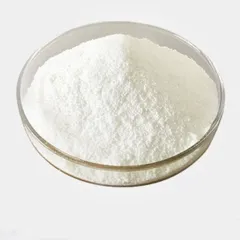
Zinc Sulfide ZnS Powder
Most of the zinc sulfide used for phosphor powder is prepared by the solution method, which is characterized by a large yield and low cost. The needle-like crystals of high purity zinc sulfide synthesized directly from elements in the gas phase are used to prepare high-performance coating materials and single-crystal materials. Zinc sulfide single crystal can be grown by a high-pressure single-crystal furnace and chemical vapor phase transport (CVD). ZNS sheets for optical materials can be prepared by hot-pressing and CVD methods, which are widely used in laser window materials. In recent years, the preparation of zinc sulfide film materials mostly adopts the metal-organic chemical vapor deposition method, because of the low growth temperature, the film integrity is good, fewer defects, easy to prepare heterojunction photoelectronic devices.
Physicochemical Properties of Zinc Sulfide ZnS Powder
Zinc sulfide is a white or yellowish powder. It will turn into a crystal while burning in H2S gas. The α variant is a colorless hexagonal crystal with a density of 3.98g/cm3 and a melting point of 1700℃. The β variant is a colorless cubic crystal with a density of 4.102g/cm3 and transforms into α type at 1020℃. It's found in sphalerite. Insoluble in water, soluble in acid.
The two polymorphs of ZnS differ significantly in their crystal structures and physical properties. The sphalerite structure (β phase) consists of tetrahedrally coordinated zinc and sulfur atoms arranged in a face-centered cubic lattice, analogous to the diamond structure. The wurtzite structure (α phase) is characterized by alternating layers of zinc and sulfur atoms stacked in a hexagonal arrangement, similar to the structure of wurtzite-type group-III nitrides. The sphalerite phase is thermodynamically stable at room temperature, while the wurtzite phase is metastable and can be obtained by heating sphalerite above 1020°C. The phase transition from sphalerite to wurtzite at 1020°C is reversible and involves a reconstructive transformation of the crystal structure. The bandgap of the two phases differs slightly, with the wurtzite phase having a slightly larger bandgap compared to the sphalerite phase. The wurtzite phase also exhibits piezoelectric properties due to its non-centrosymmetric crystal structure, making it attractive for piezoelectric device applications. The ability to control the phase composition during synthesis enables the tailoring of ZnS properties for specific applications, with the sphalerite phase preferred for most optical and luminescent applications and the wurtzite phase preferred for piezoelectric and high-temperature applications. Recent research has focused on the synthesis of ZnS nanostructures with controlled phase composition, including nanorods, nanowires, nanosheets, and quantum dots, which exhibit enhanced properties compared to bulk ZnS due to quantum confinement effects.
Under prolonged exposure to humid air, it converts to zinc sulfate. It is usually produced by the action of hydrogen sulfide with zinc salt solution. If adding trace Cu, Mn, and Ag as activators in crystal ZnS, different color fluorescence can be emitted after illumination. Used as analytical reagents, coatings, paints, white and opaque glass, filling rubber, plastics, and for the preparation of phosphors.
Zinc sulfide is corrosive and poisonous. It can irritate the skin. Operators should wear overalls and protective equipment. The workshop should be well ventilated. 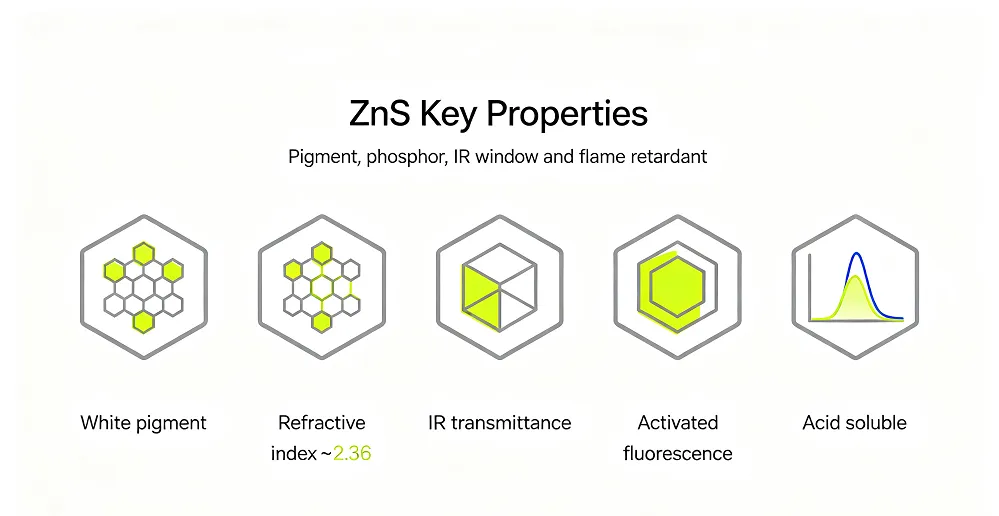
ZnS Key Properties
Characteristics of Zinc Sulfide ZnS Powder
Zinc sulfide can be used as a white pigment. Zinc sulfide pigment has low Mohs hardness, soft texture (soft than titanium dioxide), and little wear on machine metal during processing. This pigment has a distinct reflection in the short-wavelength region of visible light. In other words, zinc sulfide absorbs less light than titanium dioxide in the near-ultraviolet region (less than 400nm), so the color is bluer than titanium dioxide. Especially when used with fluorescent whitening agents it can produce excellent whiteness and brightness of the color. 
The Refractive index is about 2.36, while the refractive index of titanium dioxide is 2.55~2.73. That is to say, the covering power of zinc sulfide is only about 60~65% of titanium dioxide.
In fact, the index of refraction changes with temperature, and in general, the higher the temperature, the higher the index of refraction. For transparent or semi-permeable object colors, the higher the temperature, the less permeable the color.
Flame retardant of zinc sulfide:
ZnS can be used to replace part or all of antimony trioxide.
As a white pigment, it shows a bright hue, about equal to 60% of the whitening power of titanium dioxide. Using ZnS as flame retardant, the amount of titanium dioxide can be saved, and it is not toxic.
Infrared transmittance of zinc sulfide:
Zinc sulfide crystal is an important infrared transmittance material with good optical properties in mid and far-infrared regions.
The transmittance curve of ZnS crystal prepared by chemical vapor deposition is stable in the far-infrared region of 8-12 μm (8000-12000 nm), and the transmittance is above 73%. However, the transmittance begins to decrease in the far-infrared region of 3-5 μm (3000-5000 nm). Especially in the visible region (380~780nm), the transmittance decreases rapidly, and the transmittance deteriorates. After polishing, the crystal can be observed with the naked eye in a misty state, which leads to poor transmittance in the visible region.
Zinc sulfide crystal is used as the window of infrared detector, with a general diameter of 18~30mm and a thickness of 1~3mm. Some processes produce large diameter zinc sulfide window pieces used in large and medium power infrared detectors.
Key Applications
Fluorescence effect of zinc sulfide:
When exposed to light, zinc sulfide emits a faint green fluorescence. If trace amounts of Cu, Mn, and Ag are added to the crystal zinc sulfide as activators, different colors of fluorescence can be emitted.
The fluorescence effect of zinc sulfide is one of its most important and well-known properties. The faint green fluorescence of pure ZnS is due to the intrinsic luminescence of the crystal lattice. The addition of activators such as copper, manganese, and silver creates luminescent centers within the bandgap, enabling the emission of different colors. Copper-activated ZnS produces green emission with a long afterglow, which is ideal for glow-in-the-dark products and electroluminescent panels. Manganese-activated ZnS produces orange-red emission, suitable for warm lighting and display applications. Silver-activated ZnS produces bright blue emission, making it useful for display applications requiring blue light. The long afterglow of copper-doped ZnS makes it particularly suitable for emergency signage, safety markings, and novelty glow-in-the-dark products. The electroluminescent properties of copper-doped ZnS are exploited in electroluminescent panels, which are used as backlights for liquid crystal displays and in flat-panel lighting applications. The development of new activator combinations and synthesis methods has enabled the production of ZnS phosphors with improved brightness, longer persistence, and enhanced stability. Recent research has also explored the use of ZnS quantum dots for biological imaging and sensing applications, where the size-dependent photoluminescence of ZnS provides tunable emission colors for multiplexed imaging and detection.
Preparation Methods of Zinc Sulfide ZnS Powder
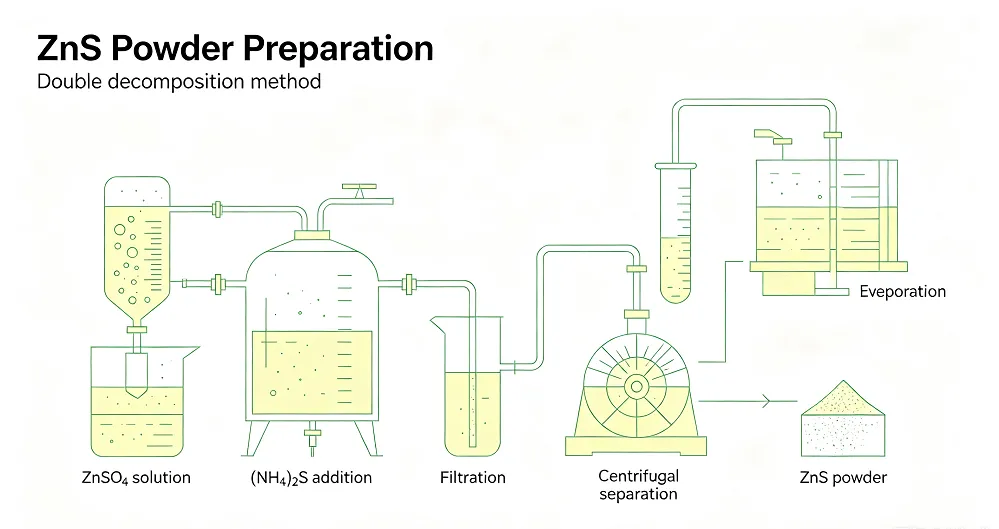
Double decomposition method: Add zinc sulfate solution to the reactor, and slowly add ammonium sulfide for double decomposition reaction under stirring. Zinc sulfide and ammonium sulfate will be generated, then remove ammonium sulfate by filtration, and then by evaporation concentration, cooling crystallization, centrifugal separation, zinc sulfide will be produced
ZnS Powder Preparation
Zinc sulfide is a group ⅱ-ⅵ compound semiconductor material composed of sulfur and zinc. The molecular formula is ZnS, molecular weight is 97.45, melting point is 1020℃(15MPa), white crystal, the lattice constant is 0.547nm, hexagonal crystal, density is 4.08g/cm3. It is hardly soluble in water, but soluble in acid. Under prolonged exposure to humid air, it will turn into zinc sulfate. The bandgap is 3.6eV, which is the widest among group ⅱ-ⅵ compound semiconductor materials. Therefore, it can be used to make blue tubes. Powdered zinc sulfide is the most important field luminescent material, photofluorescence material, used in the preparation of picture tube fluorescent screens, scoreboard displays, etc. It is also infrared optical material in the window material, coating material.
Zinc Sulfide ZnS Powder
Physicochemical Properties of Zinc Sulfide ZnS Powder
Zinc sulfide is a white or yellowish powder. It will turn into a crystal while burning in H2S gas. The α variant is a colorless hexagonal crystal with a density of 3.98g/cm3 and a melting point of 1700℃. The β variant is a colorless cubic crystal with a density of 4.102g/cm3 and transforms into α type at 1020℃. It's found in sphalerite. Insoluble in water, soluble in acid.
The two polymorphs of ZnS differ significantly in their crystal structures and physical properties. The sphalerite structure (β phase) consists of tetrahedrally coordinated zinc and sulfur atoms arranged in a face-centered cubic lattice, analogous to the diamond structure. The wurtzite structure (α phase) is characterized by alternating layers of zinc and sulfur atoms stacked in a hexagonal arrangement, similar to the structure of wurtzite-type group-III nitrides. The sphalerite phase is thermodynamically stable at room temperature, while the wurtzite phase is metastable and can be obtained by heating sphalerite above 1020°C. The phase transition from sphalerite to wurtzite at 1020°C is reversible and involves a reconstructive transformation of the crystal structure. The bandgap of the two phases differs slightly, with the wurtzite phase having a slightly larger bandgap compared to the sphalerite phase. The wurtzite phase also exhibits piezoelectric properties due to its non-centrosymmetric crystal structure, making it attractive for piezoelectric device applications. The ability to control the phase composition during synthesis enables the tailoring of ZnS properties for specific applications, with the sphalerite phase preferred for most optical and luminescent applications and the wurtzite phase preferred for piezoelectric and high-temperature applications. Recent research has focused on the synthesis of ZnS nanostructures with controlled phase composition, including nanorods, nanowires, nanosheets, and quantum dots, which exhibit enhanced properties compared to bulk ZnS due to quantum confinement effects.
Under prolonged exposure to humid air, it converts to zinc sulfate. It is usually produced by the action of hydrogen sulfide with zinc salt solution. If adding trace Cu, Mn, and Ag as activators in crystal ZnS, different color fluorescence can be emitted after illumination. Used as analytical reagents, coatings, paints, white and opaque glass, filling rubber, plastics, and for the preparation of phosphors.
Zinc sulfide is corrosive and poisonous. It can irritate the skin. Operators should wear overalls and protective equipment. The workshop should be well ventilated.
ZnS Key Properties
| Zinc Sulfide ZnS Powder Properties | |
| Other Names | ZnS powder, zinc sulphide |
| CAS No. | 1314-98-3 |
| Compound Formula | ZnS |
| Molecular Weight | 97.45 |
| Appearance | white to off-white powder |
| Melting Point | 1830°C |
| Boiling Point | N/A |
| Density | 4.1g/cm3 |
| Solubility in H2O | insoluble |
| Exact Mass | N/A |
Characteristics of Zinc Sulfide ZnS Powder
Zinc sulfide can be used as a white pigment. Zinc sulfide pigment has low Mohs hardness, soft texture (soft than titanium dioxide), and little wear on machine metal during processing. This pigment has a distinct reflection in the short-wavelength region of visible light. In other words, zinc sulfide absorbs less light than titanium dioxide in the near-ultraviolet region (less than 400nm), so the color is bluer than titanium dioxide. Especially when used with fluorescent whitening agents it can produce excellent whiteness and brightness of the color.

Zinc Sulfide ZnS Powder CAS 1314-98-3
Refractive index of zinc sulfide:The Refractive index is about 2.36, while the refractive index of titanium dioxide is 2.55~2.73. That is to say, the covering power of zinc sulfide is only about 60~65% of titanium dioxide.
In fact, the index of refraction changes with temperature, and in general, the higher the temperature, the higher the index of refraction. For transparent or semi-permeable object colors, the higher the temperature, the less permeable the color.
Flame retardant of zinc sulfide:
ZnS can be used to replace part or all of antimony trioxide.
As a white pigment, it shows a bright hue, about equal to 60% of the whitening power of titanium dioxide. Using ZnS as flame retardant, the amount of titanium dioxide can be saved, and it is not toxic.
Infrared transmittance of zinc sulfide:
Zinc sulfide crystal is an important infrared transmittance material with good optical properties in mid and far-infrared regions.
The transmittance curve of ZnS crystal prepared by chemical vapor deposition is stable in the far-infrared region of 8-12 μm (8000-12000 nm), and the transmittance is above 73%. However, the transmittance begins to decrease in the far-infrared region of 3-5 μm (3000-5000 nm). Especially in the visible region (380~780nm), the transmittance decreases rapidly, and the transmittance deteriorates. After polishing, the crystal can be observed with the naked eye in a misty state, which leads to poor transmittance in the visible region.
Zinc sulfide crystal is used as the window of infrared detector, with a general diameter of 18~30mm and a thickness of 1~3mm. Some processes produce large diameter zinc sulfide window pieces used in large and medium power infrared detectors.
Key Applications
Fluorescence effect of zinc sulfide:
When exposed to light, zinc sulfide emits a faint green fluorescence. If trace amounts of Cu, Mn, and Ag are added to the crystal zinc sulfide as activators, different colors of fluorescence can be emitted.
The fluorescence effect of zinc sulfide is one of its most important and well-known properties. The faint green fluorescence of pure ZnS is due to the intrinsic luminescence of the crystal lattice. The addition of activators such as copper, manganese, and silver creates luminescent centers within the bandgap, enabling the emission of different colors. Copper-activated ZnS produces green emission with a long afterglow, which is ideal for glow-in-the-dark products and electroluminescent panels. Manganese-activated ZnS produces orange-red emission, suitable for warm lighting and display applications. Silver-activated ZnS produces bright blue emission, making it useful for display applications requiring blue light. The long afterglow of copper-doped ZnS makes it particularly suitable for emergency signage, safety markings, and novelty glow-in-the-dark products. The electroluminescent properties of copper-doped ZnS are exploited in electroluminescent panels, which are used as backlights for liquid crystal displays and in flat-panel lighting applications. The development of new activator combinations and synthesis methods has enabled the production of ZnS phosphors with improved brightness, longer persistence, and enhanced stability. Recent research has also explored the use of ZnS quantum dots for biological imaging and sensing applications, where the size-dependent photoluminescence of ZnS provides tunable emission colors for multiplexed imaging and detection.
Preparation Methods of Zinc Sulfide ZnS Powder
Double decomposition method: Add zinc sulfate solution to the reactor, and slowly add ammonium sulfide for double decomposition reaction under stirring. Zinc sulfide and ammonium sulfate will be generated, then remove ammonium sulfate by filtration, and then by evaporation concentration, cooling crystallization, centrifugal separation, zinc sulfide will be produced
ZnSO4+(NH4)2S---ZnS+(NH4)2SO4
ZnS Powder Preparation
FAQs of Zinc Sulfide
1. What is the formula for zinc sulfide?
The chemical formula for zinc sulfide is ZnS.
2. Is zinc sulfide soluble?
No, zinc sulfide is insoluble. It is insoluble in water and alkalis, but soluble in acids.
3. Is zinc sulfide soluble in water?
No, zinc sulfide is insoluble in water.
4. Zinc sulfide is 67.1% zinc by mass. What is the mass fraction of sulfur in zinc sulfide?
The mass fraction of sulfur is 32.9% (since 100% − 67.1% = 32.9%).
5. How could you separate zinc chloride from zinc sulfide?
Use the difference in their solubility in water:
6. Ammonium sulfide and zinc chloride solutions are mixed. What is the balanced chemical reaction?
The balanced chemical equation is:
(NH₄)₂S + ZnCl₂ → ZnS↓ + 2NH₄Cl
This reaction produces an insoluble white precipitate of zinc sulfide.
7. How could you determine whether a white powder was zinc sulfide or sodium carbonate?
You can distinguish them by the following methods:
8. Who discovered that zinc sulfide fluoresces?
Sidot first prepared zinc sulfide with phosphorescent and fluorescent properties in 1886 (known as "Sidot blende").
9. Zinc and sulfur combine to form zinc sulfide (ZnS). In which type of reaction?
This is a combination reaction (also a redox reaction).
The equation is: Zn(s) + S(s) → ZnS(s). Electrons are transferred from zinc atoms to sulfur atoms.
10. What does zinc sulfide produce when heated in the presence of oxygen?
When heated in air (oxygen), zinc sulfide is oxidized and eventually converts to zinc oxide (ZnO), releasing sulfur-containing gases such as sulfur dioxide (SO₂).
11. Does a reaction occur when aqueous solutions of zinc sulfate and sodium sulfide are combined?
Yes, a reaction occurs. It produces a white precipitate of zinc sulfide and sodium sulfate.
The equation is: Na₂S + ZnSO₄ → ZnS↓ + Na₂SO₄.
12. What happens to zinc sulfide when heated in air?
When heated in air, zinc sulfide undergoes oxidation and gradually transforms into zinc oxide (ZnO).
13. Is zinc nitrate and sodium sulfide a precipitation reaction?
Yes, it is. When zinc nitrate and sodium sulfide solutions are mixed, an insoluble white zinc sulfide (ZnS) precipitate forms.
Safe Handling Notes
Main Supplier of Zinc Sulfide ZnS Powder
1. What is the formula for zinc sulfide?
The chemical formula for zinc sulfide is ZnS.
2. Is zinc sulfide soluble?
No, zinc sulfide is insoluble. It is insoluble in water and alkalis, but soluble in acids.
3. Is zinc sulfide soluble in water?
No, zinc sulfide is insoluble in water.
4. Zinc sulfide is 67.1% zinc by mass. What is the mass fraction of sulfur in zinc sulfide?
The mass fraction of sulfur is 32.9% (since 100% − 67.1% = 32.9%).
5. How could you separate zinc chloride from zinc sulfide?
Use the difference in their solubility in water:
- Add water: zinc chloride dissolves, while zinc sulfide does not.
- Filter: separate the insoluble zinc sulfide solid from the solution.
- Evaporate the filtrate: recover zinc chloride crystals by evaporating the water.
6. Ammonium sulfide and zinc chloride solutions are mixed. What is the balanced chemical reaction?
The balanced chemical equation is:
(NH₄)₂S + ZnCl₂ → ZnS↓ + 2NH₄Cl
This reaction produces an insoluble white precipitate of zinc sulfide.
7. How could you determine whether a white powder was zinc sulfide or sodium carbonate?
You can distinguish them by the following methods:
- Reaction with acid: sodium carbonate produces bubbles (CO₂) upon adding acid, while zinc sulfide does not.
- Heating test: heat the sample on charcoal; zinc sulfide forms a yellow coating (hot) that turns white (cold) of zinc oxide.
- Cobalt nitrate test: moisten the heated residue with cobalt nitrate and strongly heat it. A green color indicates the presence of zinc (as in zinc sulfide).
8. Who discovered that zinc sulfide fluoresces?
Sidot first prepared zinc sulfide with phosphorescent and fluorescent properties in 1886 (known as "Sidot blende").
9. Zinc and sulfur combine to form zinc sulfide (ZnS). In which type of reaction?
This is a combination reaction (also a redox reaction).
The equation is: Zn(s) + S(s) → ZnS(s). Electrons are transferred from zinc atoms to sulfur atoms.
10. What does zinc sulfide produce when heated in the presence of oxygen?
When heated in air (oxygen), zinc sulfide is oxidized and eventually converts to zinc oxide (ZnO), releasing sulfur-containing gases such as sulfur dioxide (SO₂).
11. Does a reaction occur when aqueous solutions of zinc sulfate and sodium sulfide are combined?
Yes, a reaction occurs. It produces a white precipitate of zinc sulfide and sodium sulfate.
The equation is: Na₂S + ZnSO₄ → ZnS↓ + Na₂SO₄.
12. What happens to zinc sulfide when heated in air?
When heated in air, zinc sulfide undergoes oxidation and gradually transforms into zinc oxide (ZnO).
13. Is zinc nitrate and sodium sulfide a precipitation reaction?
Yes, it is. When zinc nitrate and sodium sulfide solutions are mixed, an insoluble white zinc sulfide (ZnS) precipitate forms.
Safe Handling Notes
TRUNNANO is a trusted global chemical material supplier & manufacturer with over 12-year-experience in providing super high-quality chemicals and Nanomaterials, including ZnS powder, nitride powder, graphite powder, zinc sulfide, calcium nitride, 3D printing powder, etc.
If you are looking for high-quality zinc sulfide powder, please feel free to contact us and send an inquiry. (sales3@nanotrun.com)
Tags: Zinc Sulfide, ZnS Powder, ZnS Phosphor, Infrared Optical Material, Semiconductor, White Pigment
Tags: Zinc Sulfide, ZnS Powder, ZnS Phosphor, Infrared Optical Material, Semiconductor, White Pigment
Leave a Reply
Your email address will not be published.Required fields are marked. *