
By v | 14 July 2026 | 0 Comments
After 20,000 Cycles: Which Cathode Material Holds the Ultimate Answer for Sodium-Ion Batteries?
Introduction: A Race That Is Being Rewritten
A sodium-ion battery uses sodium ions as charge carriers, operating similarly to lithium-ion batteries. With sodium being approximately 1,000 times more abundant in the Earth's crust than lithium, sodium batteries are regarded as a critical technological direction for alleviating lithium supply constraints, particularly in energy storage. TRUNNANO offers a comprehensive range of Battery Material and Oxide Powder products serving the energy storage industry.
Sodium-ion Battery Technology Overview
But entering 2026, the landscape has completely changed. In 2025, global sodium-ion battery cathode material shipments reached approximately 20,000 tons, up 122.2% year-on-year. Polyanionic cathode materials accounted for approximately 14,000 tons, surging over 360% and capturing approximately 70% of the market. Layered oxides declined to 5,000 tons, down 16.6%. A leading international research team defined sodium-ion batteries as a "next-generation TWh-scale core technology for grid-scale energy storage."
I. The True Value of Sodium Batteries May Have Been Misunderstood
Many people's first impression: low energy density, short lifespan, merely a "backup" for lithium batteries. This perception is influenced by layered oxide-based sodium batteries for power applications—achieving only 2,000–3,000 cycles, far below lithium iron phosphate's 6,000–8,000 cycles.The true competitive advantage lies in what they do well. In long-duration energy storage, sodium-ion batteries have achieved cycle lives approaching 20,000 cycles—reaching cost parity with lithium on a levelized cost of energy basis. 2026 is the "first year of large-scale commercialization." Sodium batteries are expected to account for approximately 50% of the energy storage market in 2026.
Sodium batteries are not about "replacing" lithium, but about "opening new markets lithium cannot economically cover" —long-duration storage, cold-region storage, start-stop power supplies, and data center backup power.
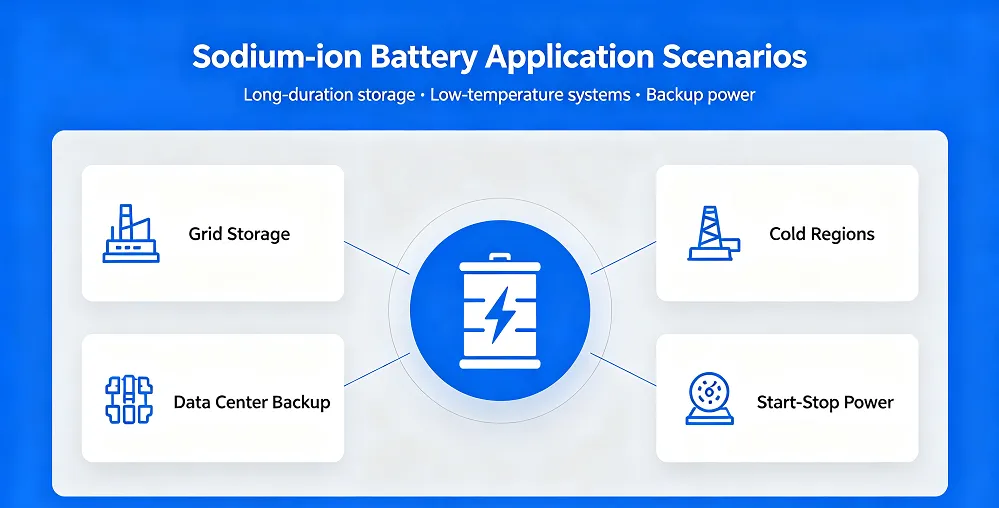
Sodium-ion Battery Application Scenarios
II. Layered Oxides—First-Mover Advantages and Ceilings
Layered oxides were the first route to be industrialized. Their structure resembles lithium-ion ternary cathodes, enabling direct transfer of production processes.Three Major Technical Pain Points
Irreversible multiphase transitions. The crystal structure is like a sandwich—transition metal and sodium layers stacked alternately. Sodium ions repeatedly intercalate and deintercalate, causing phase transitions. Deep desodiation (above 4.2V) triggers structural instability.Poor air stability. Layered oxides are sensitive to moisture and carbon dioxide, degrading upon exposure.
Limited cycle life. Only 2,000–3,000 cycles—far insufficient for energy storage. This is why layered oxide shipments contracted to less than 20% of the market in 2025.
How Is Academia Breaking Through?
High-entropy design introduces multiple elements (typically five or more) into the crystal structure, leveraging "entropy stabilization" to suppress phase transitions. Research indicates this improves energy density, cycling stability, and ion transport kinetics. International teams have also analyzed sodium chromate (NaCrO₂), recognizing its performance advantages.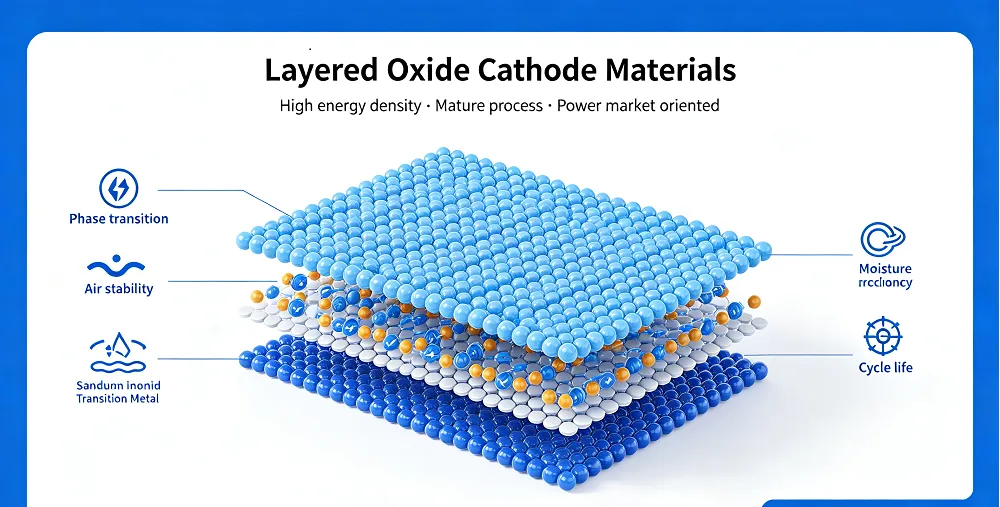
Layered Oxide Cathode Materials
10 Popular Layered Oxide Routes
| No. | Material System | Specific Capacity | Highlight |
| 1 | NaCrO₂ | ~120 mAh/g | International research focus |
| 2 | NaNi₀.₃Mn₀.₆Al₀.₁O₂ | 156 mAh/g | Al doping; enhanced thermal stability |
| 3 | P3-NaLi₀.₂Mn₀.₈O₂ | 210 mAh/g | Li doping; leading capacity |
| 4 | Na₀.₈Mg₀.₂Fe₀.₃Mn₀.₅O₂ | 110 mAh/g | Ni-free, Co-free; low cost |
| 5 | P2-Na₀.₆₇Ni₀.₃₃Mn₀.₆₇O₂ | 160-180 mAh/g | Classic P2; excellent rate |
| 6 | O3-NaFe₀.₅Mn₀.₅O₂ | ~130 mAh/g | Fe-Mn based; low cost |
| 7 | High-entropy doped O3-type | ~160 mAh/g | Breakthroughs in cycling & air stability |
| 8 | High-entropy doped P2-type | 134 mAh/g | Breakthroughs in cycling & air stability |
| 9 | NaNi₁/₃Fe₁/₃Mn₁/₃O₂ | ~140 mAh/g | Most mature industrial route |
| 10 | Na₀.₇MnO₂ | ~150 mAh/g | Mn-only; lowest cost |
TRUNNANO's Expertise
TRUNNANO leverages over 12 years of nano-powder synthesis experience and specialized production lines to improve air stability through precise particle size control. In lithium-doped layered oxides, TRUNNANO achieves far higher than conventional specific capacities. In Ni-free, Co-free materials, TRUNNANO has developed P2/O3 biphasic materials that substitute magnesium for expensive nickel and cobalt.Industry Positioning
Layered oxides' battlefield is the power sector—A00-class vehicles, two-wheelers, start-stop supplies. Large-scale entry into energy storage remains distant.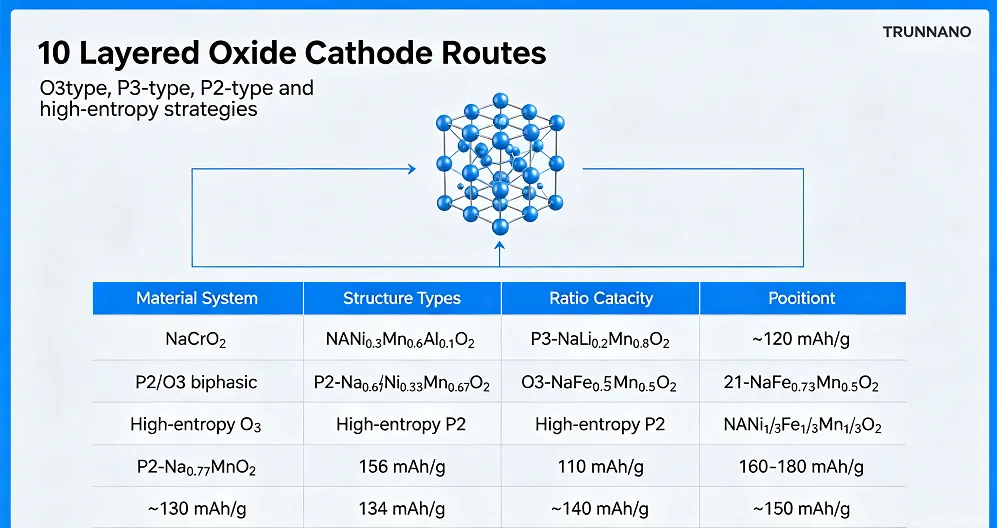
10 Layered Oxide Cathode Routes
III. Polyanionic Compounds—From "Overlooked" to "Industry Leader"
Several years ago, polyanionic compounds were not well-regarded. But in 2025, they shipped approximately 14,000 tons, surging over 360% and capturing approximately 70% of the market.The Technical Secret of "Zero Strain"
Sodium iron phosphate (NFPP) has an exceptionally robust three-dimensional framework. When sodium ions intercalate and deintercalate, the crystal lattice volume change is less than 2%. This "zero-strain" characteristic ensures ultra-long cycling stability. Hard carbon anodes allow sodium ions to intercalate with virtually zero expansion. Sodium dendrites are softer than lithium dendrites and less likely to puncture the separator.Technical Pain Points
Polyanionic materials face several challenges: vanadium-containing systems are affected by vanadium price volatility; some materials undergo lattice distortion; phosphate structures have low electronic conductivity; inactive impurity phases are readily generated.High-entropy doping optimizes ion transport and significantly improves cycling stability.
What the Market Data Tells Us
Why did polyanionic compounds surge from less than 20% to 70%? Because what energy storage needs is exactly what polyanionic materials deliver.Cost. Polyanionic materials use sodium, iron, and phosphorus—abundant, inexpensive elements, unlike expensive nickel in layered oxides. Sodium batteries are projected to achieve cost parity by end of 2026.
Cycle life. Polyanionic materials match lithium iron phosphate, with systems operating for 20 years. Layered oxides at 2,000–3,000 cycles fall far short.
Safety. Polyanionic compounds have higher thermal runaway temperatures due to their stable framework.
Low-temperature performance. Polyanionic materials maintain over 92% capacity at -20°C and discharge stably at -50°C.
In plain language: cheaper, longer-lasting, cold-resistant, and safer. Layered oxides' weaknesses—short cycle life and moisture sensitivity—are critical flaws in energy storage.
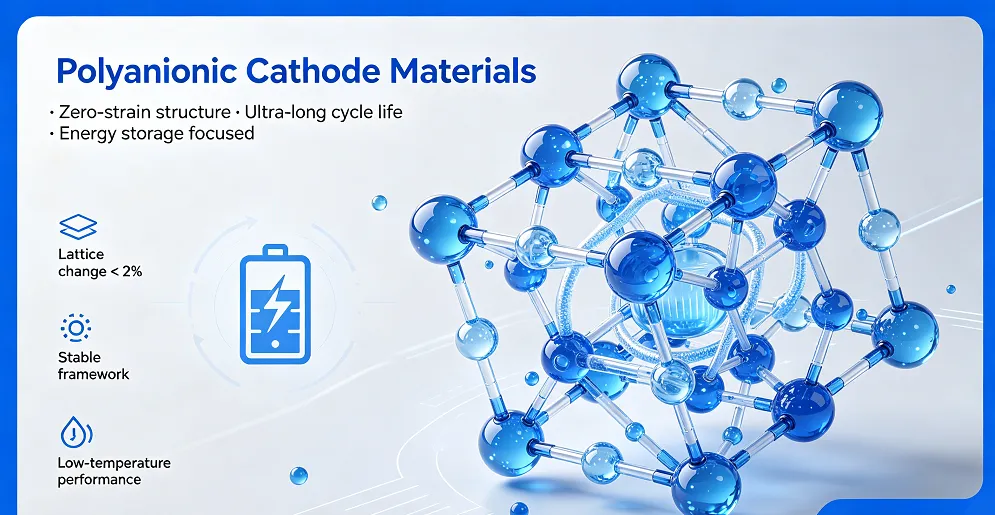
Polyanionic Cathode Materials
IV. Prussian Blue Analogues—Theoretical Champions, Practical Challenges
Prussian blue analogues possess an open framework structure with high ion diffusion coefficients. Theoretical specific capacity reaches 170 mAh/g, and theoretical raw material costs are the lowest. Inexpensive, high capacity, fast charge/discharge.But the reality: Prussian blue analogues continue to be marginalized.
Core Technical Pain Points
Water of crystallization is the core challenge. Aqueous-synthesized Prussian blue typically contains more than 10% water, which occupies storage sites, blocks diffusion channels, and triggers side reactions. The issue is fundamental to the crystal structure.Other issues: low tap density (half that of layered oxides) and cyanide regulation.
International research notes that while Prussian blue offers good stability and safety, its energy density falls short.
How Is Academia Breaking Through?
Non-aqueous synthesis is promising. One method produces low-defect nanoparticles maintaining ~79.6% capacity after 10,000 cycles. Another "deep eutectic chemistry" strategy reduces water content to 4.9wt% with cycle life exceeding 10,000 cycles. But the road from laboratory to large-scale production remains long.TRUNNANO's Positioning
TRUNNANO continues to monitor this route, with over 12 years of expertise in nanomaterial synthesis, enabling rapid entry into precursor supply once the technology matures.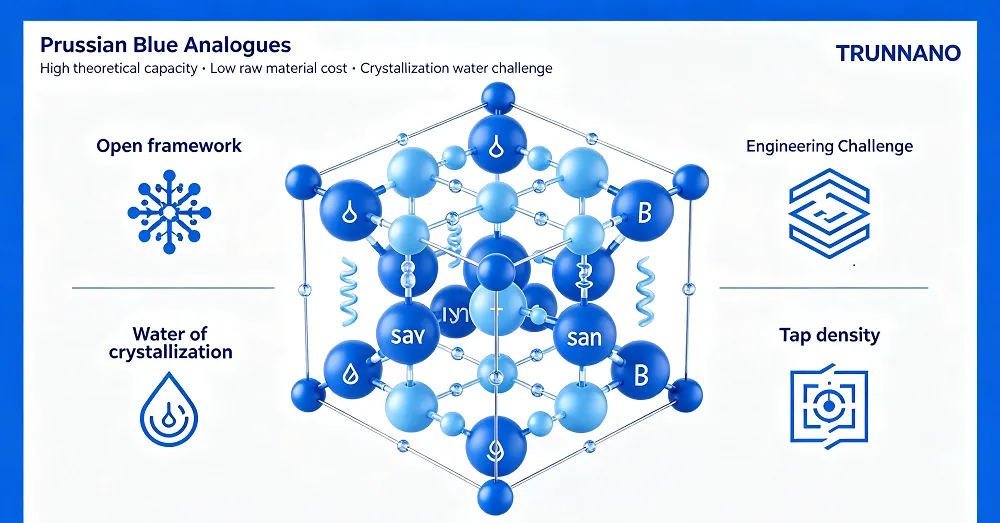
Prussian Blue Analogues
V. Which Is the Future Direction?
Core Comparison
| Dimension | Layered Oxides | Polyanionic | Prussian Blue |
| Energy Density (Wh/kg) | 140-165 | 100-140 | 140-160 |
| Cycle Life (cycles) | 2,000-3,000 | 15,000-20,000 | 1,000-2,000 |
| Low-Temp Performance | Good at -20°C | Good at -40°C | To be verified |
| Cost Trend | Moderate | Declining | Theoretically lowest |
| Core Weakness | Short life, moisture | Lower energy density | Water, low density |
| Primary Battlefield | Power | Energy Storage | Awaiting breakthroughs |
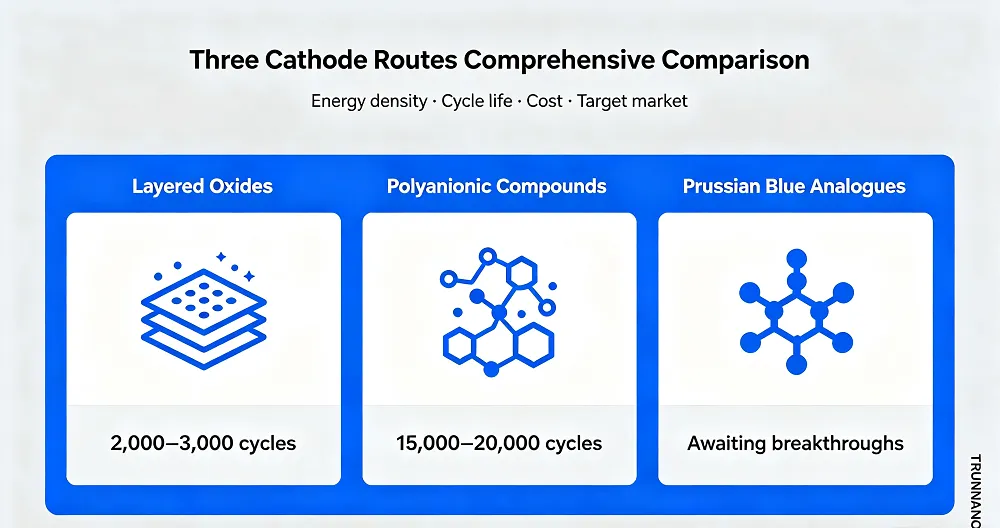
Three Cathode Routes Comprehensive Comparison
Three Levels of Judgment
First, energy storage: polyanionic compounds have already taken the lead. 20,000 cycles, 20-year system life, cost parity—these have already happened. Energy storage is the largest application market.Second, power: layered oxides hold their ground. In A00-class vehicles, two-wheelers, and start-stop supplies, energy density and rate remain critical. But entering energy storage is immensely challenging.
Third, Prussian blue: a "call option." Substantial theoretical advantages, but even greater engineering challenges.
In One Sentence
The future is value competition that matches scenario-specific requirements. In the largest growth segment of energy storage, polyanionic compounds have already become the most certain answer.
TRUNNANO Nanomaterial Solutions
VI. TRUNNANO—Empowering the Sodium-Ion Battery Cathode Industry
TRUNNANO established in 2014 with over 12 years of nano-powder material synthesis experience, operates specialized production lines from raw material processing to finished product inspection with ISO 9001 certification, and has developed multiple products for sodium-ion battery cathodes covering mainstream layered oxide routes—including lithium-doped P3-type materials for high-energy-density applications, Ni-free and Co-free P2/O3 biphasic materials for low-cost applications, and high-entropy products combining energy density with long cycle stability.
Leave a Reply
Your email address will not be published.Required fields are marked. *