
The Complete Guide to High-Purity Chromium Oxide (Cr₂O₃)
High-purity chromium oxide (Cr₂O₃), also known as chromia, is a super versatile inorganic compound that’s become a total must-have in tons of high-tech and industrial fields. Think exceptional chemical stability, impressive hardness, top-notch thermal resistance, and unique optical traits—this green crystalline powder is a total standout, popping up everywhere from advanced ceramics and metallurgy to electronics and environmental protection. This complete guide is here to break down all the key bits about high-purity Cr₂O₃: its basic properties, how it’s made, where it’s used, how we keep its quality in check, safety tips, and what the future holds. It’s a no-nonsense, easy-to-follow reference for industry pros, researchers, or anyone curious about this awesome material.
1. What is High-Purity Chromium Oxide (Cr₂O₃)?
Chromium oxide (Cr₂O₃) does exist naturally (you’ll find it in the mineral eskolaite), but for industrial use, we mostly make it synthetically. So, what counts as “high-purity”? It’s Cr₂O₃ with a purity level of 99.0% or higher—some advanced grades even hit 99.99% (4N) or 99.999% (5N) for super specific high-tech jobs. Unlike regular chromium oxide, which can have impurities like iron, silicon, aluminum, or other heavy metals, high-purity Cr₂O₃ goes through strict purification to get rid of these contaminants. That’s crucial because even tiny bits of impurities can mess up its performance in important applications.
Chemically, Cr₂O₃ is an amphoteric oxide—meaning it can react with both acids and bases—but it’s pretty inert under normal conditions. It has a molecular weight of 151.99 g/mol, a CAS number of 1308-38-9, and an EINECS number of 215-160-9. It looks like a light to deep green hexagonal crystalline powder, and with a Mohs hardness of 8-8.5 (only diamond and corundum are harder!), It’s perfect for things that need to be scratch-resistant and durable. Its high melting point (2266 ± 25℃) and boiling point (4000℃) also make it ideal for high-temperature jobs.
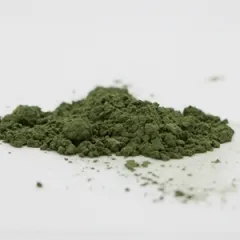
Cr2O3 Powder
2. Key Properties of High-Purity Chromium Oxide
The mix of physical, chemical, and optical properties is what makes high-purity Cr₂O₃ so sought-after across industries. Getting to know these traits helps you pick the right grade and use it to its full potential in different applications.
2.1 Physical Properties
High-purity Cr₂O₃ has some pretty distinct physical features that set it apart from other oxides—let’s break them down simply:
Appearance: It’s a fine, light to deep green powder, either as hexagonal crystals or amorphous (non-crystalline) bits. The particle size is usually 1-100 μm, depending on the grade.
Hardness: With a Mohs hardness of 8-8.5, it’s super resistant to scratching and wear—great for tough jobs.
Thermal Stability: It handles high temperatures like a pro, melting at around 2266℃ and boiling at 4000℃. It stays stable in air up to 1000℃ and won’t break down under normal industrial conditions. - Density: At about 5.21 g/cm³, it’s denser than most common oxides, which adds to its durability and wear resistance. -
Solubility: It’s almost insoluble in water, ethanol, and acetone. It dissolves a little in acids and alkalis, but it mixes easily in heated alkali metal bromate solutions.
2.2 Chemical Properties
High-purity Cr₂O₃ is pretty laid-back chemically, which makes it perfect for applications that need resistance to corrosion and chemical damage. Here’s the lowdown:
Amphoteric Nature: It reacts with strong acids to make chromium salts (like Cr₂O₃ + 3H₂SO₄ = Cr₂(SO₄)₃ + 3H₂O) and with strong bases to make chromites (like Cr₂O₃ + 2NaOH = 2NaCrO₂ + H₂O). Oxidation Resistance: It won’t oxidize in air or oxygen at high temperatures, and it only reacts with fluorine when it’s above 400℃.
Stability: It holds up well against reducing agents, organic compounds, and corrosive gases like sulfur dioxide (SO₂) and hydrogen sulfide (H₂S).
Toxicity: Unlike hexavalent chromium compounds (like CrO₃), which are really toxic and carcinogenic, trivalent chromium oxide (Cr₂O₃) is relatively low-toxic. The main risk is inhaling its dust, which can irritate your respiratory system.

Cr2O3 Powder for Refractory
2.3 Optical Properties
High-purity Cr₂O₃ has some cool optical traits that make it useful in optical and pigment applications—here’s what you need to know:
Color: It’s a vivid green, thanks to the d-d electronic transitions of Cr³⁺ ions. The best part? This color stays put even when exposed to light, heat, or chemicals—making it a top-notch green pigment (Pigment Green 17).
Band Gap: It has a direct band gap of 3.4 eV, which means it soaks up ultraviolet (UV) light but lets infrared (IR) light pass through. That makes it great for optical coatings and UV-blocking products.
Refractive Index: At around 2.5, it helps improve light transmission and reduce reflection in optical lenses and coatings.
3. Synthesis Methods of High-Purity Chromium Oxide
Making high-purity Cr₂O₃ takes precise control over reaction conditions and purification steps to keep impurities to a minimum. There are a few common methods used in industry, each with its own pros, cons, and best uses for different purity grades. The table below breaks them down simply, so you can see which method works for what:
|
Synthesis Method |
Core Principle |
Purity Level Achievable |
Advantages |
Limitations |
Industrial Application |
|
Thermal Decomposition |
Heat chromium salts (like ammonium dichromate or chromium nitrate) to 350-800℃—this breaks them down into Cr₂O₃, water, and byproducts (like nitrogen gas). |
99.0%-99.9% |
Cheap, simple process, great for bulk production, and easy to scale up. |
Might have leftover impurities from the starting materials; needs extra heating/purification to reach high purity. |
Industrial-grade high-purity Cr₂O₃ for ceramics, refractories, and pigments. |
|
Hydrothermal Synthesis |
Dissolve chromium salts (like CrCl₃) in water, seal it in an autoclave, and heat to 200-250℃ for 24-48 hours to make Cr₂O₃ nanoparticles. |
99.5%-99.99% |
Uniform particle size (10-50 nm), barely any clumping, and high purity with few impurities. |
Uses a lot of energy, low output, and not great for large-scale production. |
Nanoscale high-purity Cr₂O₃ for coatings, catalysts, and electronics. |
|
Sol-Gel Process |
Mix chromium alkoxide with ethanol to make a “sol,” then let it turn into a gel, dry it, and heat it to 800℃ to make high-purity Cr₂O₃ thin films or powder. |
99.9%-99.999% |
Ultra-high purity, can make super thin films (<100 nm), and precise control over particle size and shape. |
Complex process, expensive, and only good for small-scale or specialized production. |
High-tech applications (like optical coatings and semiconductor devices). |
|
Reduction of Chromium Trioxide (CrO₃) |
Use carbon or hydrogen to reduce high-purity CrO₃ at 600-800℃, with careful control of oxygen levels to avoid impurities. |
99.0%-99.95% |
High yield, great for making fine powder, and works with existing industrial equipment. |
Needs high-purity CrO₃ to start with, and strict temperature control to keep impurities out. |
Pigments, polishing materials, and magnetic materials. |
Besides these main methods, we also use advanced purification techniques like zone refining and ion exchange to make the purity even higher—especially for the 4N and 5N grades needed in electronics and aerospace. These techniques get rid of tiny impurities (like Fe, Si, Al) down to less than 10 ppm, so the material meets the strictest industry standards.
4. Applications of High-Purity Chromium Oxide
High-purity Cr₂O₃’s unique properties make it a must-have in all kinds of industries—from traditional manufacturing to cutting-edge high-tech. As new technologies pop up, its uses keep growing, thanks to its durability, stability, and versatility.
4.1 Advanced Ceramics
One of the biggest uses for high-purity Cr₂O₃ is in advanced ceramics. It’s a key ingredient that makes ceramics harder, more thermally stable, and more corrosion-resistant. You’ll find it in ceramic parts for high-temperature environments—like furnace linings, crucibles, and thermal barriers. It’s also used to make ceramic cutting tools, which are way more wear-resistant than traditional metal tools—perfect for cutting hard materials like steel and composites. In electronic ceramics, it’s used as a “dopant” to improve the electrical performance of ceramic capacitors, resistors, and sensors, so they work reliably in high-temperature and high-voltage situations.
4.2 Pigments and Coatings
High-purity Cr₂O₃ is a super popular green pigment (Pigment Green 17) because of its bright color, great lightfastness (it doesn’t fade), and chemical stability. Unlike organic green pigments, which fade over time when exposed to light and heat, Cr₂O₃-based pigments keep their color forever—ideal for outdoor uses like automotive coatings, architectural paints, and plastic products. Beyond being a pigment, it’s also used in protective coatings to make metal surfaces more wear and corrosion-resistant. For example, it’s sprayed onto turbine blades, engine parts, and industrial machinery to make them last longer in harsh environments.

Application of Chrome Oxide Green
4.3 Metallurgy and Alloys
In metallurgy, high-purity Cr₂O₃ is used as a refractory material and as an additive in making stainless steel and other alloys. Adding it to steel makes it more corrosion-resistant, harder, and stronger at high temperatures—perfect for marine, chemical, and aerospace applications. It’s also used to make chromium metal through the aluminothermic reduction process: it reacts with aluminum to form chromium and aluminum oxide. High-purity Cr₂O₃ ensures the final chromium metal is free of impurities, which is crucial for electronics and aerospace uses.
4.4 Electronics and Optics
Ultra-high purity (4N-5N) Cr₂O₃ is becoming more and more popular in electronics and optics, thanks to its great optical and electrical properties. In optics, it’s used as a coating for lenses, mirrors, and solar panels—it blocks UV light but lets IR light pass through, making these devices more efficient and durable. In electronics, it’s used as a dielectric material in capacitors and as a semiconductor in sensors and transistors—its high purity ensures reliable electrical performance. Plus, Cr₂O₃ nanoparticles are used in conductive inks and pastes for printed electronics, helping make flexible, lightweight devices possible.
4.5 Catalysts and Environmental Protection
High-purity Cr₂O₃ is a great catalyst for various chemical reactions, especially oxidizing organic compounds and reducing harmful emissions. It’s used in the petrochemical industry to make ethylene and other olefins, and in the automotive industry to reduce nitrogen oxide (NOₓ) emissions in catalytic converters. It’s also used in wastewater treatment to remove heavy metals and organic pollutants—since it can absorb and break down harmful substances, it’s a valuable tool for protecting the environment.
5. Safety and Handling of High-Purity Chromium Oxide
While high-purity Cr₂O₃ is way less toxic than hexavalent chromium compounds, you still need to handle it properly to keep workers safe and protect the environment.
5.1 Health Hazards
The main health risk with Cr₂O₃ is inhaling its dust—it can irritate your respiratory system, make you cough, or cause shortness of breath. Breathing it in over a long time might lead to chronic bronchitis, and animal studies suggest it could be carcinogenic with long-term exposure. Touching it can irritate your skin or cause sensitization dermatitis, and getting it in your eyes might cause mild irritation. Swallowing a lot of it can irritate your stomach and intestines, leading to nausea, vomiting, or diarrhea.
5.2 Safety Precautions
Here are some simple safety tips for handling high-purity Cr₂O₃: - Wear the right personal protective equipment (PPE): safety goggles, a NIOSH-approved dust mask, gloves, and protective clothing to avoid inhaling it or getting it on your skin/eyes. - Handle it in a well-ventilated area or under a fume hood to keep dust levels low. - Don’t mix it with flammable materials, strong reducing agents, or active metal powders—Cr₂O₃ can react with these under certain conditions. - Wash your hands thoroughly after handling, and don’t eat, drink, or smoke in the area where you’re working with it. - Store it in a cool, dry, well-ventilated warehouse, in tightly sealed containers, away from things it might react with and moisture.

Application of Chrome Oxide
5.3 Environmental Considerations
High-purity Cr₂O₃ isn’t highly toxic to the environment, but you still need to dispose of it properly. If you spill it, contain the spill and clean it up with the right methods (like vacuuming with a HEPA filter) to keep dust from spreading. Dispose of waste material according to local, state, and federal rules—don’t dump it into waterways or soil. More and more manufacturers are using closed-loop production systems to cut down on chromium emissions and reduce their environmental impact.
6. Future Prospects of High-Purity Chromium Oxide
Demand for high-purity Cr₂O₃ is expected to grow in the coming years, thanks to the expansion of high-tech industries like electronics, aerospace, and renewable energy. A few trends are shaping its future—let’s take a look:
Advanced Synthesis Technologies: Researchers are working on better, cheaper ways to make ultra-high purity Cr₂O₃ at scale, like microwave-assisted hydrothermal synthesis and plasma-enhanced chemical vapor deposition (PECVD). -
New Applications: New uses are popping up, like in quantum dots, fuel cells, and 3D printing. For example, Cr₂O₃ nanoparticles are being tested in solid oxide fuel cells (SOFCs) to make them more efficient and durable. -
Sustainability: There’s a big focus on making production more sustainable—using renewable energy for synthesis and recycling Cr₂O₃ from waste materials to cut down on environmental impact. - Customization: Manufacturers are offering more customized high-purity Cr₂O₃ products, tailored to specific needs (like particle size, shape, or purity level) to fit different industries.
Supplier
Luoyang Tongrun Nano Technology Co. Ltd. (TRUNNANO) Luoyang City, Henan Province, China, is a reliable and high-quality globa chrome oxide powder supplier and manufacturer. It has more than 12 years of experience providing ultra-high quality chemicals and nanotechnology materials, including Hexagonal boron nitride, nitride powder, Hexagonal boron nitride powder, sulfide powder, and 3D printing powder. If you are looking for high-quality and cost-effective chrome oxide powder, you are welcome to contact us or inquire any time.