
By TRUNNANO | 04 August 2021 | 0 Comments
Iron oxide used as red pigment
About Iron oxide
Iron oxide is an inorganic compound with the chemical formula Fe2O3. It is one of the three main oxides of iron, and the other two are the uncommon ferrous oxide (FeO); and ferroferric oxide (Fe3O4), which also occurs naturally as the mineral magnetite. Iron oxide is also called hematite. It is the main source of iron in steel smelting, and it is easily corroded by acid. Iron oxide is often referred to as rust. In some cases, it is not a problem to say that, because rust has several common properties and similar compositions. For chemists, rust is a poorly defined substance called hydrated iron oxide. Fe2O3 has many crystal types. Among the main α and γ configuration iron oxides, iron has a six-coordinate octahedral structure. The most important reaction is carbothermal reduction, which produces iron for steelmaking:
Fe2O3 + 3 CO → 2 Fe + 3 CO2
Another oxidation-reduction reaction is the thermite reaction with aluminum which is strongly exothermic.
2Al+ Fe 2O 3 → 2Fe+ Al 2O 3 This method is used to weld thick metals, such as the rails of train tracks, and use a ceramic container to leak the hot molten iron droplets between the two rails. Thermite is also used in weapons and making small cast-iron sculptures and tools. Partial reduction with hydrogen at about 400°C produces ferroferric oxide, which is a black magnetic material containing both ferric iron and divalent iron:
3 Fe 2O 3 + H 2 → 2 Fe 3O 4 + H 2O
Iron oxide is insoluble in water but easily soluble in strong acids such as hydrochloric acid and sulfuric acid. It also dissolves well in chelating agent solutions, like oxalic acid.
Other metal oxides or carbonates and iron oxide are heated together to obtain ferrate:
ZnO+ Fe 2O 3 →Zn(Fe 2) 2
What is Iron oxide used for?
1. Iron and steel industry: the main use of iron oxide is as a raw material for the iron and steel industry.
2. Surface polishing: a very fine iron oxide powder is called "jeweler's rouge", "red rouge", or simply rouge. It is used for the final polishing of metal jewelry and lenses and has historically been used as cosmetics. Iron oxide cuts more slowly than some modern polishing agents, such as cerium oxide, but it is still used in the optical manufacturing and jewelry industries because of the excellent finish it can produce. When polishing gold, rouge will slightly contaminate the gold, which will affect the appearance of the finished product. Rouge is sold in the form of powder, paste, polishing cloth or solid stick (with wax or grease binder). Other polishing materials are also often referred to as "rouge," even if they do not contain iron oxide. The jeweler uses ultrasonic cleaning to remove the residual rouge on the jewelry. Products sold as "scraping compounds" are often used for leather shaving to help obtain sharp edges on knives, hair straightening razors, or any other edge tools.
Different colors of iron oxides in different hydrates (α = red, β = yellow).
3. Used as a pigment: Iron oxide is also used as a pigment, and its names are "Iron Oxide Brown 6", "Iron Oxide Brown 7", and "Iron Oxide Brown 101". Some of them, such as Pigment Red 101 and Pigment Brown 6, are approved by the US Food and Drug Administration for use in cosmetics. Iron oxide and titanium dioxide are used together as a pigment for dental composites.
About the preparation method of Iron oxide
There are wet and dry preparation methods. Wet-process products have fine crystals, soft particles, are easy to grind, and are easy to use as pigments. Dry-process products have large crystals and hard particles suitable for magnetic materials, polishing, and abrasive materials.
Method 1: Dry-process
FeSO4+2NaOH→Fe(OH)₂+NaSO4 4Fe(OH)₂+O₂+2H₂O→4Fe(OH)3↓ 4FeSO4+4H₂O+O₂→2Fe₂O₃↓+4H₂SO4 Fe+H₂SO4→FeSO4+H₂↑
Put a certain amount of 5 % Ferrous sulfate solution quickly reacts with excess sodium hydroxide solution (requiring an excess of 0.04~0.08g/ml of alkali), and the air is passed into it at room temperature to make it all become reddish-brown ferric hydroxide colloidal solution as-deposited iron oxide nucleus. With the above crystal nucleus as the carrier, ferrous sulfate as the medium, the air is blown into it, and in the presence of metallic iron at 75-85°C, ferrous sulfate reacts with oxygen in the air to form iron trioxide (ie iron red) and deposits on it. The sulfate radicals in the solution react with metallic iron on the crystal nucleus to regenerate ferrous sulfate, which is then oxidized by air into iron-red and continues to be deposited, thus circulating to the end of the entire process generating red iron oxide.
Burning ferrous compounds or iron hydroxide in the air can produce iron trioxide.
4Fe₃O4+O2=6Fe₂O₃ (condition is high temperature)
Method 2: Wet-process
Nitric acid reacts with iron filings to produce ferrous nitrate. After cooling and crystallizing, dehydrating and drying, grinding and calcining at 600-700°C for 8-10 hours, washing, drying and crushing to obtain iron oxide red product. Iron oxide yellow can also be used as a raw material to obtain iron oxide red after calcination at 600-700°C. 4Fe(NO₃)→2Fe₂O₃+12NO↑+3O₂↑ Fe₂O₃·nH₂O→Fe₂O₃+nH₂O.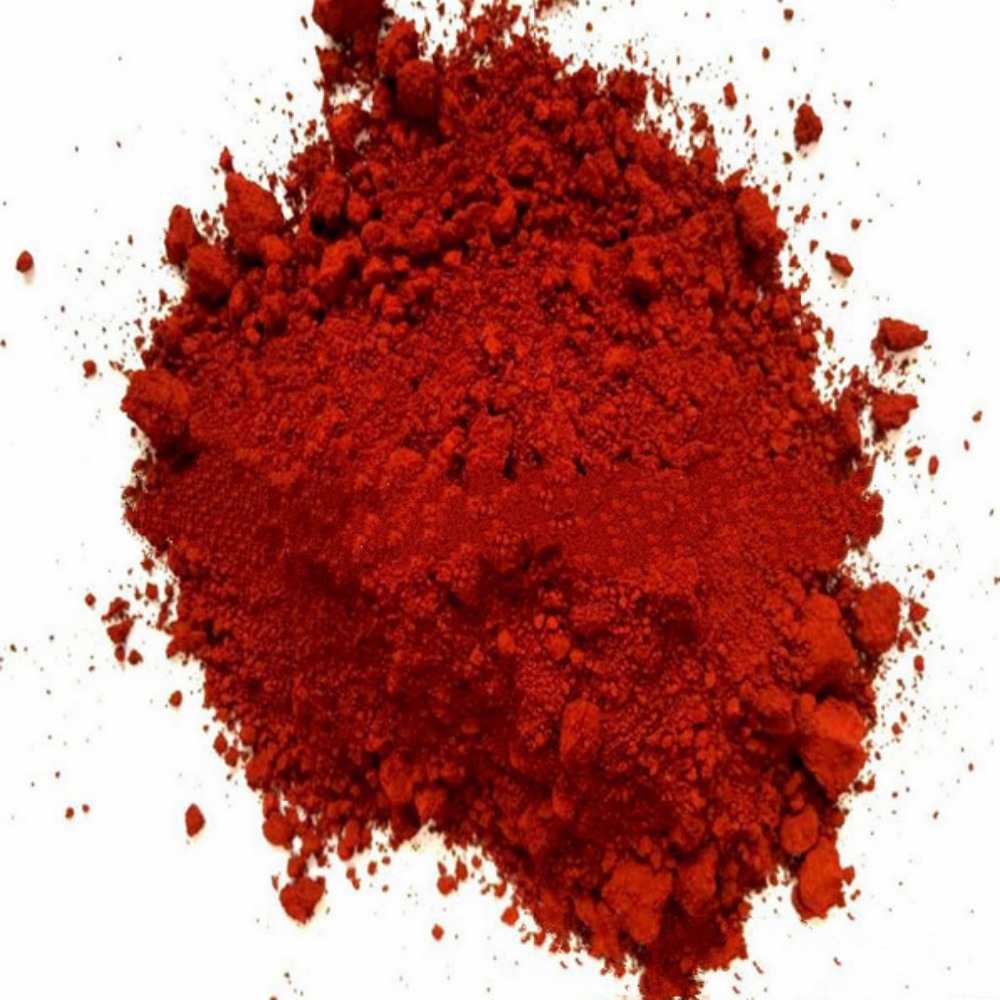 Introduction to related oxides of iron oxide
Iron oxide (Fe₂O₃) is iron trioxide, which is brown-red (red), commonly known as iron red, with a melting point of 1565°C and a relative density of 5.24. It exists in the form of hematite in nature and has amphoteric properties. It reacts with the acid to form Fe(Ⅲ) salt, and reacts with a strong base to form [Fe(OH)6]3-. It has a certain degree of reducibility in a strongly alkaline medium and can be oxidized by a strong oxidant. Iron trioxide is insoluble in water and does not interact with water. It can be produced by burning ferrous sulfate, iron oxalate, and iron oxide. It can also be produced by calcining pyrite in the air. It is commonly used as pigments, polishing agents, catalysts, and red powders. It can be used as a paint pigment. It is a metal oxide and can react with acids. Fe₂O₃ + 6HCl=2FeCl₃+3H₂O.
Ferroferric oxide is a black crystal, which decomposes at the same time when heated to the melting point (1594±5°C). The relative density is 5.18. It has very good magnetism, so it is also called "magnetic iron oxide". It is the main component of naturally produced magnetite, which is easily oxidized to iron trioxide in the air in a humid state. It is insoluble in water, soluble in acid. Commonly known as magnetic iron oxide, it is a complex oxide, of which 1/3 is Fe2+, 2/3 is Fe3+, Fe₃O4 can be regarded as a compound formed by FeO and Fe₂O₃. [The essence is Fe(FeO₂)₂, ferrous ferrite] Modern tests show that it is actually a mixed-valence compound of iron, and its chemical formula should be Fe₂Fe₃[Fe₃O4]. In magnetite, Fe2+ and Fe3+ are basically disorderly arranged at the octahedral position, and electrons can be rapidly transferred between the two oxidation states of iron, so the ferroferric oxide solid has excellent electrical conductivity. Ferroferric oxide can be obtained by heating iron in steam or reducing the ferric oxide with hydrogen at 400°C. Ferric oxide is used as a pigment and polishing agent. Magnetic iron oxide can be used in the manufacture of recording, videotape, and telecommunications equipment.
Iron oxide supplier
TRUNNANO (aka. Luoyang Tongrun Nano Technology Co. Ltd.) is a trusted global chemical material supplier & manufacturer with over 12 years of experience in providing super high-quality chemicals and Nanomaterials. Currently, our company has successfully developed a series of materials. The Iron oxide produced by our company has high purity, fine particle size, and impurity content. For the latest price of Iron oxide, send us an email or click on the needed products to send an inquiry.
Iron oxide is an inorganic compound with the chemical formula Fe2O3. It is one of the three main oxides of iron, and the other two are the uncommon ferrous oxide (FeO); and ferroferric oxide (Fe3O4), which also occurs naturally as the mineral magnetite. Iron oxide is also called hematite. It is the main source of iron in steel smelting, and it is easily corroded by acid. Iron oxide is often referred to as rust. In some cases, it is not a problem to say that, because rust has several common properties and similar compositions. For chemists, rust is a poorly defined substance called hydrated iron oxide. Fe2O3 has many crystal types. Among the main α and γ configuration iron oxides, iron has a six-coordinate octahedral structure. The most important reaction is carbothermal reduction, which produces iron for steelmaking:
Fe2O3 + 3 CO → 2 Fe + 3 CO2
Another oxidation-reduction reaction is the thermite reaction with aluminum which is strongly exothermic.
2Al+ Fe 2O 3 → 2Fe+ Al 2O 3 This method is used to weld thick metals, such as the rails of train tracks, and use a ceramic container to leak the hot molten iron droplets between the two rails. Thermite is also used in weapons and making small cast-iron sculptures and tools. Partial reduction with hydrogen at about 400°C produces ferroferric oxide, which is a black magnetic material containing both ferric iron and divalent iron:
3 Fe 2O 3 + H 2 → 2 Fe 3O 4 + H 2O
Iron oxide is insoluble in water but easily soluble in strong acids such as hydrochloric acid and sulfuric acid. It also dissolves well in chelating agent solutions, like oxalic acid.
Other metal oxides or carbonates and iron oxide are heated together to obtain ferrate:
ZnO+ Fe 2O 3 →Zn(Fe 2) 2
What is Iron oxide used for?
1. Iron and steel industry: the main use of iron oxide is as a raw material for the iron and steel industry.
2. Surface polishing: a very fine iron oxide powder is called "jeweler's rouge", "red rouge", or simply rouge. It is used for the final polishing of metal jewelry and lenses and has historically been used as cosmetics. Iron oxide cuts more slowly than some modern polishing agents, such as cerium oxide, but it is still used in the optical manufacturing and jewelry industries because of the excellent finish it can produce. When polishing gold, rouge will slightly contaminate the gold, which will affect the appearance of the finished product. Rouge is sold in the form of powder, paste, polishing cloth or solid stick (with wax or grease binder). Other polishing materials are also often referred to as "rouge," even if they do not contain iron oxide. The jeweler uses ultrasonic cleaning to remove the residual rouge on the jewelry. Products sold as "scraping compounds" are often used for leather shaving to help obtain sharp edges on knives, hair straightening razors, or any other edge tools.
Different colors of iron oxides in different hydrates (α = red, β = yellow).
3. Used as a pigment: Iron oxide is also used as a pigment, and its names are "Iron Oxide Brown 6", "Iron Oxide Brown 7", and "Iron Oxide Brown 101". Some of them, such as Pigment Red 101 and Pigment Brown 6, are approved by the US Food and Drug Administration for use in cosmetics. Iron oxide and titanium dioxide are used together as a pigment for dental composites.
About the preparation method of Iron oxide
There are wet and dry preparation methods. Wet-process products have fine crystals, soft particles, are easy to grind, and are easy to use as pigments. Dry-process products have large crystals and hard particles suitable for magnetic materials, polishing, and abrasive materials.
Method 1: Dry-process
FeSO4+2NaOH→Fe(OH)₂+NaSO4 4Fe(OH)₂+O₂+2H₂O→4Fe(OH)3↓ 4FeSO4+4H₂O+O₂→2Fe₂O₃↓+4H₂SO4 Fe+H₂SO4→FeSO4+H₂↑
Put a certain amount of 5 % Ferrous sulfate solution quickly reacts with excess sodium hydroxide solution (requiring an excess of 0.04~0.08g/ml of alkali), and the air is passed into it at room temperature to make it all become reddish-brown ferric hydroxide colloidal solution as-deposited iron oxide nucleus. With the above crystal nucleus as the carrier, ferrous sulfate as the medium, the air is blown into it, and in the presence of metallic iron at 75-85°C, ferrous sulfate reacts with oxygen in the air to form iron trioxide (ie iron red) and deposits on it. The sulfate radicals in the solution react with metallic iron on the crystal nucleus to regenerate ferrous sulfate, which is then oxidized by air into iron-red and continues to be deposited, thus circulating to the end of the entire process generating red iron oxide.
Burning ferrous compounds or iron hydroxide in the air can produce iron trioxide.
4Fe₃O4+O2=6Fe₂O₃ (condition is high temperature)
Method 2: Wet-process
Nitric acid reacts with iron filings to produce ferrous nitrate. After cooling and crystallizing, dehydrating and drying, grinding and calcining at 600-700°C for 8-10 hours, washing, drying and crushing to obtain iron oxide red product. Iron oxide yellow can also be used as a raw material to obtain iron oxide red after calcination at 600-700°C. 4Fe(NO₃)→2Fe₂O₃+12NO↑+3O₂↑ Fe₂O₃·nH₂O→Fe₂O₃+nH₂O.
Iron oxide (Fe₂O₃) is iron trioxide, which is brown-red (red), commonly known as iron red, with a melting point of 1565°C and a relative density of 5.24. It exists in the form of hematite in nature and has amphoteric properties. It reacts with the acid to form Fe(Ⅲ) salt, and reacts with a strong base to form [Fe(OH)6]3-. It has a certain degree of reducibility in a strongly alkaline medium and can be oxidized by a strong oxidant. Iron trioxide is insoluble in water and does not interact with water. It can be produced by burning ferrous sulfate, iron oxalate, and iron oxide. It can also be produced by calcining pyrite in the air. It is commonly used as pigments, polishing agents, catalysts, and red powders. It can be used as a paint pigment. It is a metal oxide and can react with acids. Fe₂O₃ + 6HCl=2FeCl₃+3H₂O.
Ferroferric oxide is a black crystal, which decomposes at the same time when heated to the melting point (1594±5°C). The relative density is 5.18. It has very good magnetism, so it is also called "magnetic iron oxide". It is the main component of naturally produced magnetite, which is easily oxidized to iron trioxide in the air in a humid state. It is insoluble in water, soluble in acid. Commonly known as magnetic iron oxide, it is a complex oxide, of which 1/3 is Fe2+, 2/3 is Fe3+, Fe₃O4 can be regarded as a compound formed by FeO and Fe₂O₃. [The essence is Fe(FeO₂)₂, ferrous ferrite] Modern tests show that it is actually a mixed-valence compound of iron, and its chemical formula should be Fe₂Fe₃[Fe₃O4]. In magnetite, Fe2+ and Fe3+ are basically disorderly arranged at the octahedral position, and electrons can be rapidly transferred between the two oxidation states of iron, so the ferroferric oxide solid has excellent electrical conductivity. Ferroferric oxide can be obtained by heating iron in steam or reducing the ferric oxide with hydrogen at 400°C. Ferric oxide is used as a pigment and polishing agent. Magnetic iron oxide can be used in the manufacture of recording, videotape, and telecommunications equipment.
Iron oxide supplier
TRUNNANO (aka. Luoyang Tongrun Nano Technology Co. Ltd.) is a trusted global chemical material supplier & manufacturer with over 12 years of experience in providing super high-quality chemicals and Nanomaterials. Currently, our company has successfully developed a series of materials. The Iron oxide produced by our company has high purity, fine particle size, and impurity content. For the latest price of Iron oxide, send us an email or click on the needed products to send an inquiry.
Leave a Reply
Your email address will not be published.Required fields are marked. *