
Comparative Analysis of Aluminum Nitride (AlN) and Silicon Nitride (Si₃N₄)
In the field of advanced ceramic materials, Aluminum Nitride (AlN) and Silicon Nitride (Si₃N₄) are two pivotal compounds that have gained widespread attention across various high-tech industries. As a market promoter in a foreign trade company, understanding the intrinsic differences, advantages, and application scenarios of these two materials is crucial for guiding clients in making informed purchasing decisions, expanding market share, and gaining a competitive edge in the global market. This article conducts a comprehensive comparative analysis of AlN and Si₃N₄ from the perspectives of chemical composition, physical and chemical properties, preparation processes, application fields, market dynamics, and cost, aiming to provide a systematic reference for industry practitioners, procurement personnel, and technical researchers. With the rapid development of semiconductor, aerospace, new energy, and other industries, the demand for high-performance ceramic materials is constantly rising. AlN, with its excellent thermal conductivity and electrical insulation, and Si₃N₄, with its superior mechanical strength and high-temperature stability, have become the core materials supporting the upgrading of these industries. However, due to their distinct characteristics, they apply to different scenarios, and a clear understanding of their differences is the key to optimizing material selection and maximizing application value.
1. Overview of Aluminum Nitride (AlN) and Silicon Nitride (Si₃N₄)
1.1 Aluminum Nitride (AlN)
Aluminum Nitride (AlN) is a binary compound composed of aluminum (Al) and nitrogen (N), with a chemical formula of AlN. It is a covalent bond compound with a wurtzite crystal structure under atmospheric pressure, which endows it with unique physical and chemical properties. AlN was first synthesized in the early 20th century, but its large-scale industrial application did not start until the 1980s, driven by the rapid development of the semiconductor industry. As a new type of advanced ceramic material, AlN has the advantages of high thermal conductivity, excellent electrical insulation, good chemical stability, and a matching thermal expansion coefficient with semiconductor materials, making it an indispensable core material in the fields of semiconductor packaging, electronic devices, and high-power equipment.
According to the latest market data, the global AlN market size reached 6.22 billion US dollars in 2024, and it is expected to climb to 9.53 billion US dollars by 2031, with a compound annual growth rate (CAGR) of 6.2%. This growth is mainly driven by the acceleration of the global semiconductor industry towards advanced processes (3nm and below), the continuous increase in the penetration rate of third-generation semiconductor materials (GaN/SiC), and the surge in demand for high-temperature thermal management solutions in electric vehicle power modules.

Aluminum Nitride Ceramic
1.2 Silicon Nitride (Si₃N₄)
Silicon Nitride (Si₃N₄) is a binary compound composed of silicon (Si) and nitrogen (N), with a chemical formula of Si₃N₄. It is the most thermodynamically stable and commercially important type of silicon nitride, with a complex crystal structure that exists in three main polymorphs: α-Si₃N₄, β-Si₃N₄, and γ-Si₃N₄. Among them, α-Si₃N₄ and β-Si₃N₄ are the most common and widely used forms. Si₃N₄ was first prepared in 1857, but its industrial application was limited due to the backwardness of preparation technology. It was not until the mid-20th century, with the breakthrough of sintering technology, that Si₃N₄ began to be widely used in aerospace, automotive, mechanical engineering, and other fields.
Si₃N₄ is a gray, odorless powder with a density of 3.17 g/cm³ and a melting point of 1900°C (decomposes). It is extremely hard (8.5 on the Mohs scale) and has high thermal stability, making it suitable for high-temperature and high-wear environments. In recent years, with the upgrading of the new energy and aerospace industries, the demand for Si₃N₄ has shown a steady growth trend, especially in the field of high-power electronic devices and extreme environment components.

Silicon Nitride Ceramic
2. Comparative Analysis of Physical and Chemical Properties
The physical and chemical properties of AlN and Si₃N₄ are the core factors determining their application fields. Although both are advanced ceramic materials with high stability, there are significant differences in thermal conductivity, mechanical strength, electrical properties, and chemical stability, which directly affect their selection in different scenarios. The following is a detailed comparison of their key properties:
2.1 Thermal Properties
Thermal properties are one of the most important performance indicators of AlN and Si₃N₄, especially in the field of electronic packaging and high-temperature equipment, where thermal conductivity and thermal stability directly determine the service life and performance of the equipment.
AlN has excellent thermal conductivity, which is its most prominent advantage. The thermal conductivity of high-purity AlN can reach 170-230 W/(m·K), and some high-performance products developed through technological breakthroughs can even reach 260 W/(m·K) or higher. For example, the gradient structure AlN ceramics developed by NGK Insulator can achieve a thermal conductivity of 260 W/(m·K) by controlling grain orientation, and have been applied to TSMC's 3nm production line in 2024. The thermal conductivity of AlN is 5-8 times that of alumina (Al₂O₃), and about 100 times that of silicon dioxide (SiO₂), which can effectively solve the heat dissipation problem of high-power electronic devices. In addition, AlN has good high-temperature stability and can maintain chemical inertness at 1600°C, making it suitable for high-temperature processes such as chemical vapor deposition (CVD) and atomic layer deposition (ALD).
Compared with AlN, the thermal conductivity of Si₃N₄ is relatively lower, generally ranging from 80-110 W/(m·K). For example, the thermally conductive Si₃N₄ substrate developed by Fulhua has a thermal conductivity of 110 W/(m·K), which achieves a combination of high thermal conductivity and bending resistance. However, Si₃N₄ has better high-temperature stability than AlN. It can be used for a long time at 1200°C, and its mechanical properties will not be significantly reduced even at higher temperatures. This makes Si₃N₄ more suitable for high-temperature environments such as aerospace engines and high-temperature furnaces.
In terms of thermal expansion coefficient (CTE), AlN has a thermal expansion coefficient of about 4.5×10⁻⁶/°C, which is very close to that of silicon (Si, 3.5×10⁻⁶/°C) and gallium arsenide (GaAs, 6.0×10⁻⁶/°C), making it an ideal packaging material for semiconductor chips, which can effectively reduce thermal stress caused by thermal expansion mismatch and improve the reliability of electronic devices. The thermal expansion coefficient of Si₃N₄ is lower, about 3.2×10⁻⁶/°C, which is closer to that of third-generation semiconductor materials such as silicon carbide (SiC, 4.0×10⁻⁶/°C). This excellent thermal matching performance can significantly reduce the interface failure probability caused by thermal stress in high-voltage and high-temperature environments, such as in 800V electric vehicle motor controllers, where the interface failure probability can be reduced by 90%.
2.2 Mechanical Properties
Mechanical properties, including hardness, bending strength, fracture toughness, and wear resistance, are crucial for materials used in mechanical engineering, aerospace, and other fields that bear mechanical loads.
AlN has good mechanical properties, with a bending strength of about 300-450 MPa and a Mohs hardness of 9, which is higher than that of most metals and ordinary ceramics. It has good wear resistance and can resist the erosion of general mechanical friction. However, the fracture toughness of AlN is relatively low, about 2-3 MPa·m¹/², which makes it brittle and easy to fracture under impact load. This limits its application in scenarios that require high impact resistance.
Si₃N₄ is known for its excellent mechanical properties, which are its most prominent advantage over AlN. The bending strength of Si₃N₄ can reach more than 800 MPa, which is twice that of AlN, and some high-performance Si₃N₄ materials can even reach 1000 MPa or higher. The fracture toughness of Si₃N₄ is also much higher than that of AlN, about 4-7 MPa·m¹/², which makes it have good toughness and impact resistance, and is not easy to fracture under external impact. In addition, Si₃N₄ has excellent wear resistance and self-lubricating properties, with a friction coefficient of only 0.1-0.2, which is lower than that of AlN (0.3-0.4). This makes Si₃N₄ widely used in mechanical parts such as bearings, gears, and cutting tools. For example, in the severe vibration environment of high-speed rail traction converters, the fracture risk of Si₃N₄ substrates can be reduced by 70%.
2.3 Electrical Properties
Electrical properties are particularly important for materials used in the electronic and electrical fields, including electrical insulation, dielectric constant, and dielectric loss.
AlN has excellent electrical insulation performance, with a volume resistivity of more than 10¹⁴ Ω·cm, which can avoid the electromigration effect during wafer manufacturing, especially suitable for the production of high-voltage power devices. Its dielectric constant is about 8-10 (at 1 MHz), and the dielectric loss is very low (less than 0.001), which makes AlN suitable for high-frequency electronic devices, such as 5G base station power amplifiers and microwave components. The dielectric loss of AlN is less than 0.0005 at 10 GHz, which is very suitable for high-frequency applications, and can reduce signal loss and improve device reliability.
Si₃N₄ also has good electrical insulation performance, with a volume resistivity of more than 10¹³ Ω·cm, which can meet the insulation requirements of most electronic devices. Its dielectric constant is about 7-8 (at 1 MHz), which is slightly lower than that of AlN, and the dielectric loss is also very low (less than 0.002). However, the electrical insulation performance of Si₃N₄ is slightly inferior to that of AlN, especially in high-frequency and high-voltage environments. Therefore, in the field of high-precision electronic packaging that requires extremely high electrical insulation, AlN is more advantageous. The low dielectric constant (εr=7.5) of Si₃N₄ can reduce signal delay, which is conducive to realizing 3C fast charging in new energy vehicle on-board chargers (OBC).
2.4 Chemical Stability
Both AlN and Si₃N₄ have good chemical stability, which can resist the corrosion of most acids, alkalis, and organic solvents, and are not easy to react with other substances under normal temperature and pressure.
AlN is stable in air at room temperature, but will slowly oxidize at high temperatures (above 800°C) to form Al₂O₃. It is insoluble in water and most organic solvents, but will react with strong acids (such as concentrated sulfuric acid and concentrated hydrochloric acid) and strong alkalis (such as sodium hydroxide) at high temperatures, resulting in damage to its structure. The powder form of AlN is prone to hydrolysis in water, while the monocrystalline form is insoluble in water. In addition, AlN has good compatibility with metals such as copper, aluminum, and gold, and can form a good bond with them, which is conducive to the preparation of metal-ceramic composite materials.
Si₃N₄ has better chemical stability than AlN. It is stable in air at high temperatures (up to 1400°C) and will not oxidize easily. It is insoluble in water, strong acids, and most organic solvents, and only reacts with hydrofluoric acid (HF) and hot phosphoric acid (H₃PO₄). This makes Si₃N₄ suitable for harsh chemical environments, such as chemical reactors, corrosion-resistant pipelines, and other equipment. In addition, Si₃N₄ has good compatibility with various metals and ceramics, and can be used to prepare composite materials with excellent performance.
3. Comparative Analysis of Preparation Processes
The preparation process of AlN and Si₃N₄ directly affects their performance, cost, and industrialization level. Due to the differences in their chemical composition and crystal structure, their preparation processes are also quite different. The following is a detailed introduction and comparison of their main preparation processes:
3.1 Preparation Process of AlN
The preparation process of AlN mainly includes powder synthesis and sintering. The quality of AlN powder (purity, particle size, particle size distribution) directly determines the performance of the final product. The main methods for synthesizing AlN powder are as follows:
1. Direct Nitridation Method: This is the most common and mature method for synthesizing AlN powder. It involves heating aluminum powder to 1000-1400°C in a nitrogen or ammonia atmosphere, and the aluminum powder reacts with nitrogen to form AlN powder. The reaction formula is: 2Al + N₂ → 2AlN. This method has the advantages of a simple process, low cost, and high production efficiency, but the purity of the prepared AlN powder is relatively low (usually 95-98%), and the particle size is uneven, which needs further purification and modification.
2. Carbothermal Reduction Nitridation Method: This method uses alumina (Al₂O₃) and carbon (C) as raw materials, and heats them to 1600-1800°C in a nitrogen atmosphere. The alumina and carbon react with nitrogen to form AlN powder and carbon monoxide (CO). The reaction formula is: Al₂O₃ + 3C + N₂ → 2AlN + 3CO. This method can prepare high-purity AlN powder (purity above 99%), but the process is complex, the reaction temperature is high, and the production cost is relatively high.
3. Vapor Phase Deposition Method: This method includes chemical vapor deposition (CVD) and physical vapor deposition (PVD). It uses aluminum-containing compounds (such as AlCl₃, Al(CH₃)₃) and nitrogen-containing compounds (such as NH₃, N₂) as raw materials, and forms AlN films or powders on the substrate through chemical reactions or physical processes at high temperatures. This method can prepare high-purity, ultra-fine AlN powder or thin films, but the production efficiency is low, the cost is high, and it is mainly used for the preparation of high-precision electronic devices.
After the synthesis of AlN powder, it needs to be sintered to form dense ceramic materials. The main sintering methods of AlN include pressureless sintering, hot pressing sintering, and spark plasma sintering. Among them, hot pressing sintering is the most commonly used method, which can prepare dense AlN ceramics with high density (above 98%) and excellent performance by applying pressure (10-50 MPa) and temperature (1700-1900°C) simultaneously. However, the production efficiency of hot pressing sintering is low, and it is not suitable for large-scale production. In recent years, with the development of sintering technology, pressureless sintering and spark plasma sintering have gradually become mainstream, which can improve production efficiency and reduce costs.
The main challenge in the preparation of AlN is the difficulty in sintering. Due to its covalent bond structure, it is difficult to densify, and it is necessary to add Y₂O₃ and other additives and sinter at a high temperature above 1800°C. In addition, the purity requirement of AlN is very strict. For every 0.1% increase in oxygen impurities, the thermal conductivity decreases by 5%, so process control is crucial.
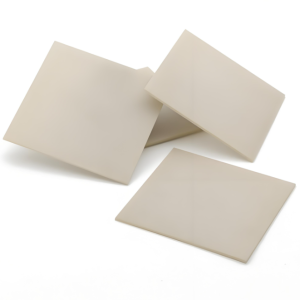
AlN
3.2 Preparation Process of Si₃N₄
The preparation process of Si₃N₄ is more complex than that of AlN, mainly including powder synthesis, shaping, and sintering. The main methods for synthesizing Si₃N₄ powder are as follows:
1. Direct Nitridation Method: This is the earliest method for synthesizing Si₃N₄ powder. It involves heating silicon powder to 1300-1400°C in a nitrogen atmosphere, and the silicon powder reacts with nitrogen to form Si₃N₄ powder. The reaction formula is: 3Si + 2N₂ → Si₃N₄. The weight of the silicon sample increases gradually due to the chemical combination of silicon and nitrogen. Without an iron catalyst, the reaction is complete after about 7 hours, when no further weight increase due to nitrogen absorption (per gram of silicon) is detected. This method has the advantages of a simple process and low cost, but the purity of the prepared Si₃N₄ powder is low, and the particle size is uneven.
2. Carbothermal Reduction Nitridation Method: This method uses silica (SiO₂) and carbon (C) as raw materials, and heats them to 1400-1600°C in a nitrogen atmosphere. The silica and carbon react with nitrogen to form Si₃N₄ powder and carbon monoxide (CO). The reaction formula is: 3SiO₂ + 6C + 2N₂ → Si₃N₄ + 6CO. This method can prepare high-purity Si₃N₄ powder (purity above 99%), and the particle size is uniform, but the process is complex, the reaction temperature is high, and the production cost is high.
3. Vapor Phase Deposition Method: Similar to AlN, the vapor phase deposition method of Si₃N₄ also includes CVD and PVD. It uses silicon-containing compounds (such as SiCl₄, SiH₄) and nitrogen-containing compounds (such as NH₃, N₂) as raw materials, and forms Si₃N₄ films or powders on the substrate through chemical reactions or physical processes. This method can prepare high-precision Si₃N₄ thin films, which are widely used in the field of semiconductor devices.
The shaping process of Si₃N₄ powder mainly includes dry pressing, isostatic pressing, and injection molding. Among them, isostatic pressing can make the green body have uniform density, which is conducive to improving the performance of the sintered product. The sintering method of Si₃N₄ mainly includes hot pressing sintering, pressureless sintering, and gas pressure sintering. Gas pressure sintering is the most commonly used method for Si₃N₄, which sinters the green body at 1700-1900°C under high nitrogen pressure (0.5-10 MPa), so that the Si₃N₄ powder can be fully densified. This method can prepare dense Si₃N₄ ceramics with high performance, and is suitable for large-scale production.
Compared with AlN, the preparation process of Si₃N₄ is more complex, the reaction conditions are harsher, and the production cost is higher. However, with the continuous progress of sintering technology, the production efficiency of Si₃N₄ is gradually improved, and the cost is gradually reduced, which promotes its wide application in various fields.
| Key Indicators | Aluminum Nitride (AlN) | Silicon Nitride (Si₃N₄) |
|---|---|---|
| Core Advantages | Excellent thermal conductivity & electrical insulation | Superior mechanical strength & high-temperature stability |
| Main Applications | Semiconductors, 5G devices, high-power equipment | Aerospace, new energy vehicles, and mechanical parts |
| Key Features | Low cost, good thermal expansion matching with semiconductors | Good chemical corrosion resistance, high fracture toughness |
For AlN, the future development focus will be on improving the purity and thermal conductivity of the material, optimizing the preparation process, reducing the cost, and expanding the application fields in advanced packaging, 5G communication, and other fields. Material innovation is an important direction. The aluminum nitride-silicon carbide (AlN-SiC) composite material can increase the thermal conductivity to 300 W/(m·K), and its market penetration rate is expected to reach 15% by 2026. In addition, intelligent upgrading and standardization promotion are also important trends. Semixicon LLC has launched an AI temperature control system that can adjust heating power in real time, reducing energy consumption in wafer manufacturing by 18%. SEMI plans to release AlN heater interface standards in 2025 to solve the compatibility problem of products from different equipment manufacturers.
For Si₃N₄, the future development focus will be on improving the mechanical properties and high-temperature stability of the material, optimizing the sintering process, reducing the cost, and expanding the application fields in new energy vehicles, aerospace, and other fields. The goal of Si₃N₄ is to achieve a thermal conductivity of 300 W/(m·K), break through the performance limit of AlN, and consolidate its leading position in the cutting-edge field. With the continuous progress of technology, the performance of Si₃N₄ will be further improved, and the cost will be further reduced, which will promote its wider application in various fields.
supplier
Luoyang Tongrun Nano Technology Co., Ltd. (TRUNNANO), Luoyang City, Henan Province, China, is a reliable and high-quality global chemical material supplier and manufacturer. It has more than 12 years of experience providing ultra-high quality chemicals and nanotechnology materials, including Hexagonal boron nitride, nitride powder, AIN ceramic, sulfide powder, and 3D printing powder. If you are looking for high-quality and cost-effective AIN, you are welcome to contact us or inqui a any time.